 WeeklySA_Admin
INCLUSIVE: In an emotional day on this week, The United Methodist Church’s general conference eliminated the ban on “self-avowed practising” LGBTQ members…
By Heather Hahn
CHARLOTTE (US) – Without debate, general conference has removed The United Methodist Church’s ban on the ordination of clergy who are “self-avowed practicing homosexuals” — a prohibition that dates to 1984.
General Conference during the morning plenary approved the change alongside 22 pieces of legislation on the consent calendar, which allows delegates to pass multiple petitions in bulk if they have overwhelming support in legislative committee and have no budgetary or constitutional impact.
The vote on the consent calendar was 692-51, with approval at 93%. Delegates and observers applauded after the vote. Also on the consent calendar, delegates voted that superintendents are not to penalise clergy or churches for holding— or refraining from holding — same-sex weddings.
Another change approved exhorts the Council of Bishops to be inclusive of gender, race, ethnicity, age, people with disabilities, sexual orientation and economic condition in naming representatives to ecumenical organisations. The legislation approved on this morning’s consent calendar continues the trend of this General Conference, which is quietly reversing some of The United Methodist Church’s long-time restrictions against LGBTQ members.
On the April 30 consent calendar, General Conference removed a number of constraints on ministry with and by gay people. One of the key changes was eliminating a ban on using United Methodist funds to “promote acceptance of homosexuality.”
In 2016, general conference delegates referred to that ban in not supporting the funding of suicide prevention efforts for LGBTQ youth. More than 7 600 of United Methodist’s approximately 30 000 congregations voted to leave in December last year when the church began wrestling with issues of sexuality and gender identity. “It’s the biggest schism in any American denomination in the history of our country,” said Ryan Burge, an associate professor of political science at Eastern Illinois University in Charleston at the time.
It should be noted that nothing passed by general conference or under consideration would compel churches to receive a gay pastor. The legislation approved this morning also explicitly protects the right of clergy and churches not to officiate at or host same-sex weddings.
Retired Bishop Hope Morgan Ward — a long-time advocate for including LGBTQ people in church life — offered a prayer after the significant vote. She invited everyone to place their hands on their hearts as they remember those in their location of ministry and service. “You every day are great, God, and every day you are working for good in the world. Stir up in us a desire to serve you, to live peacefully with our neighbours and all creation, and devote this day to your service,” she prayed.
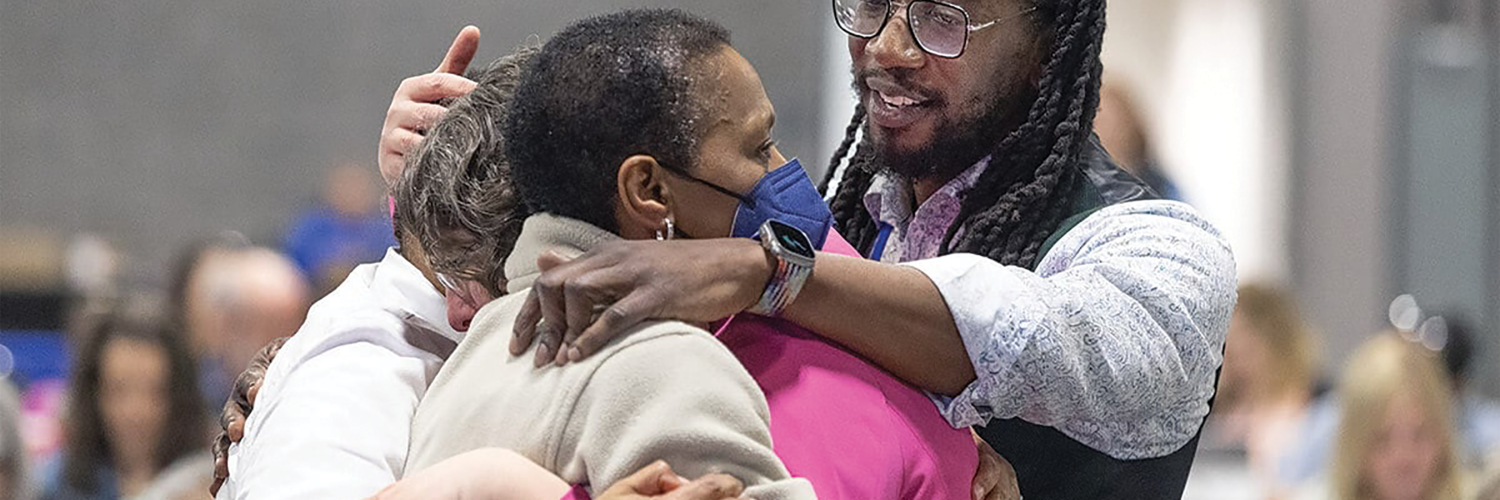
During break, delegates and observers formed a circle of easily 200 to 300, clapping and singing such hymns as “Child of God” and “Draw the Circle Wide.” Many hugged and more than a few cried, in a mass release of joy for those who had pushed, some for decades, to make The United Methodist Church fully inclusive.
The scene was a marked contrast to that of the special General Conference in St. Louis in 2019, which left progressives and many centrists in the denomination distraught at the tightening of restrictions against LGBTQ participation. Marilyn Murphy, an observer from the South Carolina Conference who has seen the church debate this issue for decades, said she was surprised it was embedded in the consent calendar but not surprised it passed.
“We’ve been going on like this since the ’70s and, finally, in just a brief few minutes with no debate, it was gone. And now we can get on about the business of the church.” Virginia Lee, an observer from the Virginia Conference, shared her joy.
“It’s a great day! And that just says it all.”
Two bishops for Africa
Meanwhile United Methodist Church in Africa is getting two additional bishops, but not the five originally planned by the 2016 General Conference.
General conference voted by 645 to 96 to add the two African bishops and voted by 692 to 43 to reshape The United Methodist Church’s map on the continent. The April 29 votes supported petitions brought forward by the church’s “standing committee on central conference matters”, a permanent general conference committee that works on issues involving church regions in Africa, Europe and the Philippines.
The approved legislation increases the number of African bishops from 13 to 15, and it adjusted the boundaries of the three central conferences on the continent so there will be four starting in 2025. Changing central conference borders requires at least a two-thirds vote at general conference, and that vote received 94%.
But debate — especially over the number of bishops to add — stretched across the morning and after lunch, with many delegates expressing frustration that the number was below the five bishops initially sought. Delegates passed two amendments to that legislation, including one aimed at speeding up the addition of more episcopal leaders in the denomination’s fastest-growing region.
In 2016, the full general conference authorised the standing committee to develop a comprehensive plan to add five bishops and potentially change the number and boundaries of central conferences on the continent. With the upheaval of COVID and the disaffiliation of a quarter of United States churches, the denomination’s financial situation has changed dramatically. As a result, the standing committee decided to revisit its legislation in consultation with United Methodist leaders from across Africa. Immediately before general conference, the standing committee met and reduced the proposed additional bishops to two.
The African continent currently has three central conferences — Africa, Congo and West Africa. Each includes multiple countries and languages.
The church adds one bishop to the current Congo Central Conference, bringing the total to five. It also adds another bishop to the current Africa Central Conference, bringing that total to six. And it renames the Congo Central Conference as the Mid-Africa Central Conference and splits in two the Africa Central Conference — so named because it’s the oldest on the continent.
Under the legislation, the four central conferences, beginning in 2025, will be as follows:
• Mid-Africa Central Conference — consisting of Central African Republic, Democratic Republic of Congo, Gabon, Republic of Congo, Tanzania and Zambia. The central conference will have five bishops.
• East Africa Central Conference, formed from part of the Africa Central Conference — consisting of Burundi, Ethiopia, Kenya, Rwanda, South Sudan and Uganda. The central conference will have two bishops.
• Southern Africa Central Conference, formed from the other part of the Africa Central Conference — consisting of Angola, Botswana, Malawi, Mozambique, Namibia, Swaziland, South Africa and Zimbabwe. That central conference will have four bishops.
• West Africa Central Conference — Burkina Faso, Cameroon, Côte d’Ivoire, Guinea, Guinea-Bissau, Liberia, Mali, Niger, Nigeria, Senegal and Sierra Leone. The central conference will have four bishops.
In the legislation as submitted, the standing committee asked to continue to work to increase the number of African bishops after the 2028 general conference. – UM News