 WeeklySA_Admin
Victims: Blacks were victims of racially driven attacks perpetrated by groups of Indian mobs in kzn, according to sahrc inquiry findings…
By Monk Nkomo
The violent unrest that erupted in KwaZulu –Natal and Gauteng three years ago exposed the flagrant violation of human rights when nearly 40 Black people, including women and children, were tortured, shot and bludgeoned to death by groups of Indians in racially driven attacks in Phoenix near Durban.
These are some of the findings of the South African Human Rights Commission (SAHRC) and the Cultural Religious and Linguistic Rights Commission (CRL) which also established that senior Indian police officers failed to intervene when groups of Indian men – armed with guns and baseball bats – set up illegal roadblocks around the Phoenix area where Black people were targeted in July, 2021.
Evidence led before the Commission heard chilling reports of how Black motorists were also stopped at Khan Road Corner, Verulam, Chatsworth and other areas and forced out of their vehicles, robbed of their belongings including phones and groceries, stabbed and shot dead by angry groups of Indians simply because they were of a black race.
Some of the victims were told by their attackers that these were acts of revenge emanating from the 1949 and 1985 protests where many Indians were killed allegedly by Black people.
One of the witnesses, Nomthando Mdunge –Khumalo, whose husband, Bongani and brother -in-law, Delani, went missing during that period, told of a horrifying story of finding both men dead at the Phoenix mortuary. Her husband’s feet were cut off and his body was set alight. Both men were murdered and their bodies set alight on July 12, 2021. They were identifiable by their gold capped teeth.
Many witnesses who were looking for their lost relatives said they found piles of bodies of Black people at the Phoenix mortuary.
Another witness, Nomhle Tshecwa, said her son, Kamvelihle (17) did not return home on July 12, 2021. After an extensive search, she found his naked body at the Phoenix mortuary. He had been shot on the buttocks and his neck was broken. The death certificate handed to her shockingly revealed that he had died of ‘’natural causes’’.
These are but some of the chilling stories about the gruesome assaults and killings perpetrated by a group of Indian vigilantes who blocked the roads and used burnt cars and logs of wood to man the roadblocks in Phoenix and other areas where Black motorists were stopped, forced to lie on the ground, robbed, assaulted and killed and their vehicles burnt.
Some of the witnesses told the Commission that they miraculously escaped the wrath of these angry mobs by fleeing into the open veld.
‘’ The July 2021 unrest left a trail of destruction and personal suffering in its wake as countless individuals experienced the violation of their basic human rights. Testimony exposed the flagrant disregard for human rights.
Families were torn apart as loved ones were injured or killed, homes and businesses were looted and livelihoods were shattered. The emotional toll on survivors was immense, with feelings of fear, grief and trauma permeating their daily lives’’, the Commission found.
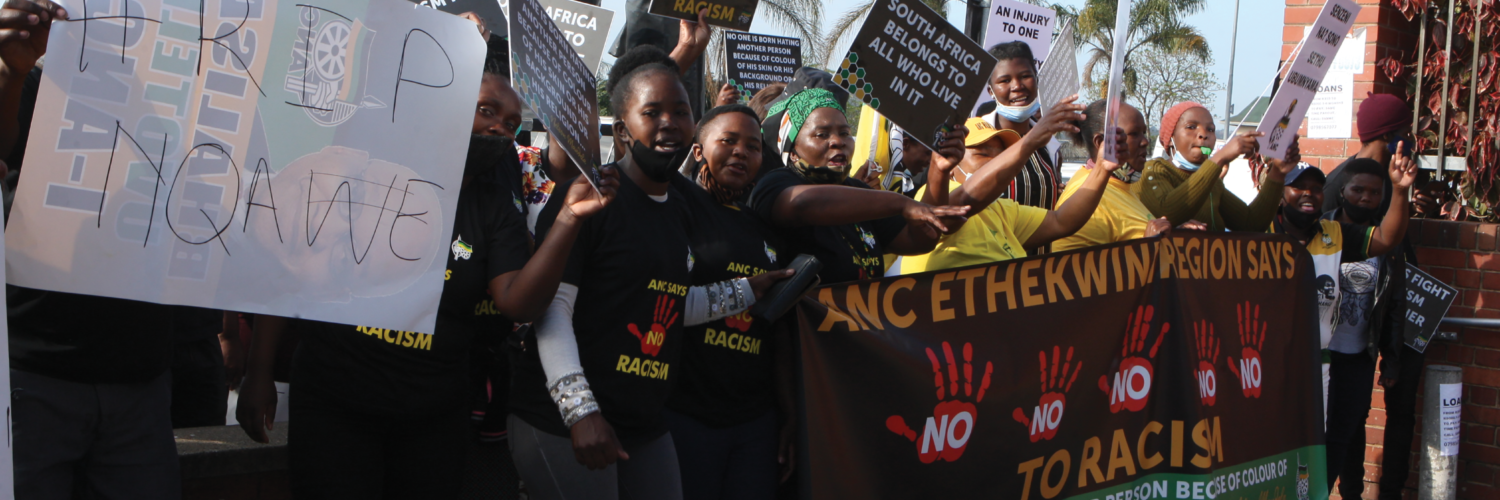
Black African people, the Commission added, were targeted based on their race. They were victims of racially-driven attacks perpetrated by a number of other racial groups.
One of the witnesses, Zakheleni Sibisi, testified that the violent acts committed by some members of the Indian community against Black people, were driven by racial hatred and historical animosities that included the 1949 Cato Manor protests and the 1985 Inanda uprisings where a number of Indians were injured and killed allegedly by Black people.’’ These actions stemmed from racial hatred and unresolved issues between Black and Indian people’’.
The killing of Black people on July 2021 by a group of Indians, was unwarranted, Sibisi added. The stopping of vehicles at Phoenix highways, the racial profiling and the subsequent torture and killing of Black people were unnecessary and barbaric. There were no threats in those areas that justified the loss of human lives. ‘’ These actions were unjustified and disproportionate to any perceived threats.’’
The Commission found that the reference made to Cato Manor 1949 and Inanda 1985 in reflections about July 2021, especially racialised violence in Phoenix, suggested that the violence that ensued in that area enjoined a historical reference point which for some, explained, justified or clarified interracial violence between African and Indian people.
“The racialised violence of 2021 offers a barometer through which the South African society can measure progress towards racial integration and social harmony. The apartheid system established a racial hierarchy which located White people above all and African people below all – with Indian and Coloured people between them’’, according to the Commission.
The impact of the unrest which also affected Gauteng, culminated in the destruction and looting of about 200 shopping malls and 1787 retail stores. A total 14500 jobs were affected in Gauteng and 150 000 jobs were estimated to be at risk in KZN. The impact on the Gross Domestic Product (GDP) was estimated at R50 billion. Between July 9 and 19 in 2021, the Rand had depreciated by 2,4 percent.
The Commission, which found no link between the jailing of former President Jacob Zuma and the unrest, recommended, amongst others, that victims of unfair discrimination should utilize the Equality Courts and seek justice against their perpetrators.
A collaborative effort should be initiated between the Commission, government, sociologists and psychologists to devise and test proposals that can tackle systematic racism and cultivate a unified national identity.