
 WeeklySA_Admin
THOUGHT-PROVOKING: Book offers some pragmatic and innovative approach on how to overcome some of the country’s historical and structural challenges…
By Jacob Mawela
As this weekend marks South Africa’s milestone of 30 years of democracy, a quote by Game of Thrones actor Peter Dinklage’s Tyrion Lannister character, “the more immediate problem is that we’re f-ck d,” would seem to corroborate what a newly released book seeks to mitigate!
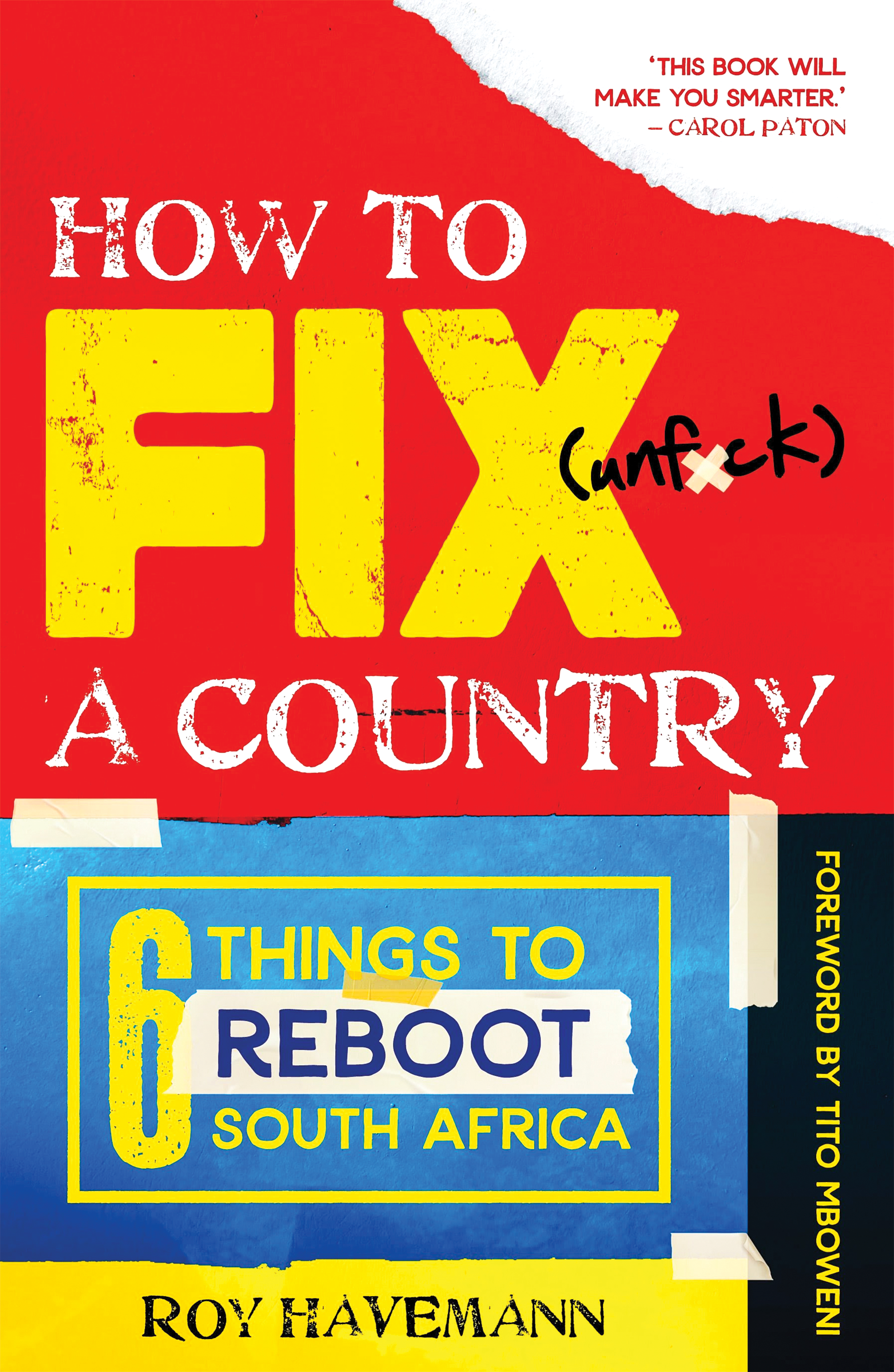
Titled, How To Fix (unf-ck) A Country and authored by erstwhile consultant to the SA Presidency, Roy Havemann, it suggests six things to reboot South Africa listed as drivers the incumbent government could apply to lead the economy to growth!
The levels of unemployment and inequality are such that the majority of citizens have – due to being short-changed from benefiting from natural wealth of a country imbued with a system incapable of leveraging its resources – little to nothing to celebrate!
And it is within this ‘f-ck-d state of the nation’ context that Havemann decided to throw in his tuppence worth of ‘solutions’ to the socio-economic challenges.
Of a society given to oversimplifications and throwing of brickbats rather than offer remedies, Havemann reminds of John F Kennedy’s quote: “Ask not what your country can do for you – ask what you can do for your country”. Sometimes, averred one macroeconomics lecturer, the solutions to our problems are right here, in our very own country. It is in this spirit that the author expounds upon these – preluded by both examples and elements of success.
Some examples of success proffered by Havemann touch on how South Africa’s BRICS partners China and India reformed state-owned enterprises (in the former’s case) and untangled red tape (in the latter’s case), translating into the unleashing of success. And how a joint venture between a global mining giant and SA’s neighbour, Botswana, unlocked success and education ultimately served as a lynchpin of growth in Kenya!
Mentioning Mao Zedong’s assertion of the imperativeness of absorbing experience suitable to one’s conditions, the author points to a concept referred to as ‘comparative advantage’ (the idea of countries focusing on things they are relatively good at) as being at the heart of China’s success.
Having visited the country to witness first-hand its development, Havemann summarises drivers which led to the drastic transformation of the Asiatic behemoth.
Regarding India (which as a country is more populous than Africa’s combined population), the subcontinental colossal emerged from running out of money in 1991 to the reformation of red tape (which in pre-1991 India hampered ease of conducting of business) and implementation of a new policy in the same year which deregulated industry and abolished licensing in an estimated 80% of industries. These measures, as well as opening up the country to global markets, unlocked rapid economic growth.
On “Elements of Success”, Havemann mentions technology and the power of ideas; investment; labour and institutions as capable of driving economic success.
Following are the challenges identified by Havemann as well measures to mitigate them:
• Eskom: subsequent to the utility informing Parliament on Valentine’s Day of 2007 that it had insufficient electricity to power South Africa, Havemann reckons that, in addition to measures put in place by the supplier and government, one of the solutions to the crisis lies in innovations such as provision of ‘off the grid’ solar-powered electricity to businesses and per kilowatt-charged installation (which pays back upfront costs and is lower than the cost of buying electricity from municipalities or Eskom) to households. One of his suggestions (long-term answer) is the unlocking of the monopoly enjoyed by Eskom!
• Education: noting that 81% of South African children are not learning to read for meaning in any language by Grade 4, the author hints at three things which can be done in education, reading (by applying what he calls the 6-T approach of: Teaching, Training, Tongue, Texts, Tests and Time), nutrition (studies found that children benefiting from the National School Nutrition Programme – some 8.8 million of them – achieved higher marks) and opportunity to attend better schools enabled through a ‘school voucher’ (whereby parents obtain it so as to spend on their children’s education at schools of their own choosing). He concludes that education empowers individuals to reach their full potential – who in turn benefit the economy, community and country.
• Equality: under a subchapter titled, “How Can We Reduce Poverty and Inequality?” points to the system of grants as South Africa’s way of dealing with poverty and inequality – adding that the government spends 3.5% of its GDP to sustain half of its population of some 60 plus million. Whereas the top 1% of its citizenry (earning over R1.5 million per year) pay almost 20% of all personal income taxes, millions exist sans any income! The answer to inequality and poverty, concludes the subchapter, is economic success brought about through interventions (e.g. fixing electricity systems, upgrading schools, building infrastructures and strengthening institutions) geared towards growth.
At the epilogue, Havemann enquires somehow despairingly: Why, oh why can we not get it right?
Observed Ralph Mathekga, author of When Zuma Goes and The ANC’s Last Decade, ‘The book offers a pragmatic and innovative approach on how to overcome some of the historical and structural challenges that have held back efforts to set South Africa on a sustainable growth path’.
* How To Fix (unf-ck) A Country is published by Jonathan Ball Publishers and available at leading bookstores countrywide. It retails for R310