 WeeklySA_Admin
HONOUR: Municipality named after Dr AB Xuma, former ANC president and local native, angering “slighted” king of the AmaQwathi…
By Siyabonga Kamnqa
A BITTER feud threatening to divide the small Eastern Cape hometown of veteran freedom fighters Walter Sisulu and Dr AB Xuma has ensued over the renaming of the town’s municipality.
AmaQwathi nation, rulers of Ngcobo in the Eastern Cape, are seething over “being disrespected in their own land” by the government, objecting to the renaming of Ngcobo Local Municipality to Dr AB Xuma Local Municipality. This decision has the Dalasile tribal authority infuriated.
During a glittering ceremony in September 2022, the Ngcobo Local Municipality was renamed Dr AB Xuma Local municipality in honour of the late former ANC president.
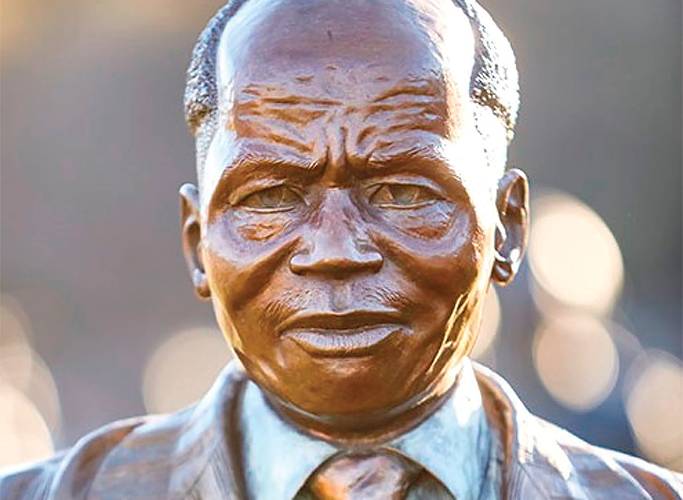
Dr Xuma, who was a medical doctor, hails from Manzana village in the town of Ngcobo. His statue and that of Walter Sisulu were erected at the town’s Heroes Park Memorial in the town.
Addressing the media at the Nkondlo Royal Palace in Ngcobo yesterday, AmaQwathi chiefs – under the leadership of Inkosi Zwelenkosi Dalasile – said they felt “insulted” by the decision.
They expressed their unhappiness at what they described as the disdainful treatment meted out to them by the government, coupled by poor service delivery in rural areas of AmaQwathi and the “irregular and unlawful” renaming of the municipality.
“The irregular changing of our town’s municipality to Dr AB Xuma Local Municipality caught us by surprise. We were never informed and we feel disrespected. We are not happy at all and we’ve been trying to fight this for a long time,” said Inkosi Dalasile.
Abathembu king Buyelekhaya Dalindyebo was scheduled to attend the meeting, but failed to pitch despite accepting the invitation from the Nkondlo Great Place.
The chiefs said they had turned to Dalindyebo as their king as the last resort, to intervene on the matter since having exhausted all other avenues.
A clearly upset Dalasile said, as the AmaQwathi nation, they had been fighting the decision since 2022, but were being taken from pillar to post and feel that the government doesn’t respect them in their own land. They had made several attempts to reach out to senior government officials locally, provincially and nationally, but to no avail.
“We have written to Premier Oscar Mabuyane to voice our concerns. He only acknowledged receipt of our letter, but never acted. We also asked UDM leader, General Bantu Holomisa to intervene and he sent a petition to some Government ministers, but there was never a response. Even President Ramaphosa was made aware of our grievances, but he referred us back to the provincial Government,” said Dalasile.
Inkosi Vululwandle Mase said they felt that, by changing the name without consulting the AmaQwathi nation, the government was erasing their history.
“And we cannot allow that. This town was attained some 300 years ago through Chief Fubu, who fought hard. It is therefore an injustice that pains us that the municipality saw it fit to change the name without consulting us. That was the biggest mistake that needs to be rectified”.
Inkosi Mase said, while they acknowledged the role played by Dr AB Xuma in the liberation of the country, they still felt the government erred in renaming the municipality after him.
“We are certainly not at war with the Amandila (Dr Xuma’s clan name) at all. Dr AB Xuma is a national figure and several streets, townships and buildings have been named after him throughout the country. But, for Chief Fubu’s land to be taken just like that and be given to him, is an insult to us as the AmaQwathi nation,” he said.
When Weekly SA Mirror asked which name the tribal authority would have preferred the municipality to be renamed after, Chief Levy Tyelinzima Dalasile chipped in: “Just look at King Sabata Dalindyebo Municipality and other municipalities that are named after kingdoms which they fall under. All we want is our town’s history not to be erased.”
Turning their attention to issues of service delivery, the AmaQwathi chiefs said the government had neglected the poor in rural areas.
Inkosi Thandizulu Dalasile said: “We are not happy about service delivery at all. There are no proper clinics in our villages. Unemployment is the order of the day. Right in the palace where we are there is a dry tap and that is the case in most villages around here.
Most villages haven’t seen water flowing from their taps for years. Stock theft is also a major concern. Nowadays, thieves no longer steal, they just grab your livestock at gunpoint. We are appealing to the government to ensure that law takes its course because the nation is under threat due to this stock-theft issue.” Attempts to get a comment from the Dr AB Xuma Local Municipality failed at the time of writing.
The Dr AB Xuma Local Municipality Overview
The municipality is situated in the Chris Hani District in the Eastern Cape Province. It is one of six municipalities in the district. It changed its name from Engcobo Local Municipality to Dr AB Xuma Local Municipality in June 2022.
The municipality claims the most youthful population, as well as the highest rates of poverty and unemployment, in the district, coupled with a high dependency ratio. The economy is underperforming and currently fails to create needed jobs and revenues. A dedicated LED strategy has been developed in order to guide interventions in turning this situation around. The municipality’s low productivity score points to the low GDP per worker (formal and informal), a relative shortage of skills available to the economy, and low growth.
On a broad scale, the Dr AB Xuma Municipality has some striking features: it is a peripheral area in terms of the national economy, is underdeveloped, has a fragmented settlement pattern, has a low-density rural settlement environment, and its resource base is under pressure.
On the scale of urban development, Engcobo Town is classified as a Sub-District Development Node by CHDM (i.e. it is among a group of towns deemed to be on a second tier below the dominant district node of Komani). This means that Engcobo is understood to have an influence (reach or catchment population) beyond simply its local area and that it draws people to the town to access goods and services from a broader area (i.e. in some cases even from neighbouring municipalities).
However, Engcobo may also currently be described as a low-density urban environment. In spite of its low density and intensity of development, Engcobo’s business centre is thriving, though it does not function optimally due to overcrowding and a lack of facilities serving both pedestrian and vehicular traffic. Business in the town is reliant on commuters (rural consumers) and there is no mass of resident consumers. This limits the range of commercial and social facilities that the private sector provides in town and inhibits the development of a more vibrant urban character. – Source: Eastern Cape government