 WeeklySA_Admin
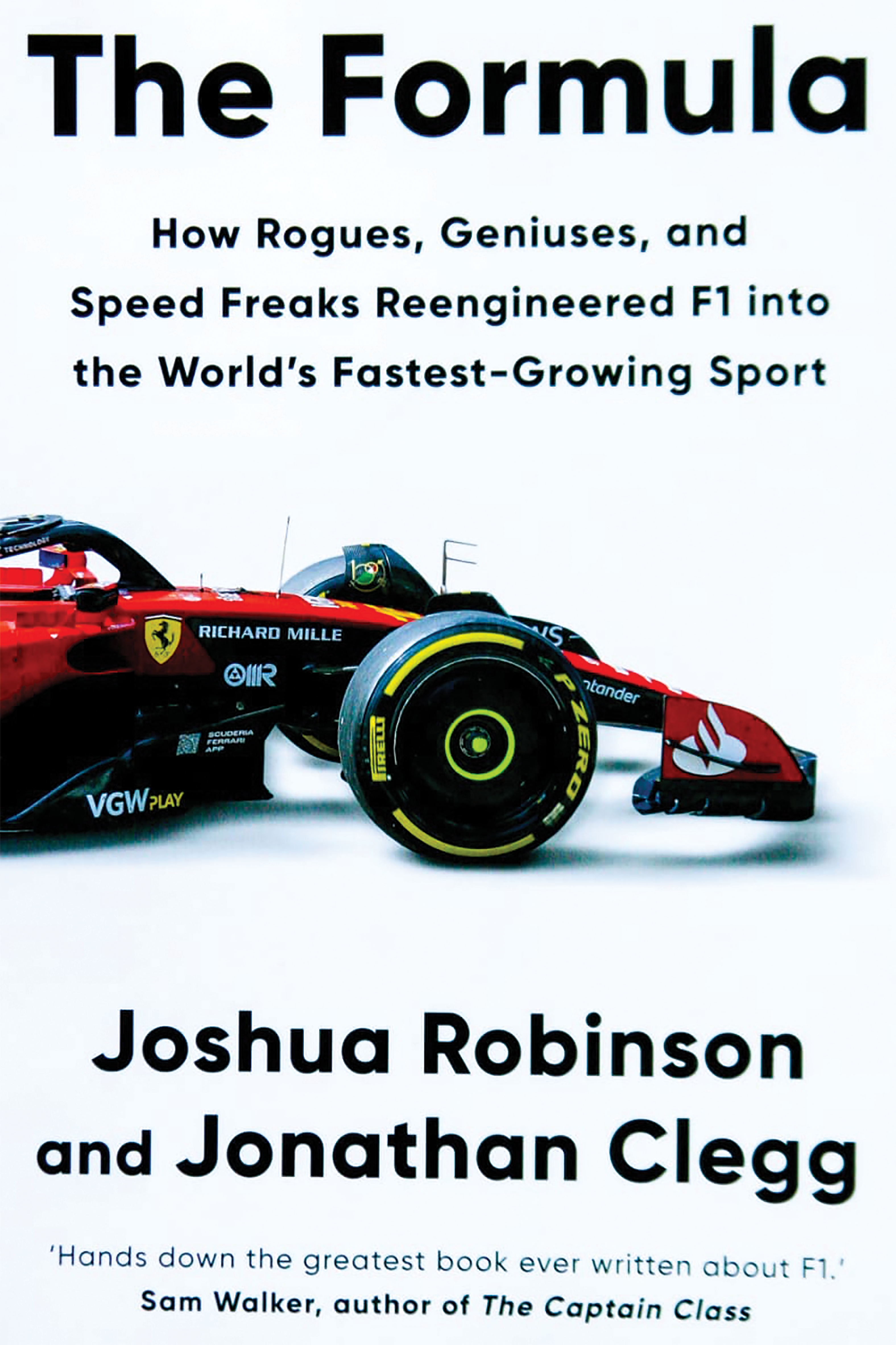
LEGEND: Penned by Wall Street Journal journalists, the book isn’t just about legendary adversarialism between two nations that have shaped the series, but also about its monumental trials which nearly put the final spoke in its fast wheel…
By Jacob Mawela
“Formula 1 is Ferrari and Ferrari is Formula 1!” This deadpan, the date of its issuing albeit unregistered, was uttered by a figure who rose from being a young British motor racing team owner to becoming, paradoxically, the owner of: FORMULA 1 – Bernie Ecclestone.
Formula, in this context, refers to the dense set of regulations and specifications which every car and driver ought to adhere to in order to race in a Grand Prix – not a mathematical equation. The Ferrari Ecclestone referred to on the other hand, was not the exclusive automobile brand, but rather its inventor, Enzo Ferrari.
In the pursuit of ‘the Holy Grail’, which it be the business of Formula 1, Il Commendatore, as Ferrari was differentially referred to, may have been held in esteem by a Brit such as Ecclestone. In contrast, Ferrari’s fellow Italians involved in motorsport’s most prestigious series disparagingly referred to Ecclestone’s F1-related ilk as garagistas, meaning, grease monkeys!
Not to imply that Ferrari wasn’t in on his countrymen’s mockery of their British rivals – for, if anything, he detested so many of them for stacking up constructors’ world titles in cars evidently faster and advanced than his, in the 1960s.
In fact, the duo of authors of this tome titled, The Formula, mention that the Italians would shout Basta! anytime they noted an innovation they didn’t have, that the British mechanics joked that the sport’s governing body’s acronym, FIA (Fédération Internationale de l’Automobile) stood for Ferrari International Assistance – in reference to its perceived adherence to Ferrari’s appeals as opposed to other teams’.
If the preceding instances appear to point to a rivalry between the Italians and the British, particularly Englishmen, it might well be because in the ensuing 70-plus years of F1’s existence, participants from these European nations have been at the forefront of the series’ continuity, evolution, innovation, prestige and current reputation as the World’s fastest-growing sport!
Enzo Ferrari had emerged from the sleepy town of Maranello, in the countryside of Emilia-Romagna as a car manufacturer aspiring to participate in motor racing – to turn himself into one of the most powerful people the sport had ever known!
Despite his misgivings regarding Brits, he acknowledged their driving talents so much so that a Yorkshire lad, Mike Hawthorn, delivered Ferrari the F1 world title in 1958 and another Brit, John Surtees, another in 1964.
According to others, Ferrari’s recruiting of British drivers – albeit borne of pragmatism – was tantamount to agreeing to deals with the ‘enemy’ (devils)!
After the 1950s the Scuderia (stable) – as Ferrari is referred to – would never have an Italian champion again to add into Alberto Ascari’s triumphs of 1952 and 1953 – a status quo which persists to the time of this review. Probably as a consequence of his prompt cessation of hiring Italian drivers upon being stung by the Catholic Church’s objection of his ‘shining symbol of Italy’ (Ferrari) killing Italian boys, with the Holy See’s newspaper, the Osservartore Romano, comparing him to a Roman god “who continues to devour his own sons.”
Eugenio Castelotti, in 1953 and Luigi Musso, in 1958, were the drivers who lost their lives whilst competing under the scarlet marque’s banner during Enzo’s tenure – with the team principal lamenting over Musso: “I have lost the only Italian driver who mattered.”
Yet, when Ferrari was nearing his demise, Pope John Paul II made a pilgrimage to visit him – no longer an amoral killer of Italian boys in the eyes of the Vatican, but as a man who built cars worthy of a papal blessing!
Before his demise, though, a South African driver named Jody Scheckter delivered, in 1979, what proved to be Ferrari’s final championship in Enzo’s lifetime – with the brand having to endure 21 years after his triumph before it would realise another championship with the onset of Michael Schumacher’s dynasty.
Il Cavallino Rampante (the prancing horse) – Ferrari’s other reference – remains the only team, to date, to have participated in every season of the F1 championship from the series’ inception.
If in Enzo Ferrari, Italians boasted ‘the pontiff of motor racing’, then their rivals the Brits could justifiably counter their braggadocio by pointing to Formula 1 as owing its continued existence to the four decades’ long contribution of one of their own, viz, Bernie Ecclestone.
A used-car dealer who once sold a Lamborghini Miura to the “It Girl” of ‘Swinging Sixties’ London, Twiggy, the model –he rose from being the owner of the Brabham F1 team in 1972 and proposing the formation of a body which would optimise logistics of racing in F1 for the British teams and those who would eventually form the Formula One Constructors’ Association (FOCA) to securing crucial concessions under the terms of the Concorde Agreement (a peace treaty between FOCA and the Fédération Internationale du Sport Automobile presided over by a Frenchman named Jean-Marie Balestre) which resulted in his ultimate seizing of control of the series!
Considered “wired to make deals” by a long-time lieutenant, over a period extending to four decades and beyond, Ecclestone would toil on to establishing Formula 1 into the fastest-growing sports business in the world and multi-billion-dollar global media juggernaut consumed by a television audience of some 200 million across more than 100 countries per race!
Never mind Ecclestone’s 2009 highly controversial comment praising Adolf Hitler as a “man who got things done” or his recruiting of another Brit, Max Mosley, to the FIA despite the lawyer’s familial baggage as the progeny of the leader of the British Union of Fascists, in the 1930s, whose parents married at the home of Hitler’s chief propagandist, Joseph Goebbels, and in addition to him and the FIA partnering with rogues such as apartheid South Africa in the ‘70s and ‘80s – with ensuing time, “the little guy” with silver hair from rural Suffolk in England would become known around the paddock as “the Supremo!”
In an industry whose lifeblood swivelled around velocity, the Italians superciliousness of Brits as grease monkeys may well have been petty professional jealousness as, in the series’ history, the men from the landmass separated from mainland Europe by the English Channel led the pack in the areas of creative innovations, designing, engineering, technical know-how, aerodynamics, et cetera, as embodied by team principals such as Team Williams’ Frank Williams and McLaren’s Ron Dennis – as well as masterminds such as Patrick Head, Ross Brawn, Adrian Newey, et al. The combined endeavours of the afore-mentioned lot were to be justified by the collection of driver’s world championships amassed by fellow countrymen, ranging from Nigel Mansell to Lewis Hamilton.
Penned by Wall Street Journal journalists, Joshua Robinson and Jonathan Clegg, The Formula isn’tjust about an Italian versus British legendary adversaries, but rather about the saga of an empire which has survived industrial espionage (such as the Ferrari vs. McLaren Spygate scandal), intentional crashing and an overdrive of total impunity which sent F1 into a tailspin of momentary self-destruction!
Alas, such lows for a series which boasts Circuit de Monaco in Monte Carlo – which writer Somerset Maugham called “a sunny place for shady people!”
* The Formula is a trade paperback published by Octopus and distributed across South Africa through Jonathan Ball Publishers. Available at leading bookstores countrywide, it retails for R470