 WeeklySA_Admin
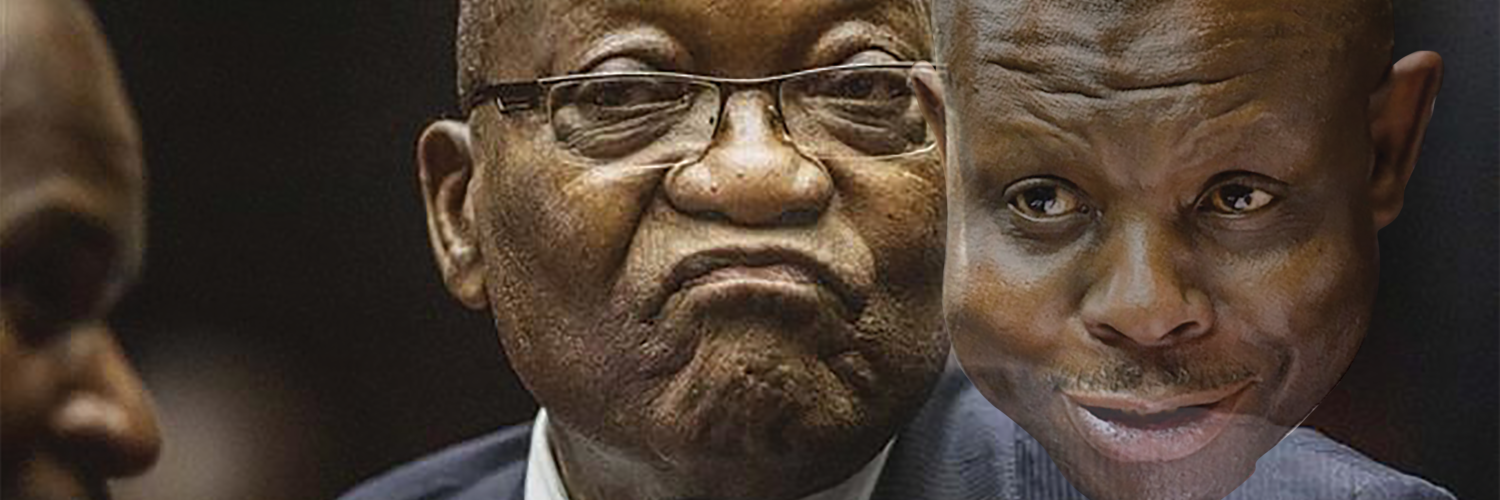
ASSET OR LIABILITY?:Why the controversial former Western Cape judge president could ultimately prove to be the MK party’s undoing in Parliament…
By Sy Makaringe
The handpicking by former president Jacob Zuma of Mandlakayise John Hlophe as the Umkhonto we Sizwe party’s parliamentary leader appears fathomablr and strategic in the short term – yet it might prove disastrous and costly in the long run.
With the Constitutional Court confirming ahead of the 2024 elections Zuma’s ineligibility to stand as a member of parliament and in the wake of the expulsion of Jabulani Khumalo as MK’s second in command, the party found itself in an unenviable position to quickly to come up with a suitable replacement to deploy to parliament to properly represent its hardline views and uncompromising stance.
Given, like Zuma, the extreme anger he harbours against the “ANC government of Ramaphosa”, which was accused of orchestrating his impeachment for misconduct in March this year, Hlophe seemed to be the perfect proxy to fight the former president’s battles – some personal – in parliament. Incidentally, it was Hlophe’s decision in 2008 to join Zuma in the battleground that led to his impeachment 16 years later.
Three months after Zuma was elected ANC president in Polokwane and due to be inaugurated as president of the republic a year later, Hlophe infamously tried to influence Constitutional Court judges Chris Jafta and Bess Nkabinde to rule in his favour in the arms deal case the octogenarian was – and is still – facing.
The IsiZulu phrase Hlophe used – “Sesithembele kinina” (We’re now relying on you) – in an attempt to sway the Constitutional Court justices’ ruling became the subject of intense interpretation as he (Hlophe) vigorously tried to fend off the charges against him. It was under Zuma appointee Chief Justice Mogoeng Mogoeng and during Zuma’s nine years as president that Hlophe’s case was allowed to drag on unresolved.
Left with no benefits as a consequence of his impeachment after 29 controversial years on the bench, a significant number of which he spent as judge president of the Western Cape Division of the High Court, it is widely believed the 65-year-old Hlophe was parachuted to the position as payback for his unwavering loyalty to Zuma. He was not even on the original 200-name list of the MK party’s candidates earmarked for seats in the National Assembly.
If that was not the case, it could be an indication of the dearth of quality leadership within the ranks of the six-month-old party, something that Zuma desperately needed to achieve his ambition of breaking the back of the “ANC of Ramaphosa” and positioning the MK party as a dominant political force in the country. The track record of Hlophe’s political activism, even during his student days in KwaZulu-Natal in the late 1970s and early 1980s, is conspicuously obscure at best and completely non-existent at worst.
Instead, he is well-known for his legal academic excellence that saw him lecturing in administrative law at the University of Natal and the University of Transkei between 1988 and 1994 before joining the Cape High Court bench in 1995.
It is worth noting that Hlophe got Zuma’s nod as MK’s parliamentary leader – given, to all intents and purposes, the former president makes all his party’s key decisions – ahead of his trusted and politically battled-scarred loyal soldiers such as former Finance Minister Des van Rooyen and ex-Police Minister Nkosinathi Nhleko.
If Hlophe’s maiden press conference after his swearing in as the leader of the official opposition in parliament on Tuesday is anything to go by, he might well be the MK party’s Achilles Heel in a job in which fire-and-brim oratory is something of a stock-in-trade. At best, his showing was woefully underwhelming, lacking in aura, charisma, posture and presence that his shrewd political boss commands on such occasions.
He failed to seize the moment that presented itself when ANC’s Fikile Mbalula and DA’s Helen Zille, whose parties are leading partners in the Government of National Unity (GNU), had an embarrassing public spat over the crafting of the seventh administration’s cabinet.
He tacitly lent legitimacy to the GNU when he remarked that it was normal in such situations for negotiations to be protracted, perhaps blissfully unaware that Zuma had a few days earlier described the GNU – to a chorus of loud applause from party supporters – as “nonsense” and “meaningless”.
Missing was the MK’s combative language and colourful political rhetoric that it often uses to discredit “the ANC of Ramaphosa”. Instead the characteristic derisive tone was replaced by utterances such, “we’re here to work”, “we’re not apologetic”, “we’re not petty”, “we’re not hooligans” and “we’ll work within the law”. No mention of the “ANC of Ramaphosa” or white monopoly capital.
Those who expected the much familiar soundbites and polemics from a man who was out for revenge were hugely disappointed.
For his part, Hlophe emphasised – as Zuma had expressed earlier in the week – the need for the MK to work with “other progressive forces” like the EFF and ATM, a statement he was to repeat in subsequent media interviews. Hlophe’s flat answers to journalists’ questions seemed to frustrate party spokesperson Nhlamulo Ndlhela, who facilitated the proceedings. On a couple of occasions, Ndhlela wanted the press conference to come to an end sooner, and was visibly annoyed when journalists kept on firing more questions.
Incidentally, the last time South African politicians flirted with such political experimentation things did not end well for them.
In 2009, a man of the cloth in the person of Mvume Dandala, a bishop of the Methodist Church, was chosen as a comprise parliamentary leader of the Congress of the People (COPE), which had sensationally broken away and seized 30 seats in the subsequent general elections, after Mosiua Lekota and Mbhazima Shilowa could not agree on who should lead the party. Not only was Dandala out of his depth in the complex political milieu, he also struggled to keep the party together. He resigned in frustration a few months later as the spat between Lekota and Shilowa escalated perilously. COPE never recovered from that fallout, finally exiting parliament after this year’s general elections.
The 82-year-old Zuma is known as a master strategist, a quality believed to derive from his being ace chess player. But this time around he may have made a wrong move with his appointment of a political novice like Hlophe as the MK’s talisman in parliament.
* Sy Makaringe is a Limpopo-based editorial content development specialist
Comment
LIFE SENTENCE FOR RACIST KILLER WELCOME
The life sentence imposed by the Mpumalanga High Court this week on a white security farm manager who shot and killed a young defenceless high school learner who, together with his friends were looking for temporary jobs, should be welcomed as a deterrent against racist attacks on Black people especially in rural areas.
Bhekimuzi Anele Ziko ( 18) a student at Lovunywa High School in Langeloop village in Mpumalanga, his brother and friends, were walking around a farm in the Komatipoort district on December 5, 2018 looking for temporary jobs when they were confronted by Sarel Petrus du Plessis (52), a security farm manager.
Without saying a word, he started shooting at the four young boys. Ziko was fatally injured. His brother and two friends managed to flee. Their testimony regarding the tragic events of that day unfolded in the Mpumalanga High Court this week where Du Plessis, who had pleaded not guilty, was convicted on all counts after the State had succeeded in presenting overwhelming evidence against him.
Judge Nelisa Phiwokazi Mali, found no mitigating factors that could prevent her from imposing the prescribed life sentence. Du Plessis was also jailed for a further 38 years for attempted murder and possession of a firearm and ammunition. The sentences will run concurrently. The stiff sentence would serve as a deterrent to society and those who took the law into themselves, the Judge said.
Du Plessis is among a list of racist whites who still ill-treated Black people especially in rural areas where people of a darker skin were still subjected to harassment and torture and even death by ruthless whites who still believed in the doctrine of apartheid – a system which has since been declared a crime against humanity .
The only sin that Ziko, his brother and friends had committed was looking for temporary jobs at a wrong place at a wrong time. Du Plessis had no justification to just confront innocent children , and without saying a word, opening fire on them. His suspicion that they were planning to steal does not justify his evil action of of shooting at these children at point-blank range. This was nohing but a blatant racist attack. We wonder if he would have acted likewise if the boys were white.
Judge Mali must be commended for her ruling which should serve as a deterrent against racist whites who still viewed Black people as nonhumans who can be subjected to ill-treatment and even death simply because of the colour of their skin.
Those white farmers who still treated Black people as slaves and paying them meagre wages and forcing them to work and stay in inhuman conditions, should be exposed. They have no place in our democratic society.
Black people have suffered enough under apartheid. We cannot allow this monster to rear its ugly head within our midst again. Those whites who are still trapped in the apartheid kraal must be exposed and be subjected to the same fate as Du Plessis – in prison for life.