 WeeklySA_Admin
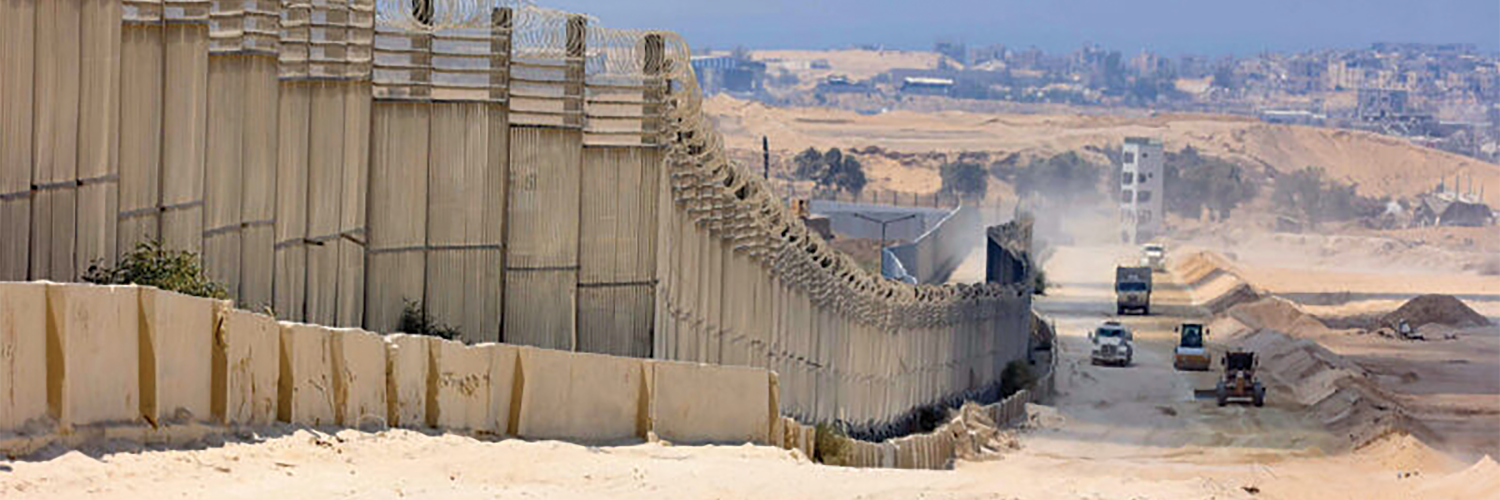
AXIS: The Philadelphia Corridor is a narrow belt 100 meters wide and 14km long that runs parallel to and along the border between the Gaza Strip and Egypt. The name Philadelphia was randomly chosen by the Israeli army, while Palestinians and Egyptians call it the Saladin Corridor….
By Eugenio Garcia Gascon
In recent months, Philadephi Corridor has become very important, as Prime Minister Benjamin Netanyahu has demanded that any ceasefire agreement with Hamas includes the permanence of Israeli troops in that axis.
In contrast, the Islamist organisation Hamas’s position is that any agreement should include the complete withdrawal of soldiers from the entire Gaza Strip, including the Philadelphia corridor.
Maintaining troops in that corridor is a key issue for Netanyahu, who believes that if the soldiers are withdrawn, Hamas will be able to rearm easily and the threats made by the Palestinian organisation could be repeated, possibly leading to another surprise attack similar to that of October 7 2023, when some 1 200 Israelis died in the south of the country.
The Biden administration has asked Netanyahu to give up his position in the Philadelphia corridor, something the prime minister has vehemently refused to do, even though Israeli military officials insist that the presence of troops is not essential to control surface movements in the corridor.
Another issue is the underground tunnels that connect the Strip with Egypt, which have been used for many years by Palestinian groups to smuggle weapons into the Strip. This has been a major problem for Israel, which has tried in the past to neutralise it in vain, since weapons and ammunition have continued to circulate freely through the tunnels.
In this context, Netanyahu held a rare press conference on September 2 to stress his position on the Philadelphi Corridor. He basically reiterated what he had said on previous occasions, namely that any agreement with Hamas must respect the permanent presence of Israeli soldiers on that axis, something he defined as “vital” for the Jewish state. His critics in Israel and the United States accuse him of trying to keep the war going for as long as possible in order to stay in power. According to the opposition, Netanyahu does not want to leave the Strip because it would make it easier for him to remain prime minister and neutralise his political rivals.
At the press conference, Netanyahu attacked the argument of the opposition and military leaders that the army could return to the Philadelphi Corridor at any time if circumstances demanded it. Netanyahu said that the same opposition had previously said that the army would return to Lebanon, if necessary, after the evacuation in 2000, but that this did not happen, and that it is one thing to talk and another to keep one’s word. According to him, the same would happen on the border between the Gaza Strip and Egypt. Another argument used by his detractors to deny the “vital” importance of the Philadelphi Corridor is that in the first eight months of the war, that is, until May 29, Netanyahu never referred to the Philadelphia Corridor as a major issue, nor did he mention it as a war objective. According to this version, Netanyahu only brought up the issue with the intention of disrupting the ongoing negotiations with Hamas, in which the United States is participating, and suddenly it became a priority.
At this point, the Philadelphi axis has become the main obstacle to a ceasefire. The army, especially the air force, continues to bomb the Strip in a random manner, causing dozens of deaths every day, particularly of women and children. At this stage of the war, it is clear that Netanyahu does not want to end these attacks, claiming that in this way he is putting pressure on Hamas to release the hostages.
The situation of the dozens of hostages still alive is very precarious. In early September, soldiers found the bodies of six captives who had been executed only a short time before in a tunnel in the south of the Gaza Strip.
The United States has warned Israel that the proximity of the troops puts the hostages in mortal danger, as can be deduced from this latest incident. Although this circumstance should give Netanyahu pause, everything indicates that he will not give in on the issue of the corridor, even at the risk of the lives of the hostages.
* Eugenio Garcia Gascon has been a correspondent in Jerusalem for 29 years. He is a Cirilo Rodríguez journalism award winner. The article was sourced from Globalter
Comment
THE DEPARTMENT’S UNKINDEST CUT
. The controversial decision by the Gauteng Department of Education to cut essential services including feeding schemes and transport for learners to avert the loss of 3400 teachers due to budgetary constraints, could result in catastrophic consequences.
While these cuts are seen as a temporary solution, the decision is expected to adversely affect thousands of vulnerable learners from poor families who relied heavily on these services.
The Gauteng MEC for Gauteng, Matome Chiloane, announced that the decision to cut these essential services followed the R4,5 billion shortfall in their budget caused by various financial pressures including rising costs and inadequate funding.
It is unfortunate that the department had to resort to this drastic and essential move of preserving 3400 teaching positions to maintain educational standards at our schools at the expense of thousands of children from low-income households who were now facing a bleak future.
Cutting feeding schemes and transport should be viewed as some kind of punishment for learners from poor households. These children, especially those living far from school facilities, leave their homes hungry in the morning and depend on this single meal a day to help them focus on their studies. Denying them this meal would lead to these children being stressed, hungry and unable to focus in class.
Withdrawing transport that helps them to and from school would exacerbate the situation as this was the only transport at their disposal that helped them attend school regularly. Cutting this transport could result in thousands of them being unable to afford alternative means of going to school. This would put their education at risk and many could drop out of school.
The Gauteng Department of Education has tried to do its best to balance the act but the cost could be huge. Instead of saving 3400 teaching posts, the department could end up having caused thousands of learners dropping out of school because of these cuts of critical services that helped them with food and transport.
The national government, which has pledged to provide quality education for all learners and had also introduced feeding schemes and transport at schools especially in rural areas, must act swiftly to intervene in resolving the problems faced by the Gauteng department of education. The government has been able to avail billions of rands to bail out cash-strapped State-owned enterprises like the South African Airways.
If the authorities really care about their future leaders, they must move quickly to come to the department’s rescue. They must also ensure the safety of the 3400 teaching positions. Education helps shape the future of our children so that they can secure good jobs and contribute towards the country’s economic growth. It is important to nurture and guide them to a bright future. They cannot be forsaken simply because of budgetary constraints.
The future of our children has its foundation in education.