 WeeklySA_Admin
CONQUERED: This volume highlights centuries of anti-colonial resistance in the Global South and examines colonial violence and oppression while paying homage to the people who resisted…
By Jacob Mawela
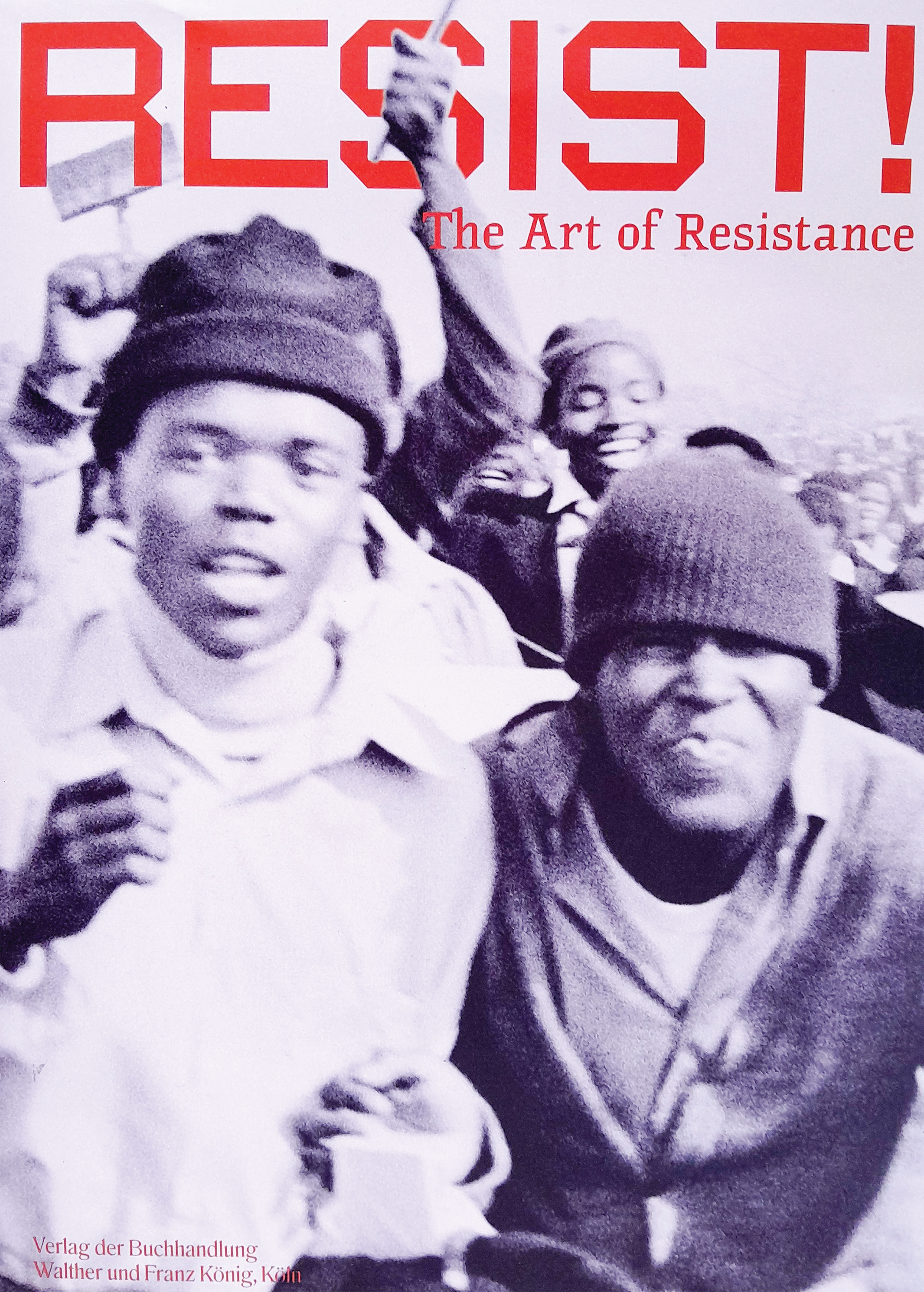
“This is my country South Africa. My camera will give my country the freedom.” This is a quote emblazoned on a page of the book RESIST! The Art of Resistance, which explores over 500 years of colonial oppression in the Global South and its continuing effects. The tome represents a snapshot of a year-long exhibition of the same name which took place at Rautenstrauch-Joest Museum in Cologne, Germany, during the pandemic from April 2021 to January 2022.
The exhibition was held as a tribute to the women, men and children who resisted colonisation in many different ways and whose stories are rarely told or heard. It featured works of more than 40 contemporary artists from the Global South and the diaspora telling their stories of rebellion and war, violence and trauma – but also survival and resilience.
Published on the occasion of the exhibition, the book features artists such as Omar Victor Diop, Medu Art Ensemble, including South Africa’s foremost photojournalist Peter Magubane, and the book is compiled by Nanette Snoep, the director of Rautenstrauch-Joest Museum.
The quote: “This is my country South Africa. My camera will give my country the freedom”, is attributed to Magubane, whose monochromatic image of schoolchildren rampaging through a street – caption, “The Young Lions, June 16, 1976” – adorns the cover of the book. “I did not want to leave the country to find another life. I was going to stay and fight with my camera as a gun,” continued the inscription below the image.
The doyen of South African photojournalism, he is further quoted thus: “I did not want to kill anyone, though. I wanted to kill apartheid!”
Augmenting South Africa’s contribution to the project is the Medu Art Ensemble, a collective of South African and international artists from the visual arts, theatre, music and literature formed by the poet Mongane Wally Serote and artist Thami Mnyele in 1978 in protest against South Africa’s apartheid policies of the time.
Six of the ensemble’s posters are composed of a particularly striking silkscreen print which combine text and images one titled, “Don’t Entertain Apartheid – Support the Cultural Boycott”, produced in 1982 in response to American singer Millie Jackson performing in South Africa despite a cultural boycott forbade international artists from touring the country! While in exile in neighbouring Botswana and continuing anti-apartheid resistance, Mnyele would be killed during an SADF cross border raid in June 1985.
Namibian massacre
Segueing to another Southern African country, Snoep also incorporates a heart-breaking Namibian contribution titled, “It’s Yours”, co-curated by activists from that country, Esther Utjiua Muinjangue and Ida Hoffmann, intended to raise public awareness of the genocide of the Ovaherero and Nama people committed by colonial Germany from 1904 to 1908, which culminated in an official apology and reparations from Germany!
Muinjangue and Hoffmann’s contribution depicts the long-drawn struggle for closure to a 117-year-old crime set against the backdrop of the Berlin Conference of 1884 (which led to European countries colonising Africa). The aftermath had the German Empire colonising the then South West Africa. appropriating land, cattle and natural resources of the Ovaherero community, triggering an uprising, which was brutally quelled – at the order of Kaiser Wilhelm – by the sadistic Lieutenant General Lothar von Trotha, who on October 2 1904, issued an extermination order for the murder by shooting of the tribe’s men, women and children. On April 22 1905, this massacre was followed by another of the Nama people – which had resulted in the wiping out of 80 percent of the Ovaherero and 50 percent of the Nama peoples by 1908!
Furthermore, Kaiser Wilhelm ordered the installation of concentration camps in which survivors, who looked like walking skeletons, were incarcerated – and worst of all, at which the natives were killed, their bodies decapitated and their skulls shipped to Germany!
Presented in the form of a room, “It’s Yours” incorporated an autonomous space entitled, “Not About Us Without Us” (a sort of rallying cry alluding to the co-curators as voices campaigning for justice on behalf of their murdered ancestors some of whose remains are skulls displayed in Gery to this very day).
Comprising multimedia displays, the posters contain disturbing content depicting raped dead bodies, naked, hanged Ovaherero women, etcetera – all of that as a continuing quest, which Muinjangue initiated some 15 years ago, to bring around the German government, which had refused to recognise what occurred as genocide and to acknowledge its role in the atrocities!
If, in addition to extracting admission of responsibility from Germany for the more than a century genocide, the Namibian ladies also sought the return of their forebears’ skulls from the European nation – then if follows that they were in likewise company in the form of fellow curator, Nigerian art historian, Peju Layiwola’s crusade for the Restitution of the Benin Court Artworks from European museums including Germany, whose Rautenstrauch-Joest Museum incidentally happened to possess 92 of the artworks.
British looting
Originating from the Kingdom of Benin in Nigeria, whose royal palace along with other monuments were ransacked and burned to the ground by British troops in 1897, resulting in thousands of objects of ceremonial and ritual value looted and brought to Europe as so-called spoils of war, Layiwola had for more than 20 years been at the forefront of the campaign to have the artefacts’ (referred to as the Benin Bronzes) returned to their homeland!
Unlike Muinjangue and Hoffmann’s endeavours, Layiwola – a granddaughter of Oba Akenzua II, King of the Kingdom of Benin – has been able to cover meaningful ground in her ongoing engagement with the Germans, which to date resulted in the Cologne City Council approving the transfer of ownership of the RJM’s 92 artworks to the Federal Republic of Nigeria on December 8 2022.
A poem titled, “I have come to take you home”, written as a tribute to Sarah Baartman featured in the snapshot within a space referred to as, “I MISS YOU: About Missing, Giving Back and Remembering” – possibly offers apt endorsement of the ongoing quests by both the Namibians and Nigerians for the rectification of vanquished legacies.
Two contemporary matters pertaining to the 21st century also feature in the publication. This is the “Rhodes Must Fall” movement sparked in 2015 by student Chumani Maxwele’s protest against the bronze statue of Cecil John Rhodes (a representative of British colonialism and a proponent of apartheid) situated at the University of Cape Town. This includes “the Black Lives Matter” which initially came to prominence in the wake of African-American, George Floyd’s murder by a police officer in Minneapolis on May 25, 2020.
In the former incident, the protest resulted in the toppling of colonial monuments worldwide, including the removal of the statue of Mouzinho de Albuquerque (one of most prominent figures in the colonial government of Portuguese East Africa) from Lourenco Marques (Maputo) – featured through a pictorial sequence in the publication – instigated by FRELIMO upon Mozambique’s independence in 1975.
The project also probes the tribulations of the Roma (who for over 600 years have suffered slavery and a holocaust, which accounted for 500 000 victims across Europe); the Tupac Amaru II Rebellion; the Uprising on the Slave ship Amistad; the Mau Mau Uprising, etcetera.
A hardback, RESIST! is published by Thames and Hudson and distributed locally by Jonathan Ball Publishers. Available at leading bookstores countrywide for R925