

 WeeklySA_Admin
DATA: A new wearable device developed by US scientists is helping researchers measure human flatulence in real time—challenging long-held assumptions and unlocking fresh insights into the gut microbiome…
By Own Correspondent
Scientists at the University of Maryland have developed “Smart Underwear,” a novel wearable device designed to measure human flatulence, offering researchers a long-overdue tool to objectively study intestinal gas and gut health.
By tracking hydrogen levels in flatus, the device allows scientists to revisit long-standing assumptions about how often people pass gas, while opening a new window into the daily activity of the gut microbiome.
For decades, physicians have struggled to accurately assess complaints related to intestinal gas. As gastroenterologist Michael Levitt—often referred to as the “King of Farts”—noted in 2000, it has been “virtually impossible” to objectively document excessive gas using conventional methods.
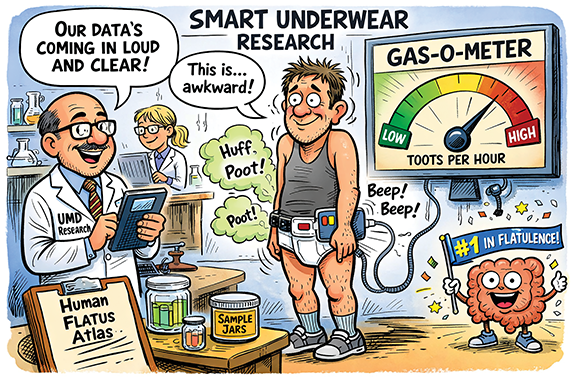
To address this gap, a research team led by Brantley Hall, an assistant professor in the Department of Cell Biology and Molecular Genetics, developed a discreet, clip-on sensor that attaches to underwear and continuously monitors intestinal gas production.
In a study published in Biosensors and Bioelectronics: X, the team—led by assistant research scientist Santiago Botasini—found that healthy adults produce flatus an average of 32 times per day. This is roughly double the 14 (±6) daily events commonly cited in earlier medical literature.
The study also revealed wide individual variation, with daily counts ranging from as few as four to as many as 59 events.
Researchers say earlier estimates were likely inaccurate due to reliance on small, invasive studies or self-reporting—methods prone to missed events, faulty memory and the inability to track gas during sleep.
The Smart Underwear device offers a more precise alternative by continuously measuring hydrogen—a gas produced exclusively by gut microbes—providing real-time insight into microbial fermentation in the digestive system.
“Think of it like a continuous glucose monitor, but for intestinal gas,” Hall explained.
The device demonstrated strong performance, detecting increased hydrogen production after participants consumed inulin, a prebiotic fibre, with nearly 95% sensitivity.
‘Human Flatus Atlas’
Beyond measuring individual patterns, the research team has launched an ambitious project known as the Human Flatus Atlas. The initiative aims to establish, for the first time, a scientific baseline for what constitutes “normal” flatulence.
“Normal ranges exist for blood glucose and cholesterol, but not for flatulence,” said Hall. “Without that baseline, it’s difficult to determine when gas production is truly excessive.”
The project will collect data from hundreds of participants across the United States, tracking flatus patterns day and night while correlating results with diet and microbiome composition.
Participants are grouped into emerging categories, including:
• Zen Digesters — individuals who consume high-fibre diets but produce minimal gas
• Hydrogen Hyperproducers — those who generate high levels of intestinal gas
• Typical individuals — those falling between the two extremes
To deepen the analysis, researchers will also collect stool samples from participants at both ends of the spectrum to study microbial activity.
Ultimately, the project aims to move beyond identifying which microbes live in the gut to understanding what they are doing in real time.
“The Human Flatus Atlas will establish objective baselines for gut microbial fermentation,” Hall said.
“That’s essential for evaluating how diet, probiotics or other interventions influence microbiome activity.” – Science X
LIFESTYLE Briefs
Vaping linked to cancer risk
A comprehensive review of more than 100 studies has found that vaping is likely to increase the risk of both oral and lung cancer, adding to growing concerns about the safety of e-cigarettes.
Published in the journal Carcinogenesis, the review analysed research conducted since 2017, focusing on people who used nicotine-based e-cigarettes exclusively, as well as studies comparing vapers with traditional smokers. It excluded dual users to isolate the effects of vaping.
Researchers found clear evidence of carcinogenicity in human studies, including biomarkers such as DNA damage, oxidative stress, inflammation, and epigenetic changes in oral and respiratory tissues. Animal studies reinforced these findings, with mice exposed to vape aerosols developing lung tumours.
While long-term epidemiological data is still emerging, the authors argue that the cumulative evidence is strong. Co-author Bernard Stewart of the University of New South Wales described the review as the most definitive indication yet that vaping increases cancer risk compared to non-users. In an accompanying commentary, researchers cautioned against repeating past mistakes made with tobacco, where harms took decades to be fully acknowledged.
The findings come amid ongoing concerns that vaping is being marketed as a safer alternative to smoking, particularly among young people who have never smoked. – Kerry Cullinan
Ancestry connection to autism genes
A major new study led by researchers at The Mount Sinai Hospital, published in Nature Medicine on March 30, finds that autism risk genes are largely consistent across people of different ancestries.
The research analysed genetic data from more than 15 000 Latin American individuals, including about 4 700 diagnosed with autism—one of the largest such studies in a diverse, mixed-ancestry population. Scientists examined over 18 000 genes, focusing on rare, harmful variants linked to neurodevelopmental disorders.
The team identified 35 genes significantly associated with autism in the Latin American cohort. These showed strong overlap with genes previously identified in studies of predominantly European populations, reinforcing the idea that autism’s biological foundations are universal.
The findings help address a long-standing gap in genetic research, which has historically focused on European populations, often leading to less accurate diagnoses for others. Researchers also found that widely used gene conservation metrics may be slightly skewed due to this bias, though they remain reliable for the most critical genes.
The study underscores the need for more inclusive genomic research to improve diagnosis, reduce health disparities, and advance precision medicine for autism worldwide. – Science X
Your walk reflects your mood
The way you walk could be a clear signal of your emotional state, according to new research published in Royal Society Open Science. While it is already known that posture and movement can reflect mood—such as heavy steps suggesting anger or slumped shoulders indicating sadness—scientists have now identified a specific movement pattern that may reliably communicate emotion.
Researchers led by Mina Wakabayashi in Japan conducted two experiments to decode these signals. In the first, actors were asked to recall emotional experiences—anger, happiness, fear and sadness—while walking. Their movements were recorded and converted into point-light videos, showing only key joint positions. Observers were able to identify the emotions at rates well above chance.
Analysis revealed that a single factor—the width and timing of arm and leg swings—played a decisive role. Larger, more exaggerated swings were associated with anger, while smaller, restrained movements signalled sadness or fear.
In a second experiment, researchers manipulated this movement pattern in neutral walking animations. Participants again accurately identified the intended emotions, confirming the finding.
The study suggests that even subtle changes in gait can communicate feelings, with potential applications in animation, robotics and human–computer interaction. – Phys.org