 WeeklySA_Admin
BACKLASH: Nearly 123 000 people petition FIFA to remove the ‘Pride Match’ label from the Egypt-Iran World Cup fixture, as football authorities in both countries object and debate intensifies over sport, culture and neutrality…
By Own Correspondents
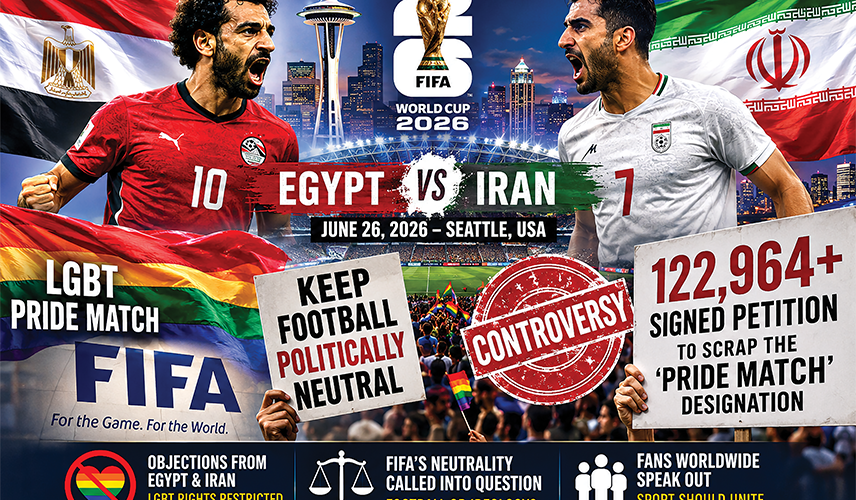
NAIROBI – A growing controversy is surrounding the FIFA World Cup 2026 fixture between Egypt and Iran after nearly 123 000 people signed a petition calling on FIFA and the Seattle FIFA World Cup 2026 Organising Committee to remove the match’s designation as an official “LGBT Pride Match”.
The match is scheduled to take place on June 26 in Seattle, United States, during the city’s annual Pride celebrations.
The petition, launched by CitizenGO, follows FIFA’s decision to designate the fixture as a Pride Match – a move that has drawn criticism from some football supporters, religious groups and football authorities in both Egypt and Iran. In a statement issued on June 19, CitizenGO said more than 100 000 people had joined the campaign within days of its launch. By the time of publication, the number of signatories had reached 122,964.
The World Cup should unite people through
sport – not divide them through ideology…
CitizenGO, a global pro-life and pro-family advocacy organisation active in more than 50 countries, says the campaign seeks to persuade FIFA President Gianni Infantino and the Seattle organising committee to reverse the designation and restore what it describes as political neutrality to the tournament.
Supporters of the petition argue that FIFA’s endorsement of a match-specific Pride designation contradicts the governing body’s longstanding position that football should remain free from political, religious and ideological messaging.
‘Football neutrality’
“The FIFA World Cup is the world’s greatest sporting event. It should unite fans from every nation, culture, religion and background through a shared love of football,” the petition states. “It should not be used as a platform for political, social or ideological activism.”
The petition further argues that FIFA’s decision appears inconsistent with previous efforts to maintain neutrality in the sport.
“For years, FIFA and football authorities have insisted that football must remain neutral. Players and clubs have been sanctioned for displaying religious, political or personal messages, often citing Law 4 of the Laws of the Game,” it states. “Yet the designation of an official Pride Match appears to contradict these principles and creates the perception of a double standard.”
CitizenGO officials maintain that the World Cup should remain focused on sport and international friendship rather than social or political advocacy.
“Football belongs to everyone. The World Cup should unite people across cultures, religions and nations, not be used to promote ideological activism,” said Sebastian Lukomski, Global Campaigner at CitizenGO. “People are speaking out because they believe FIFA is abandoning its own commitment to neutrality,” he added. The controversy has been amplified by opposition from football authorities in both participating countries.
According to Turkey-based Anadolu Agency, the Egyptian Football Association (EFA) formally requested FIFA to prevent LGBT-related demonstrations and messaging during the match.
In a letter to FIFA, the EFA argued that while football should remain welcoming to all supporters, organisers should avoid activities that could provoke cultural and religious sensitivities among supporters from Egypt and Iran.
The federation said such activities would be “culturally and religiously incompatible” with the values held by many supporters from both countries.
The EFA further cited FIFA statutes emphasising neutrality on political and social issues, as well as the organisation’s commitment to respecting the cultures, beliefs and identities of participating nations. The Egyptian federation therefore requested that FIFA ensure the match remains focused solely on football and sporting competition.
Iranian Football Federation President Mehdi Taj has also publicly criticised the designation.
Speaking to Iranian state television, Taj described the decision as “an unreasonable and illogical move” that effectively signals support for a particular social group. “Both Egypt and Iran have objected,” Taj said, adding that the matter should be addressed by FIFA before the match takes place.
‘A sick joke’
The unusual pairing of a Pride-themed event with two countries that maintain some of the world’s most restrictive laws regarding homosexuality has drawn international attention.
Commenting on the controversy, The Atlantic wrote: “It’s hard to imagine a more fraught combination for what was supposed to be a fun Friday night.”
The publication noted that homosexuality remains punishable by death in Iran, while homosexual activity in Egypt can result in prison sentences under various legal provisions.
“When FIFA’s schedulers announced the Pride Match pairing after December’s draw, it felt a little like a sick joke,” The Atlantic observed, noting that opposition to the designation had emerged from multiple quarters.
Despite objections from Egypt, Iran and campaign groups such as CitizenGO, LGBT-themed events and demonstrations are expected to take place in Seattle as part of the city’s broader Pride celebrations during the World Cup period.
As the June 26 fixture approaches, FIFA faces mounting pressure from critics who argue that the tournament should remain politically neutral, while supporters of Pride-related initiatives maintain that football should reflect values of inclusion and diversity.
The dispute has transformed what would ordinarily be a routine group-stage fixture into one of the most politically and culturally debated matches of the 2026 FIFA World Cup. – ACI Africa/WSAM