 WeeklySA_Admin
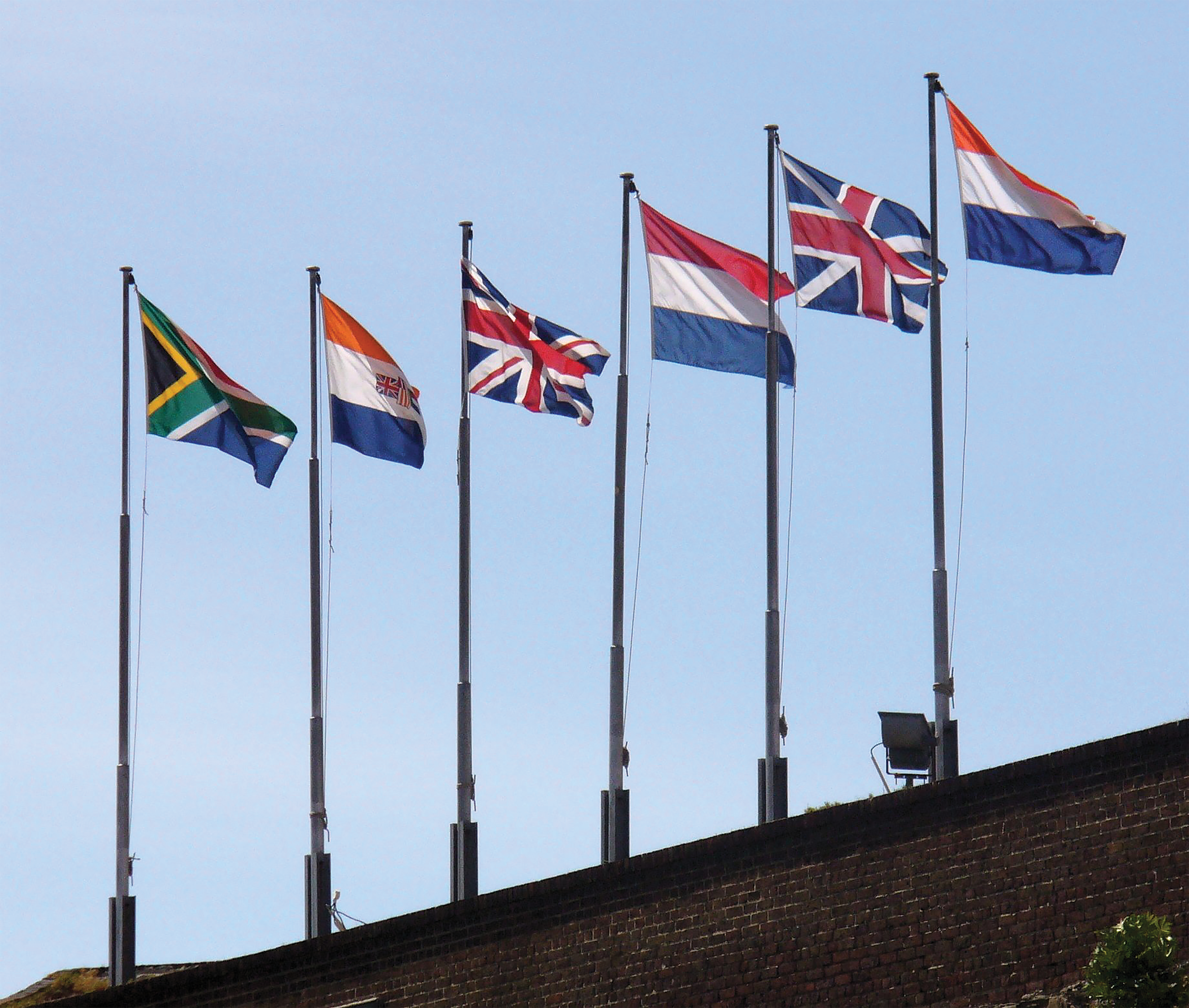
SYMBOLISM: South Africa’s apartheid flag has been declared hate speech by a top court. But while courts are important and their judgments matter, racism is a long and internationally entrenched social phenomenon that cannot be undone via judicial processes
By Musawenkosi Cabe
The flag of apartheid South Africa, which has become a wider symbol for white racism and a common feature in the “farm murders” protests led by Afriforum (the right-wing, Afrikaans “civil rights” organisation), was declared hate speech by the Supreme Court of Appeal (SCA), in April.
The appeal was brought by Afriforum against the ruling of the Equality Court that the gratuitous display of the old flag was in contravention of the provisions of the Promotion of Equality and Prevention of Unfair Discrimination Act, also known as the Equality Act. This ruling was made after the Nelson Mandela Foundation lodged a complaint with the Equality Court that the public display of apartheid flags during a protest organized by Afriforum in October 2017 contravened the Equality Act. This is a major victory not only for the Foundation but also for every South African who wishes to see a line drawn against public displays of racism. However, the victory could have been sweeter had the SCA endorsed in its entirety the ruling of the Equality Court.
The SCA’s judgment comes at a time when public discourse is polarized mainly by popular figures such as Vusi Thembekwayo and others such as Jonathan Jansen who want us to believe half-baked “truths” that apartheid was better than the current order. In dismissing the appeal by Afriforum, the SCA was unambiguous in saying that indeed “the message displayed” by the apartheid flag “is a longing for the days of apartheid and restoration of white minority rule.” Elsewhere in the judgment, the court went further to say: the message being sent, intentionally, is that life in South Africa was better under apartheid and black people are to be downtrodden, despised, and denied their humanity, solely on account of being their race. There is no escaping it: the message legitimizes white supremacy.
There is reason for every South African to be deeply concerned about the trajectory that the country is taking under the leadership of the African National Congress. The constitutional project of movement toward an egalitarian society is clearly being undermined by growing levels of inequality, poverty, rampant crime and corruption, gendered violence, political assassinations, diminished confidence in the state, the energy crisis, and inadequate access to basic services, to mention a few. But none of these problems that beset our democracy mean that we should not guard against yearnings for white minority rule that seek to erase a historic fact that apartheid was a crime against humanity.
A rational approach to the various crises of the present is to work to resolve them in a manner that meets our aspirations for a decent future. A future-oriented politics also requires us not to lose sight of how the racialized capitalism entrenched under apartheid reproduces itself in “post-apartheid” South Africa.
This judgment by the SCA is important in that it confirms the Equality Court ruling that hate speech does not only have to take the form of words; symbols, like the apartheid flag, can also be used to pass messages of hate speech. However, the SCA did not agree with the Equality Court in terms of the private display of the flag. The Equality Court had held: that in modern-day South Africa, there is hardly any space which is private to one race to the exclusion of another; and that displaying the old flag “in private spaces like homes and schools is equally unacceptably offensive and ‘hurtful,’ as black people are invariably employed and exposed in other ways to such spaces.”
Afriforum, relying on the right to privacy in section 14 of the Constitution and the Qwelane judgment, asked the SCA not to confirm this finding of the Equality Court. In Qwelane the apex court had declared that an opinion piece that preached homophobia by the late South African journalist John Qwelane constitutes hate speech. The court also amended parts of section 10 of the Equality Act that were deemed to have chilling effects on the right to freedom of speech. Afriforum wanted to rely on parts of this judgment where the court had expressed the view that hate speech prohibition did not extend to private conversations.
For completely different reasons from that of Afriforum, the SCA held that the Equality Court “… erred in issuing a declaratory order which includes any display of the old flag within the privacy of a home, as being a contravention of the Act …” The SCA reasoned that the issue was not fit for judicial pronouncement because the Nelson Mandela Foundation had not made out a case and properly argued one at the Equality Court and before the SCA. The court went on to say that “no hardship will be caused to any of the parties if its consideration is withheld until such a complaint is lodged with the Equality Court.”
The SCA misdirected itself in dispensing with the Equality Court declaration in relation to the order being extended to private homes. The court completely ignored an important aspect of the testimony of the Chief Executive Officer of the Nelson Mandela Foundation, Sello Hatang. For Hatang, one of the two painful memories that were triggered by the events of “Black Monday” in 2017 (when the old apartheid flags were gratuitously displayed), and at the nationwide protests against “farm murders” (part of Afriforum’s propaganda narrative of “white genocide”), was the racial abuse of his grandmother, who worked as a domestic worker. During school holidays, as a young man, Hatang would walk with his grandmother and witness the racial abuse from idle white children saying “Here comes a baboon.” It was also important for the Nelson Mandela Foundation that children are not indoctrinated into becoming racist by harboring these kinds of symbols in homes.
Had the SCA attached value to Hatang’s testimony, it would have seen the logic, legal reasoning, and correctness of the ruling of the Equality Court. As a matter of fact, we know that private homes, including on farms, are places of work for domestic and farm workers. These workers are black working-class people, mostly women. When they must work in homes in which the apartheid flag is displayed their humanity is trampled upon. In effect, the judgment means that private individuals retain the right to be racist and to brandish racist symbols in their homes, which are almost invariably also workplaces, while we wait for the right case to come before the Equality Court.
We should not be under any illusions about the limitations of court processes in dealing with racism and white supremacy. Courts are important and their judgments matter, but racism is a long and internationally entrenched social phenomenon that cannot be undone via judicial processes. Ultimately racism will only become a thing of the past when both black and white people effectively take on the ideas, institutions, and individuals animated by the false consciousness of white superiority. However, given our racist past, courts have a constitutional obligation to deal with racism and racist conduct by establishing jurisprudence that makes it difficult to be racist, not just in public but also in the private realm.
That is why the Nelson Mandela Foundation, the South African Human Rights Commission and everyone involved must strongly consider appealing the judgment. The appeal must be on two grounds. One is that the Equality Court was correct in extending the declaration that the apartheid flag amounted to hate speech even when displayed in private homes. The second is that the Constitutional Court needs to clarify the meaning of Qwelane in relation to the private conversation not falling within the ambit of hate speech law.
* This article was sourced from Africa Is a Country, a news website of opinion, analysis, and new writing on and from the African left. Musawenkosi Cabe, is a freelance legal journalist. He is also a 2022 fellow with Atlantic Fellows for Racial Equality and is studying inequality studies through the Southern Centre for Inequality Studies.
Comment
JOURNALISTS’ SAFETY PARAMOUNT
This week’s murder of Lesotho’s investigative journalist and radio presenter Ralikonelo Joki, shot multiple times by several assailants on 14 May at the gate of the Tsénolo FM radio station in the capital, Maseru, has drawn worldwide condemnation, raising renewed concerns about the safety of journalists at the same time.
Prior to the incident, Joki had apparently received death threats in connection with his work in recent months – but courageously soldiered on to remain true to the call of a craft fraught with occupational hazards.
In fact, Joki’s tenacity invokes Henry Grunwald’s famous quote, which aptly underscores journalism’s daredevil code: “Journalism can never be silent: that is its greatest virtue and its greatest fault. It must speak, and speak immediately, while the echoes of wonder, the claims of triumph and the signs of horror are still in the air”.
Encouraging words, though providing cold comfort for, not only Joki’s bereaved family still trying to make sense of it all, but also to other journalists walking in the shadow of imminent danger elsewhere this very minute.
Worldwide condemnation by more than a dozen organisations of the callous deed should cast much-needed spotlight again on the safety of journalists globally, serving to prompt governments to treat the matter with more seriousness. Deploring Joki’s murder, UNESCO Director-General Audrey Azoulay said violent attacks on journalists must not be used to discourage them from conducting their fundamental work, on which all of society rely.
Indeed, the contribution of journalists in shaping societies is inestimable – a thankless vocation that puts them in the firing line of harm contrived by those who live by their own code of truth and perpetrate misdemeanours with impunity. Journalists are a critical cog to the wheel of a strong, independent media navigating its noble role as a referee between governments and citizens.
Between 2006 and 2020, over 1,200 journalists have been killed around the world – and, since 1993, a total of 1 599 murdered, according to the UNESCO’s “observatory of killed journalists”. Nineteen have been killed since January this year.
For its part, UNESCO (United Nations Education, Scientific and Culture Organisation) sets out to promote the safety of journalists through global awareness-raising by coordinating the implementation of the UN Plan of Action on the Safety of Journalists and the issue of impunity.
In recognition of far-reaching consequences of impunity, especially of crimes against journalists, the United Nations General Assembly adopted a resolution in 2013, in which it proclaimed November 2 as the ‘International Day to End Impunity for Crimes against Journalists’. The resolution urged member states to implement definite measures countering the present culture of impunity.
It is this resolution that inexorably binds the Lesotho government to leave no stone unturned in its hunt for the suspects responsible for Joki’s murder. Impunity, as UNESCO warns, can only lead to more killings, often symbolising the symptoms of worsening conflict and breakdown of law and judicial systems.