
 WeeklySA_Admin
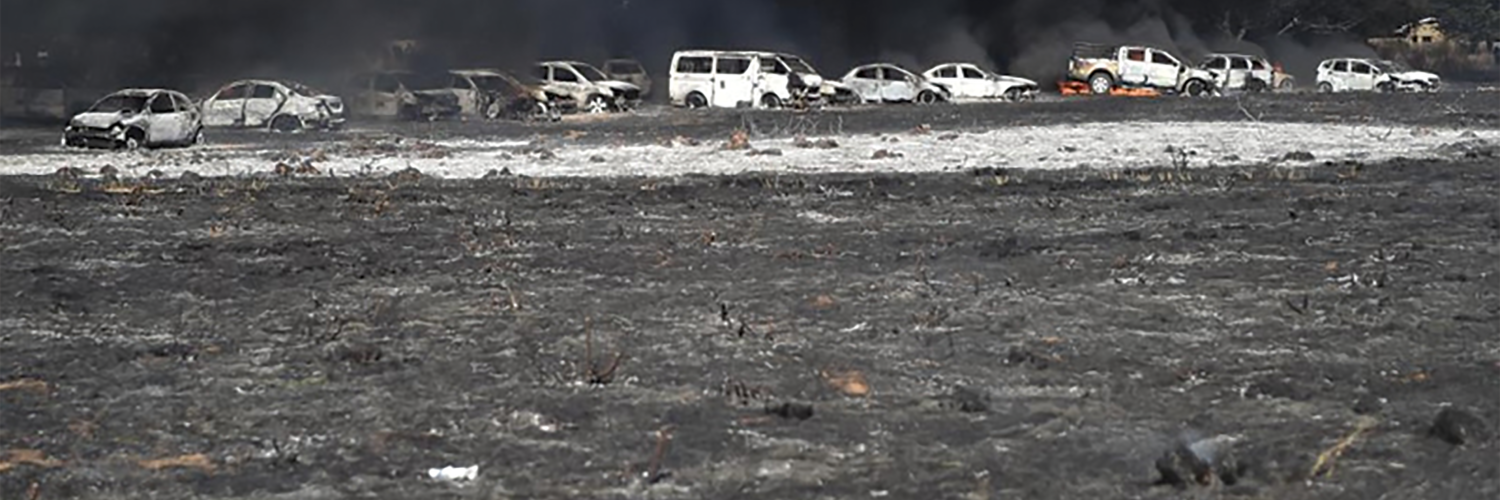
INFERNO: A total 49 cars burnt to ash at Toyota 1000 Desert Rally in Botswana…
By WSAM Correspondent
This past Sunday, (June 25) saw approximately 49 cars burned to the ground at the 2023 Toyota 1000 Desert Race in the small mining town of Jwaneng, southern Botswana, SA Trucker reported.
Fortunately, no deaths or injuries have been reported thus far as the incident took place while most owners were enjoying the action-packed racing.
Eyewitnesses at the Desert Race claimed that the fire came from a glowing ember that fell off a food vendor’s braai onto the dry winter grass, which proceeded to immediately catch flame and engulf the nearby vehicles waiting in the parking lot.
Owners saw the incident and rushed to the scene, but many were too late as their cars were already in ashes or busy burning.
Emergency services were called shortly after the fire broke out but firefighters struggled to contain the flames due to the sheer number of vehicles that were set alight and the wintery conditions that are conducive to veld fires.
In the many videos that have since emerged on social media, onlookers could be seen pushing vehicles out of harm’s way but only a handful could be saved as the fire jumped from one to the other within minutes.
Models such as Ford Rangers, VW Golfs, Toyota Quantums, a Hyundai Tucson, Mercedes-Benz C-Class, and more met their fiery demise.
Botswana police said they are still “investigating the cause of the fire” and no official statements have been released at the time of writing.
The authorities are currently assessing eyewitness accounts and collecting more evidence to get to the bottom of the unfortunate incident.
As the investigation continued, further details were expected to come to light on the actual reason for the fire and the number of vehicles that were damaged.
The organisers of the event have reportedly issued a statement expressing their concern and commitment to cooperating with the authorities to determine the cause of the incident, and they have reassured the public that all necessary precautions will be taken to prevent similar incidents in the future.
COLLAPSED PYRAMID SCHEME LEAVES DOZENS HEARTBROKEN
RACKET: Victim and family lose more than R500 000 in investment scam after operators vanish with millions in life savings belonging to unsuspecting investors…
By Sonti Maseko

The woman talking to me is educated. She would describe herself as smart. And, yet she fell for it, hook, line and sinker; the latest in Mzansi’s long history of pyramid schemes – an overseas-based called QZ Investments.
In April, the scheme simply vanished – shut down its web pages, and with that, raked away millions and millions from their duped African “investors”.
“I thought I did my research,” the soft-spoken victim, related her story with an unmistaken air of resignation to the earth-shattering event that’s befallen her family. “I invested R80 000, my 29-year-old daughter R100 000 (and) my mother R40 000. Everything was well-planned, their system was very good,” Ous Puleng (not her real name) revealed.
“To me this was a legit company, they said they were audited by one of the largest and global auditing firms (name withheld pending further enquiries); it was like buying an investment package,” she said. QZ Investments targeted mostly the African middle class professionals, people with dispensable income, with a taste for a comfortable lifestyle and others who loved to dream big. In a flurry of messages exchanged on social media by members of this extensive club of investors, now coming out of the shadows, a picture emerges of the business model of the modern pyramid scheme.
Doctors, lawyers, advocates, police officers, nurses, teachers, general workers, pensioners and even people who considered themselves experts in multi-level networks are among its victims.
Another special category of people in Black communities who were targeted were church members, primarily those in charismatic churches, and groups, purported to have sunk millions into what they knew was a foreign owned investment scheme, whose owners were Chinese, operating through a local board of directors. The directors were mostly young, highly visible and upwardly mobile individuals, in each African country where they operated the scam.
For Ous Puleng, the shock realisation that she was a victim of a scam, happened on May 23, when, like other members, she had become accustomed to withdrawing dividends paid out every Monday to investors. She failed to log into the system. Weeks earlier, investors, in what with hindsight seemed like a preparation for the collapse, were warned to expect changes because, as QZ management claimed, the company was in the process of listing with the Nasdaq – an impressive, big name in financial markets.
Ous Puleng was able to link with one of the local directors of the company, a woman called Priya, based in Durban. “She was crying, (saying) that QZ was no longer there; that she was resigning”. However Ous Puleng pointed out that Priya was among those who harvested millions from QZ Investments as a director. So rich that she had treated her team of recruits, free of charge, to a trip to Dubai. “Another woman was reputed to be making a million rands per day,” she claims.
These lavish treats heaped upon selected hard-working team members, whose work was to find investors and encourage them to sink bigger and bigger monies into the scheme; faster and faster, for near instant returns, worked wonders in terms of money poured into the scheme, given the short life span of a pyramid scheme. QZ Investment seemed to have appeared on the financial horizon in late 2022, described as a 400 percent return on investment (ROI) MLM crypto Ponzi scheme, according to online research.
Ous Puleng was sold by the Dubai incentives and resolved to work even harder. The directors began touting for a trip to Shanghai in China for top performers. Bangkok and even hotels bookings in New York were dangled above the heads of the members. Beyond recruiting members of her immediate family; her daughter and mother, she convinced a member of her own church to invest R300 000, into QZ Investments, for which she earned R30 000 in commission. She reinvested the commission to grow her own portfolio in QZ.
A simple search on Google, in the first line confirms that QZ Management is a scam. According to screen shots of information from members, QZ operations beyond South Africa spread to Ghana, Nigeria, Swaziland and Kenya, among the African nations targeted. Above board, QZ was virtually unknown and unheard of to many people, including journalists. Its operations appeared to skillfully straddle the public and online domains. Live and online presentations were the platforms where it primarily based, it’s operations. It appears that for a pyramid to thrive, especially in the early days of recruitment in high numbers, secrecy is key and new recruits are made to feel special and exclusive, encouraged to “invite” close people they care for with the promise that they would live the “African dream”, albeit a transplant of the American dream was within their grab.
As evidence demonstrating the closely guarded secret of overnight success and riches that rules the operations of a pyramid scheme, Ous Puleng pointed out to a member, one guy who, apparently checking out the company, posted details on a different platform outside. For that he was criticised by other investors and labelled and villified, “that he did not like progress”.
Ous Puleng vividly remembers billboards on the road to OR Tambo International, advertising this investment company and the recruitment drive was led by social media influencers who hosted online live presentations, real life presentations and gala dinners where attendees already looked the part of living the charmed life, dressed to nines, celebrating success and new riches. She provides video clips as receipts giving a glimpse into the QZ Management in operation. The month of June brought turmoil in the lives of the ordinary investors, who have been hit by the reality of where to find money for bond payments, car payments, and facing their partners, friends and families.
Others told WSAM they have ruined lifelong relationships with fellow church members, while one woman said she has started begging for food and groceries from friends. The Chinese CEO, Blake Yeung Pu Lei, of QZ Management, in Shanghai, has disappeared from the pages on the internet. As for the local board of directors; “they are busy opening other (new) schemes, similar to QZ, but they are not making noise”, mused Ous Puleng.
It appears that when a pyramid scheme collapses, the head simply cuts-off, discards the chaos of the ailing body, and simply begins afresh or rinse-and-repeat in business language.
Turning to the police has not helped either. Investors who went to lay charges against the company were advised instead, to make statements implicating close friends and relatives who recruited them into the scheme.