 WeeklySA_Admin
PROSPERITY: China and South Africa launched a joint initiative to support modernisation and technological development in Africa on the sidelines of recent G20 Summit in Johannesburg…
By Abdul Rahman
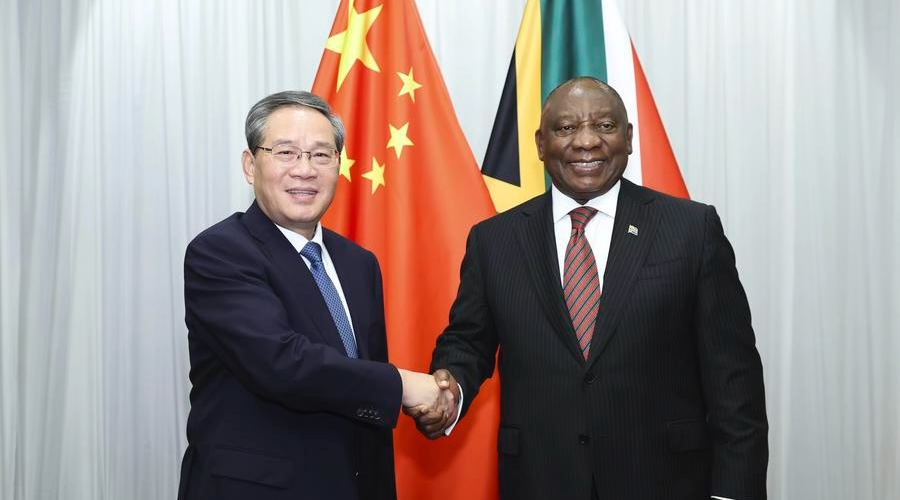
During his trip to South Africa to attend the G20 summit, Chinese Premier Li Qiang announced the launch of the China-South Africa Joint Initiative on Cooperation Supporting Modernization in Africa with the objective of creating shared prosperity across the continent.
The initiative is aimed at creating global collaboration to increase investments on the continent in order to help the countries achieve sustainable economic development with climate sensitive technology.
The initiative is based on an understanding reached between President Xi Jinping and South African President Cyril Ramaphosa, said Guo Jiakun, official spokesperson of the Chinese Ministry of Foreign Affairs on November 27.
The initiative is centred on the principles of justice, equitability, openness, and win-win for all the parties involved. It aims to put the interests of the people first and encourages the values of diversity, inclusiveness, and sustainable development. The initiative will help the region and the world achieve peace and security, a public document of the initiative released on November 22 says.
It is expected that cooperation under the initiative will entail green, coordinated, and sustainable industrialization to ensure economic growth and poverty reduction in Africa.
One of the major components of green industrialization is the focus on green infrastructure and green mining on the continent. Greater international investments in renewable energy projects in Africa will help achieve this goal.
The support for advancing value-added processing of minerals is also a cornerstone of the cooperation initiative, to ensure that a greater share of the economic benefits from minerals and resources remain within the continent.
In contrast to collaborations with Global North countries, the initiative is primarily a vision for South-South cooperation in areas such as climate change and the Belt and Road initiative.
The document outlining the mechanism emphasises that modernization in the region should be based on African countries’ distinctive cultural features, development needs, and experience sharing. For this purpose, the governments in the region should try to build consensus on areas such as governance, needs of modernization, and poverty reduction in their countries.
People-centric modernisation
The initiative ultimately aims to achieve greater industrialization, technological transfer, education, and training of the workforce on the African continent in a way which puts the people and their interests first.
The economies of the majority of countries on the African continent are focused on the agricultural sector, with little or no industry. The lack of industrial capacity presents one of the biggest challenges for economic growth on the continent which is thus confined to export of raw materials, and the import of finished goods. The continent is home to the largest number of least developed countries in the world (32 out of 44).
Mining is another major sector mostly controlled and operated in the interests of foreign countries. The initiative proposes to change this dynamic with greater involvement and control of local governments over industries like mining and technology.
The initiative claims to be based on the belief that “modernisation is a common pursuit and an inalienable right of all countries of the world.”
China has long campaigned for the right of every country to develop according to its own specific material and cultural context, without any external control. The China-South Africa initiative is part of that commitment.
The initiative also aims to raise agricultural output through investments in modernization of the agriculture sector as it remains the largest employer on the continent yet.
Agriculture employs more than half of Africa’s total workforce and yet nearly 60% of its population are facing food insecurity, as per the United Nations Conference on Trade and Development (UNCTAD) in 2021. This is despite the fact that Africa amounts to 45% of all sustainable arable land in the world. The continent has the lowest per capita productivity in agriculture in the world.
The agriculture sector is dominated by the production of cash crops such as coffee and cocoa, which are mostly exported. The production of these cash crops are labour intensive with little or no use of technology.
A vast amount of land in Africa is leased to foreign countries or private companies for agricultural production which is export oriented.
The China-South Africa initiative strives to change this scenario by aiming for technological upgrades as well as increased control over the land and resources by the local population. The move is focused on achieving food security and economic well-being for the majority of the people.
Another major aspect of the initiative is to focus on investment in healthcare and the initiation of an African pharmaceutical industry.
Most of the African countries presently rely on the import of medicine from India and elsewhere. According to UNCTAD, nearly 70% of medicine on the continent is imported from outside, with only eight countries out of 54 having some production capacity.
Given the fact that the demand for medicine is increasing on the continent, due to population growth and changing health needs, there is a huge potential to develop an industry on the continent. It can provide both cheaper drugs and economic opportunities to people.
Developed world
The initiative urges developed countries to fulfil their commitments to Africa under the official development assistance and climate financing obligations, apart from providing other support, so that African countries can focus on a climate-friendly development model and achieve a just energy transfer.
Though developed countries, both as part of the G20 and otherwise, have repeatedly pledged support to African countries in achieving their sustainable development goals (SDGs), most of the time, these pledges have been unfulfilled.
This year’s G20 summit has adopted a declaration in which the developed world has again promised to fulfil their obligations to help African countries deal with the growing sovereign debt crisis as well as provide assistance, both technological and financial, to fulfil their development aspirations and climate obligations.
Though some doubt the fate of developed countries’ promises made on sovereign debt, the China-South Africa initiative hopes it will materialize.
There has also been the point about the potential for interference and the colonial dynamic that often comes with financial aid from the developed countries or western-dominated financial institutions.
The China-South Africa initiative, however, strictly states that all multilateral cooperation in Africa should be based on the principle of “Africa initiated, domestic ownership, and Africa led” to maintain the absolute sovereign decision-making rights of every country on the continent.
Africa’s share
One of the major aspects of the modernisation initiative is to build Africa’s collective security infrastructure under UN Resolution 2719.
Adopted on December 21, 2023, Resolution 2719 recognizes the need for the Security Council’s cooperation with the African Union for the promotion of peace, security, and stability in Africa, with the objective of improving collective security in the region.
The China-South Africa initiative recognizes the need to increase grants and funding for African community organizations, provide debt relief and suspension, disburse greater development financing, and increase the role of African countries in global governance.
It pushes for reforms in the UN as a way to increase Africa’s role in global governance and supports the strengthening of the African Development Bank (AfDB).
According Zhao Wenfei, minister counsellor at the Chinese embassy in South Africa, the “initiative reflects Africa’s unique features and focuses on goals such as modernization, shared prosperity, social and cultural advancement, environmental harmony, and peaceful development,” Africa News quoted.
The initiative has been supported by the UNCTAD. Its secretary general, Rebeca Grynspan, was quoted by China Daily supporting the initiative, claiming “China is writing a new story of multipolarity with new inclusion. This cooperation promises a common goal and shared prosperity.”– People’s Despatch