 WeeklySA_Admin
SELF-RELIANCE: Biggest participation incentive is that training is free
By Thuli Zungu
SEVERAL communities in Gauteng have received much needed help from Coca-Cola to cushion the devastating impact of rising unemployment and to improve their quality of life.
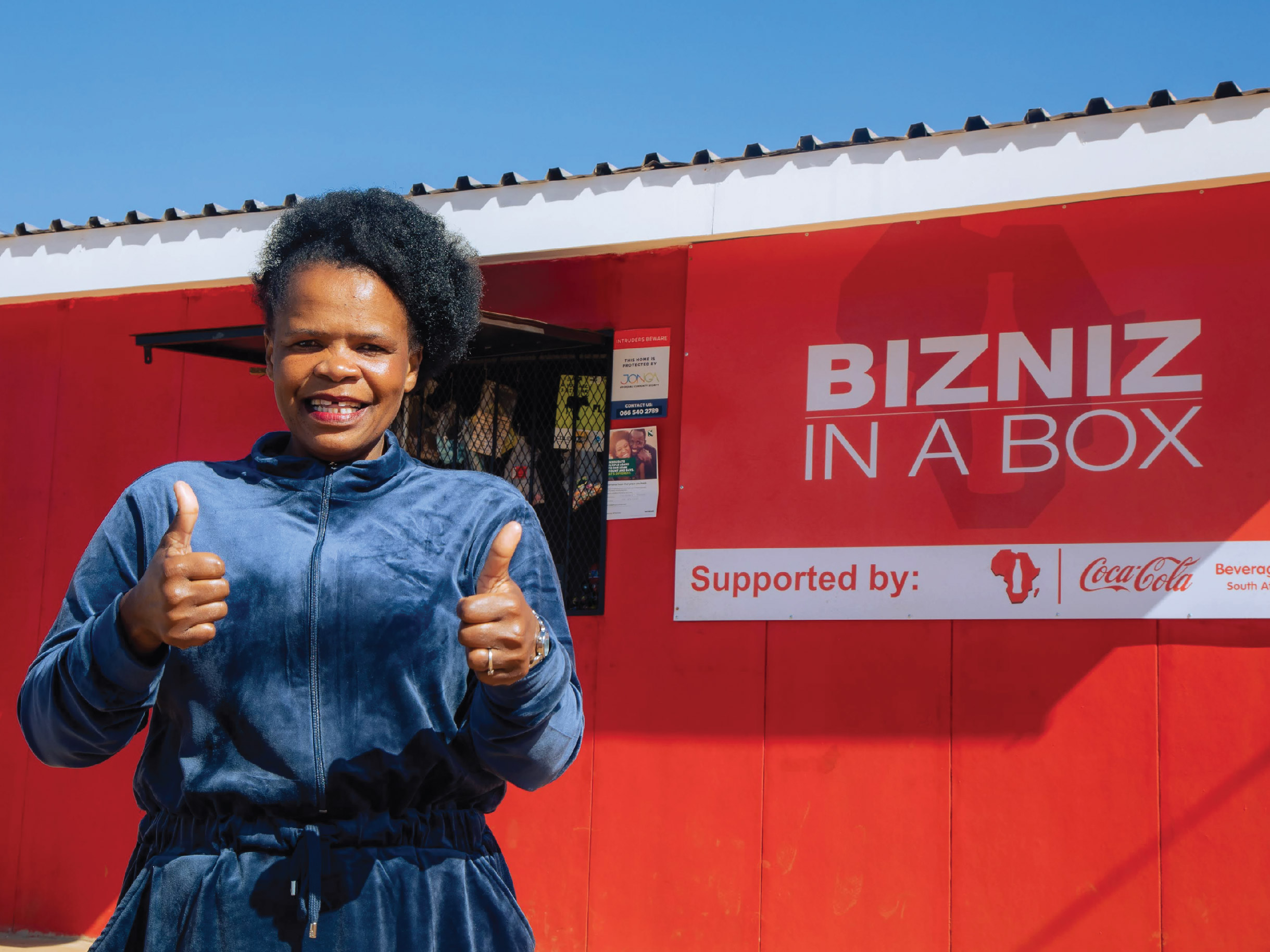
Early this month, Coca-Cola Beverages South Africa (CCBSA) helped residents of the Elias Motsoaledi Informal Settlement in Devland, east of Johannesburg to become economically active the face of fast-rising unemployment, which has been worsened by the Covid-19 pandemic. One of the beneficiaries Mpumi Pongolo 56, the founder of Revelations 21, which is a non-profit organisation that is located in the settlement. Pongolo has partnered with Coca Cola to run a “Bizniz in a Box” business training and development facility, which comes with a three month-long training material to help the community to start up their own businesses.
Simply put, the “Bizniz in a Box” is a small business operating from a container. Pongolo helps fellow community members to learn the rudiments of starting, operating and sustaining a small business, which could, ideally be run from a container. For an example, the Revelations 21 NPO’s “Bizniz in a Box” container offers groceries and fast food for sale, to generate an income and economic opportunity for the area, Pongolo said.
The biggest incentive for participation is that the training is free, and Pongolo has already started mentoring ten aspirant entrepreneurs from the community, as no cost, since the beginning of the month. Revelations 21, which has no access to electricity, uses gas or firewood to cook meals for the needy community members. But Pongolo says the community remains resilient. “Although the community has been here for many years, we still do not have electricity, and the residents still struggle to access adequate housing, service delivery and other vital amenities,” Pongolo said.
Pongolo said that this was not the first time their NPO had received a donation from Coca Cola. “In 2017, Coca Cola, which has a manufacturing facility in Devland, had donated a generator to help with much needed charging for our sponsored computers. In the same year, Coca Cola also provided a kiosk out which we us to sell cool drinks. And since there was no electricity, Coca Cola installed a solar powered electricity system for the whole property,” Pongolo said.
Before Coca Cola had come to their rescue, Revelations 21, which was established in in 2013, was originally operating from a shed out which they were caring for the elderly, vulnerable children and people living with HIV-Aids. They were also feeding more than 200 children, daily; and were essentially giving first preference to the children who were part of the NPO’s -school programme, thus encouraging the youngsters to take their studies seriously, including being up to date with the homework.
The other recipients of the “Bizniz in a Box” containers and the associated business training and development programme are situated in the Elias Motsoaledi informal settlement in Diepkloof, Soweto; Phola in Diepsloot, the Ikageng Itireleng Aids Ministry in Soweto, the Food for Life non-governmental organisation in Midrand and Gift of the Givers in Stormill, West Rand.
Nozicelo Ngcobo the Public Affairs, the communication and sustainability director at CCBSA confirmed that the “Bizniz in a Box” is the company’s community enterprise development programme through which Coca Cola helps to train and equip township-based entrepreneurs to run their own businesses, ranging from fast food, cafes, car washes, salons, and others. Ngcobo said, since launching in 2015, the programme has trained over 700 young entrepreneurs around the country and helped more than 125 of them to run their own container-based businesses; and had also helped to create employment in the townships. “Bizniz in a Box aims at creating an ecosystem of viable micro-businesses offering complementary products and services in the township communities, using the spaza shop concept as an anchor,” she said.
Ngcobo has said that, in the case of their support that has been given to Revelations 21, so far, began with the demolition of the NPO’s existing dilapidated building, which were replaced with three “Wendy Houses” to accommodate its equipment and host activities. “Each “Wendy House” is equipped with a kitchen that has a stove, tables and chairs, as well as a staff room with a boardroom table and office chairs, all donated from CCBSA’s Devland plant. Each of these structures also has an office with cupboards, tables, chairs and bookshelves. A fence and gate were built around the property, which is also adorned with a food garden with a shade net,” Ngcobo said.
“For us at Coca-Cola Beverages South Africa (CCBSA), sustainability is an integral part of our decision making process. We want to operate in such a way that our operations are intrinsically linked to the sustainability of the environment where we operate. This is our shared vision for how we work together to create social value and make a positive difference for the customers and communities we serve. Furthermore, CCBSA is committed to producing and selling our products in a responsible way and ensuring a sustainable future. In this context, CCBSA’s finger must be on the pulse of South Africa, understanding the risks that we face and how this potentially affects our business as we make decisions. Our sustainability strategy contributes directly towards our vision to sustain our social license to operate.”
MORE INFO ABOUT THIS INNOVATIVE COMMUNITY SUPPORT PROGRAMME
The “Bizniz in a Box” The initiative provides full cycle training with a fully-equipped retail outlet (in the form of a container) from which qualifying community members are able to trade, immediately.
The containers are stocked by Coca-Cola Beverages South Africa CCBSA and its partners, and the aspirant entrepreneurs are assisted to comply with all legal and regulatory requirements to allow them to run their own small businesses in line with all the relevant rules and regulation of the country.
Once an agreement has been signed, the community members take legal ownership of the containers and commence their repayments to Small Enterprise Finance Agency (SEFA). Each business operates out of a custom-designed container, covering various core needs of the local community, including internet cafés-like services, car wash facilities, fast-food shops and, or mini bakeries. The initiative provides full cycle training with a fully-equipped retail outlet (in the form of a container) from which qualifying community members are able to trade, immediately.
THE PROS AND CONS OF COMPLIANCE WITH SKILSS DEVELOPMENT ACT
The purpose of the skills development act is to:
• Develop the skills of people in South Africa in order to improve productivity in the workplace and competitiveness of employers;
• Invests in education and training of workers;
• Encourage workers to participate in learning programmers;
• Encourage businesses to improve the skills of their workers;
• Improve the chances of getting a job for previous disadvantaged people;
• Impact of skills development act on business, and to;
• Promote self-employment
Advantages of implementing the Skills Development Act:
• Trains employees to improve productivity in the workplace;
• Increases the return on investment in education and training;
• Workplaces are used as active learning sites, where employees can gain practical job experience;
• Promote self-employment and black entrepreneurship, and;
• Improves best employment opportunities for workers from previous disadvantage groups.
Disadvantages
• Increases cost of the process requires a large amount of paperwork
• Productivity may decrease as employees are expected to attend training during working hours
• The time and money spent on improving employees skills is wasted if they leave the business
• Implementation of the Skills Development Act can be difficult to monitor and control.
Role of SETAs in supporting the Skills Development Act
• Promote and establish leaderships
• Register learnership learning programmes
• Monitor the actual training by service providers
• Allocate grants to employers, education and training provider
• Provide training material for skills development Facilitators
Compliance with Skills Development Act
• Employers who collet PAYE should register with SETAs
• Business should register with SARS in the area in which their business is classified in terms of SETA
• Provide all employees with the opportunity to improve their skills
· Encourage employees to participate in learnerships and other training programmes
Penalties for no-compliance with Skills Development Act
• Businesses that do not pay the skills Development Levy may not offer leaderships
• A labour inspector could order the business to stop operating should the business be found guilty of illegal practices.
Sourced: Parliamentary information services