 WeeklySA_Admin
MEASURES: Mother’s tears of relief amid a nation’s anguish: missing daughter returns unharmed as Government targets unresolved GBV cases…
By Monk Nkomo
‘’ God is great’’.
These were the first words that were uttered by Sheila Masilo when her daughter, Kutlwano, who has been missing for a week, arrived safely at their Soshanguve home in Pretoria this week.
Kutlwano Masilo (33) was found at the Soshanguve station after an intensive search by police after she went missing around Block F in Soshanguve.
Police spokesperson Captain Tintswalo Sibeko confirmed that Masilo was found unharmed and had been reunited with her family.
Kutlwano’s mother, Sheila Masilo, who wept uncontrollably at the sight of her daughter when she arrived home, said she was happy that her daughter had been found alive.
‘’We thank The Lord for her safe return after having spent almost a week in trauma and unable to sleep or eat. We were worried that Kutlwano was another victim of the women who had been murdered in Ekurhuleni since July 2026.
We are really relieved. We also thank the police and all the people who helped in helping to search for Kutlwano since Tuesday last week’’.
The family was still traumatised to comment more and to give further details how Kutlwano had disappeared and how she was found.
While her return brought an end to one family’s ordeal, the broader crisis intensified last weekend when the bodies of a 10th and an 11th woman were discovered in the metropolitan area.
The 10th body was found near Tembisa early on September 26. Police subsequently arrested a 36-year-old man who had allegedly fled to Tzaneen in Limpopo following the killing.
The following day, a private security patrol discovered another woman’s body in an open area in Springs, bringing to 11 the number of women’s bodies found in Ekurhuleni since July.
Police have not established that all the deaths are connected and have cautioned against premature speculation that a serial offender is responsible. Investigators have, however, identified similarities in some of the cases and are pursuing all possible leads.
Meanwhile, after the happy ending for the Masilo family, a day after President Cyril Ramaphosa made a passionate appeal to men during his address to the nation on the killing of women in Ekurhuleni.
Unsolved cases targeted
To curb the soaring incidence of gender-based violence, Ramaphosa unveiled a plan aimed at strengthening the systems of policing, investigation, forensic processing, prosecution and community safety required to protect women and children and ensure that victims and survivors have access to justice.
Calling on men to stop abusing women, he urged every sphere of government to understand that the safety of women was part of their responsibility.
He reaffirmed its commitment to tackling gender-based violence and femicide through a four-point recovery plan, aimed at strengthening policing, investigations, forensic processing and prosecution.
Key measures and calls to action include:
• Recover unresolved cases: A national operation will target murders, attempted murders, rape and serious sexual offences against women and children.
• Speed up forensic work: Reduce evidence-processing backlogs and improve turnaround times for priority GBVF cases.
• Strengthen justice systems: Improve investigations and prosecution so victims and survivors can access justice.
• Mobilise communities: Report crimes, provide information to investigators and support survivors.
• Challenge abusive behaviour: Men and boys must speak out against violence and reject attitudes that normalise domination and abuse.
“Silence and turning a blind eye to abuse cannot become normalised,” Ramaphosa said.
The President also announced a 60-day nationwide safety audit requiring municipalities to identify dangerous public spaces, including areas with broken streetlights, abandoned buildings, poorly secured parks and other conditions that expose women to violence.
Police and the National Prosecuting Authority have further been instructed to complete a 90-day review of unresolved cases involving murder, attempted murder, rape and other forms of gender-based violence. Funded action plans are expected to follow the reviews.
Ramaphosa acknowledged that the measures taken by the government so far had not been sufficient to stem the violence.
He said the country could not “police and arrest” its way out of the crisis and that greater emphasis had to be placed on prevention, safer public spaces and changing the behaviour that enabled violence against women.
Since gender-based violence and femicide was classified as a national disaster last year, the government had reprioritised resources and strengthened coordination between the criminal-justice system and services supporting survivors.
The National Council on Gender-Based Violence and Femicide is now operational and held its inaugural board meeting in Pretoria in August.
Additional resources have also been directed to police Family Violence, Child Protection and Sexual Offences units, while Finance Minister Enoch Godongwana is expected to announce further allocations in the Medium-Term Budget Policy Statement on October 21.
Government plans to expand the network of Sexual Offences Courts and Thuthuzela Care Centres, improve shelters for survivors and strengthen DNA-processing and forensic-investigation capacity.
Ramaphosa said bail laws would also be tightened and that police stations were being equipped with victim-friendly services and specialised gender-based violence desks.
“Women who report abuse must not be turned away,” he said.
Gauteng targets GBV hotspots
RESPONSE: Police support, forensic evidence, survivor shelters and municipal safety audits form part of the province’s response to the murders of women in Ekurhuleni…
By WSAM Reporter
Gauteng will prioritise police stations recording the highest rape caseloads, strengthen services for survivors and audit unsafe public spaces as it steps up its response to gender-based violence and femicide following the murders of women in Ekurhuleni.
Premier Panyaza Lesufi announced the measures after meeting mayors, municipal managers and law enforcement agencies to coordinate the provincial response to President Cyril Ramaphosa’s four-point national plan.
Ten police stations have been identified for additional support covering policing, victim empowerment and case dockets.
“That’s why we have to ringfence these police stations and provide the relevant support that is needed,” Lesufi said.
The provincial measures include:
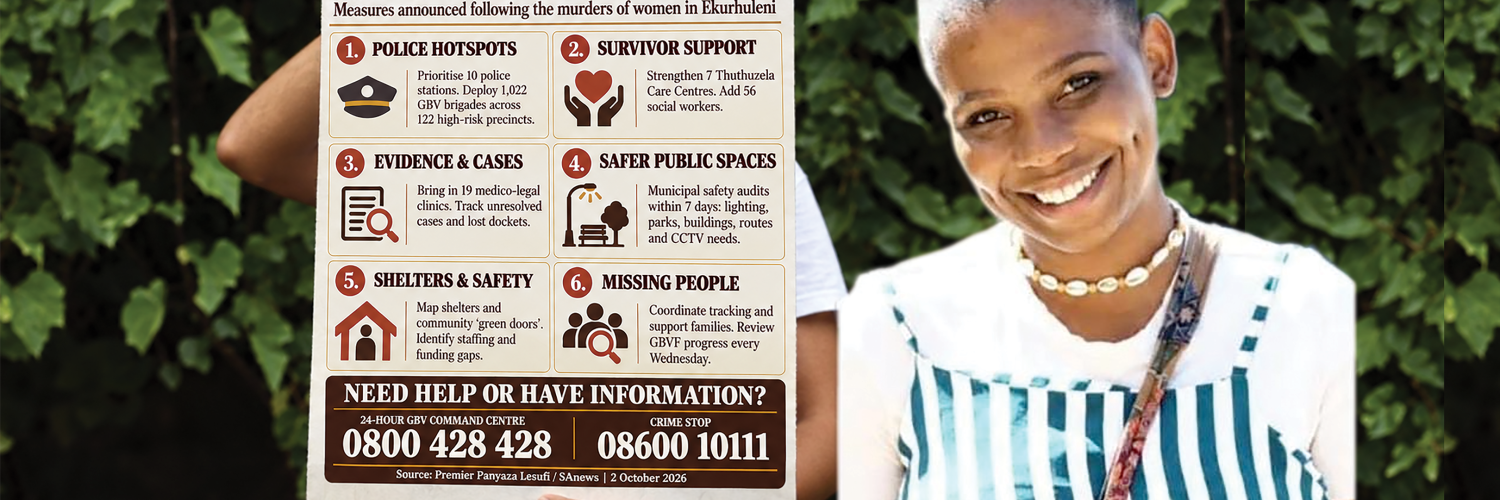
• Police and case support: Prioritise the 10 stations, strengthen SAPS GBV desks and deploy 1,022 GBV brigades across 122 high-risk police precincts, equipped with tools of trade.
• Survivor services: Strengthen seven Thuthuzela Care Centres, support sexual offence courts and victim-friendly rooms, and add 56 social workers within the Department of Social Development.
• Forensic evidence: Bring 19 medico-legal clinics into the response to help prevent the loss of evidence.
• Case recovery: Audit case numbers, track individual recovery plans and investigate police station failures, including lost dockets. Follow-up will also cover protection orders, bail-related safety and communication with families.
• Safer public spaces: Municipalities must submit audits within seven days identifying broken streetlights, overgrown spaces, insecure parks, abandoned or hijacked buildings, unsafe routes and taxi facilities, alongside areas needing CCTV support.
• Shelters and places of safety: Map shelters and community “green doors”, and identify gaps in buildings, staffing and funding for women and children seeking protection.
• Missing people: Coordinate tracking through an intergovernmental resource team and provide support to families of people who remain missing or unaccounted for.
Lesufi said Ekurhuleni would receive additional support. A new intergovernmental GBVF committee will meet every Wednesday to assess progress, while a technical team will seek assistance from national departments and entities.
The province’s measures support the national commitments to recover unresolved cases, reduce forensic backlogs, conduct women’s safety audits and address alcohol-related violence.
Lesufi said the province was strengthening existing systems, with commitments that should be measurable and open to public scrutiny.
Help: Report information to Crime Stop on 08600 10111, or contact the 24-hour GBV Command Centre on 0800 428 428.