 WeeklySA_Admin
RESTRAINT: Soft-spoken yet unshakeable, Cameroonian coach David Pagou reveals how humility, faith and quiet authority shape not only his leadership style, but the mindset of a team refusing to be defined by noise, pressure or history.
By Own Correspondent
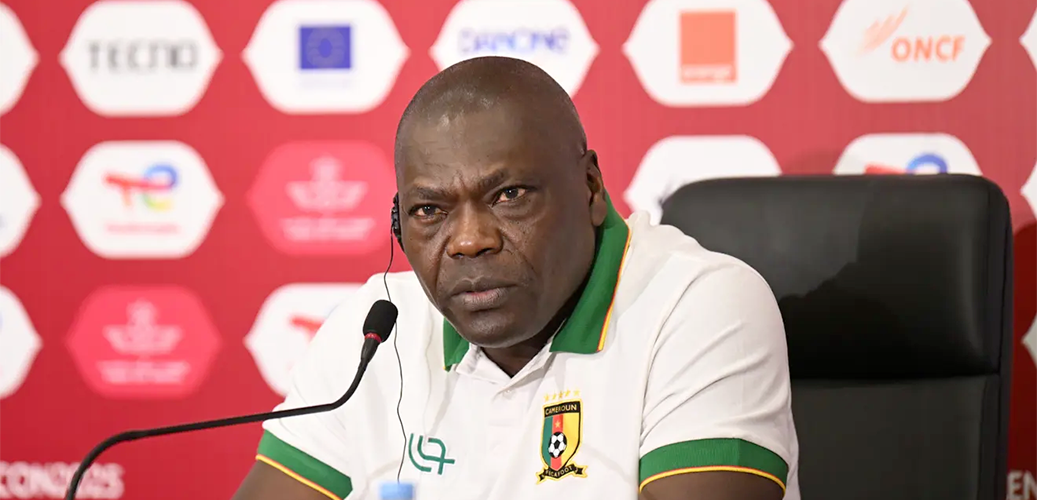
He never raises his voice to dominate the room. And yet, when David Pagou speaks, everyone listens. In the conference room of the Main Media Centre in Rabat, the Cameroonian coach imposes a singular presence, built on calm authority, evident respect, and speech deeply rooted in his convictions. His communication is neither theatrical nor calculated.
From the very first minutes, the tone is set. Pagou does not address an indistinct mass of journalists. He calls each person by name: “Kevin,” “Yvan,” “Mirabeau,” “Alain,” “Pamela, “Eyong”, “Giovanni.”These details, far from trivial, establishes a particular atmosphere. The press conference stops being a collective interrogation and becomes a human exchange. The coach looks at his interlocutors, names them, thanks them. In an environment that can sometimes be tense, this approach creates mutual respect. It also disarms.
“A child of God is not afraid. Obstacles are not walls — they are opportunities.”
— David Pagou
Humility as a Foundation
For David Pagou, humility is not a posture of convenience. It structures his speech. Asked about the state of his team, he avoids definitive statements.
“We are not always satisfied,” he says. “There are still many areas to work on.”
No triumphalism followed the qualification for the quarterfinals after the 2-1 victory over South Africa, no assertions of certainty. Cameroon moves forward but remains a work in progress.
Even when he talks about his own career — being the first Cameroonian coach to qualify a national team for a quarterfinal in the African Cup of Nations in this context — Pagou avoids personalizing it. He speaks of the group, young players, the nation. He defines himself as “a soldier.” The word carries weight. A soldier serving a cause greater than himself.
A Faith That Guides Him
David Pagou does not hide his faith. He embraces it fully, without ever turning it into a slogan.
“The Lord guides me,” he says almost naturally when asked about his contract situation or external pressure.
For him, God is not a refuge of convenience but a constant compass. This spirituality flows through his managerial discourse.
“A child of God is not afraid,” he asserts when discussing refereeing decisions or a hostile environment.
Obstacles become levers, disadvantages turn into opportunities. This deeply rooted worldview gives his speech a rare coherence. It also reassures his players, instilling a sense of calm in the face of the unpredictable.
‘Hemlè’, the Mindset First
Pagou often speaks about mentality — the Cameroonian Hemlè, an inner strength that transcends technique and tactics. But he refuses to make it a cover-up.
“Hemlè hides nothing,” he explains. “It completes.”
For him, mentality is the extra soul that can tip balanced matches, never an excuse to mask weaknesses.
His way of explaining these concepts is vivid, almost pedagogical. The metaphor of a mountain, before which Cameroonians advance without retreating, leaves a mark. Pagou knows how to talk football without excessive jargon, using words that are accessible and rooted in a shared culture and history.
A Voice That Reassures
There is also the voice. Deep, calm, resonant. A voice that commands silence without demanding it. This voice reassures his players as much as it structures the media space. It gives the impression of a man master of his time, emotions, and message.
When he talks about certain players, like Bryan Mbeumo, Pagou reveals another side of his communication: that of a shrewd psychologist-manager. He talks about temperament, upbringing, the need to sometimes be “pushed” to better express oneself. Again, the speech is nuanced, never stigmatizing.
Pagou recalls private conversations, the responsibilities entrusted, the “locomotive” role assigned to key players. He values behaviors observed in the locker room, the flow of communication, and shared standards. Public communication becomes a natural extension of internal work.
Refusing the favourite tag
On Friday, at the Moulay Abdellah Stadium in Rabat, Cameroon will face Morocco, the host nation and a World Cup semifinalist. And David Pagou categorically rejects the status of favourite.
“The Atlas Lions are the natural favourites,” he repeats.
He cites infrastructure, organization, and the structural progress of Moroccan football. This discourse, far from flattering the opponent, reflects a consciously realistic perspective.
Pagou methodically dismantles historical shortcuts:
“It’s true that Cameroon beat Morocco in 1988, but the past does not guarantee the future,” he insists.
According to him, past encounters have no bearing on a generation that wasn’t even born at the time. This way of framing the discussion in the present avoids unnecessary emotional weight.
Consistent Speech to the End
Even on the most sensitive topics — refereeing, crowd pressure, institutional rivalries — David Pagou remains consistent. No controversy, no slip-ups. He recognizes the humanity of referees, recalls his role and that of his players. Everyone has their place.
When he mentions Walid Regragui, Pagou refuses any comparison. “You don’t compare incomparable things.”
Respect for the other’s path, clarity about his own. Once again, communication without an oversized ego.
Quiet Leadership
Throughout this dense press conference, one fact becomes clear: David Pagou does not seek to impress. He seeks to be fair. His communication rests on three clear pillars: humility, faith, and responsibility. It addresses journalists as much as players, the public as much as the Cameroonian nation. – Cafonlie