 WeeklySA_Admin
DECAY: South Africa is overwhelmed by a deluge of narratives about its failings—like a person submerged underwater struggling to breathe—while leadership insists that words alone can replace genuine action…
By Themba Khumalo
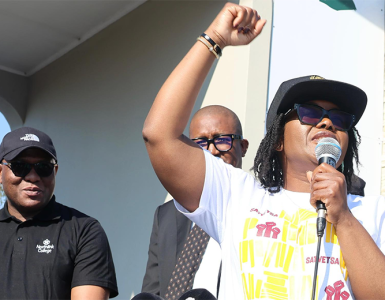
There is something almost theatrical about Cyril Ramaphosa standing at a podium and scolding local councillors for being strangers in their own communities.
The image is rich with irony. A president lamenting detachment — as though he himself has not spent years governing from a careful, cushioned distance, issuing concern in place of consequence.
Yes, councillors are strangers. Anyone who has tried to get a pothole filled, a pipe fixed, or a streetlight working knows this. They drift through communities like visiting dignitaries, not servants of the people. But the real question is this: who raised them?
Who presides over the system that produces these hollow officials, these absentee custodians of collapse?
Ramaphosa speaks as though local government is some rogue organism, operating independently of the state he leads. It is not. It is the most honest reflection of it.
It is not that Ramaphosa does not see the fire.
It is that he insists on holding a meeting about it while the house burns…
When he says councillors must “get to know the cities they govern”, one is tempted to ask: when last did the president truly acquaint himself with the lived reality of the country he governs? Not through reports, not through carefully managed site visits, but through the raw, unfiltered dysfunction that defines daily life for millions.
“They must be able to reach a balance sheet, the balance sheet of their city,” he said — as though the collapse of local government is merely an accounting problem, rather than a political failure incubated over years.
Well, the reality is that none of this is new. None of it is hidden. None of it is a fresh discovery or another moment of revelation. The truth is that our country is not suffering from a lack of awareness. It is drowning in lethargic awareness.
We know the taps are dry. We know the infrastructure is crumbling. We know the books do not balance — not in municipalities; not in state-owned entities; not in the moral ledger of governance itself. What we do not have is consequence. What we do not have is urgency that translates into action rather than speeches.
Ramaphosa’s favourite refuge is the language of “structural reform” — a phrase so constantly repeated it has begun to sound like a lullaby. Reform is always coming. Reform is always necessary. Reform is always just over the horizon. But in the meantime, the country decays in the present tense.
He warns of resistance within the state, as though he is not the head of that very state. Who, exactly, is resisting him? Ghosts? Or colleagues, he refuses to confront with anything resembling political steel?
Leadership is not the art of describing obstacles. It is the act of removing them.
Instead, we are treated to a familiar performance: diagnosis without surgery. The president lists the ailments — water crises, failing municipalities, economic exclusion — with the fluency of a seasoned analyst. His remarks at News24’s On The Record conference underline that he is aware of every failure, yet awareness has never produced action. But a head of state is not paid to observe the wreckage. He is paid to clear it.
Even his defence of committees has the weary ring of bureaucratic improvisation. A water crisis committee here, a commission of inquiry there — as though South Africa can ‘committee’ its way out of collapse. The country does not need more panels. It needs power exercised with intent.
And then there is the favourite refrain: apartheid’s economic architecture.
It is, of course, true that the past casts a long and ugly shadow. The monopolies, the exclusion, the concentration of wealth — these are real and enduring scars.
Land reform legislation has stalled in parliament for years. State-owned enterprises earmarked for restructuring remain paralysed, not by apartheid-era design, but by political inertia. These are not inherited impossibilities — they are chosen delays.
But history, for Ramaphosa, has become less an explanation and more an alibi.
Thirty-two years into democracy, the continued failure to dismantle these structures cannot be blamed solely on their existence. It must also be blamed on the absence of decisive leadership to break them. You cannot inherit a broken house and spend thirty-two years explaining the cracks without ever picking up a hammer.
At some point, the explanation becomes an excuse.
The president is right about one thing: South Africans are impatient. But this impatience is not reckless or short-sighted. It is the impatience of people who have watched promise after promise dissolve into polite inaction. It is the impatience of citizens who are told to wait while their reality worsens.
Crime festers. Infrastructure buckles. Municipalities fail. And still, the response is measured, careful, almost apologetic — as though decisive action might offend someone, somewhere, within the delicate ecosystem of party politics.
Even on policing, where Ramaphosa now promises to “hear all the bad news”, there is a sense of belated awakening. South Africans have been living with the bad news for years. They do not need a commission to tell them what they already know. They need a government willing to act on it.
What emerges from all of this is a troubling pattern: a president who speaks with clarity but governs with hesitation. A leader who understands the problem in exquisite detail but seems perpetually reluctant to wield the authority required to fix it.
It is not that Ramaphosa does not see the fire. It is that he insists on holding a meeting about it while the house burns.
And so we return to his criticism of councillors — these strangers in their own communities. He is not wrong. But the truth cuts deeper than he seems willing to admit.
South Africa is increasingly governed by strangers. Not just in municipalities, but at the very top. Leaders who speak the language of urgency but practise the politics of delay. Leaders who diagnose boldly but act timidly. Leaders who appear, at times, as distant from the lived reality of the country as the councillors they chastise.
The tragedy is not that the president is unaware.
It is that he behaves as though awareness is enough.