 WeeklySA_Admin
Elect: Mafolo was elected to the national assembly for the anc in sa’s first democratic elections in 1994
By Monk Nkomo
The passing on of the African National Congress stalwart, Titus Magashe Mafolo had left an immeasurable void in the hearts of the leadership as well as the movement he so faithfully served, according to South Africa’s deputy President, Paul Mashatile.
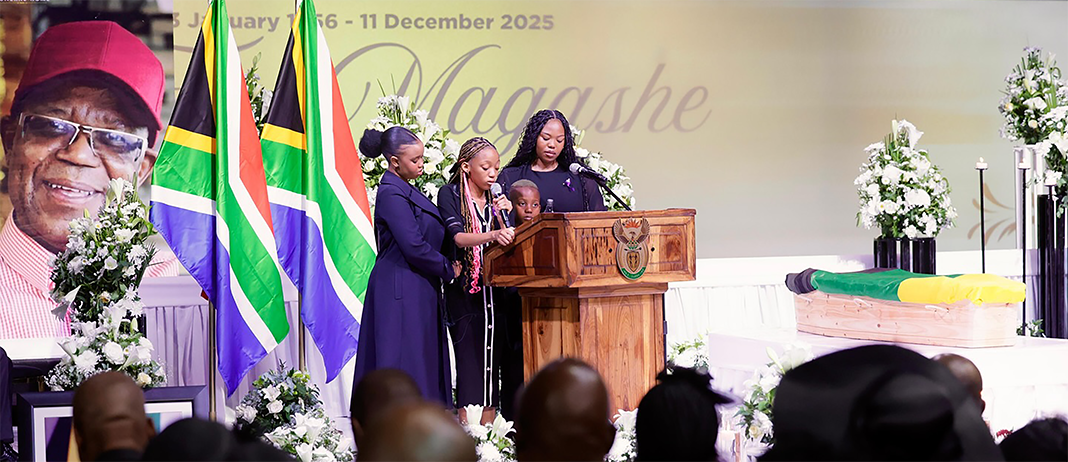
Delivering the eulogy at Mafolo’s special provincial official funeral service at the packed 3C Church in Irene on Friday, Mashatile told mourners , who included former South African President, Thabo Mbeki and a host of other dignitaries that Mafolo was a steadfast ANC activist and a resolute public ADRE
‘’We gathered here in this solemn moment to honour and celebrate the life of a thoughtful intellectual, mentor, friend, father and dear brother. His departure leaves an immeasurable void in our hearts and in the movement he served so faithfully. In remembering Comrade Titus Mafolo, we draw strength and inspiration from a life built on conviction, cultural identity and intellectual courage’’.
Mashatile said Mafolo’s life was a testament to principled leadership , humility and unwavering service. He honoured his courage in the struggle , the shaping of democratic governance and his tireless mentorship. He exemplified what it meant to lead from the front : not for accolade or position but for a cause greater than oneself.
‘’ Indeed , at this juncture, were are obliged to ask what it is that we can learn from the life of Comrade Titus Mafolo. Some of the key attributes we can glean from his life include his steadfastness : through the adversity of detention, political shift and personal trials, he remained unshakeable in principle and purpose.’’
Mafolo also had humility with gravitas in that he carried immense influence without fanfare. He would be remembered for his calm dignity and warmth and also as a mentor who nurtured a generation of activists, communities and intellectuals, all while uplifting his community in Atteridgeville.
Mashatile thanked the Mafolo family for allowing them as a government to honour a life that had contributed to this country. Indeed, Atteridgeville and South Africa had lost a gem. Mafolo was deeply committed to the anti-apartheid struggle from a young age. Trained as a journalist, he was active in the United Democratic Front, a part of his activism being having to endure imprisonment, torture and banning orders by the apartheid government and not once did he waver in his commitment to freedom, justice and equality.
‘’In the post-apartheid dispensation, Mafolo played a significant role in the reconfiguration of governance, specifically as it relates to issues of social transformation and redress, tackling major structural inequalities that characterised South Africa’s political landscape’’.
Specifically, in 1994, Mafolo was elected to the National Assembly for the ANC in South Africa’s first democratic elections, where he chaired the Portfolio Committee on Housing and worked alongside the Institute for Democracy in South Africa. Some of the key policy areas that he contributed to included addressing the massive housing backlog, dealing with the architecture of apartheid spatial planning through efforts towards racial inclusion and laying the foundation for the process to integrate housing into the Reconstruction and Development Programme under the leadership of President Thabo Mbeki.
In 1998, he joined President Thabo Mbeki’s team and served for ten years as the Chief Political Advisor, a position that marked him as one of the key architects of The Presidency as the epicentre of government and an important institution to ensure that the government fulfilled its democratic objectives. Through this role, ‘’Bro Ti’’, as he was affectionately known, set the standard of excellence in governance and did indeed wield influence behind the scenes, setting a foundation for the institution.
Mashatile added that after serving in The Presidency, Mafolo continued his service to the nation in the Ministry of Human Settlements, where he served as Political Advisor to Minister Lindiwe Sisulu and as a member of the Ministerial Advisory Panel, tirelessly working to improve housing and living conditions across South Africa, a vocation that unassumingly followed him.
‘’One of the striking qualities of Titus Mafolo was his passion for building an Afrocentric future where Africans would not be mere spectators but active architects of their destiny. He was an enthusiastic advocate for reclaiming identity, culture, and language—whether through renaming efforts like Pretoria to Tshwane or founding intellectual spaces such as The Native Club. Comrade Titus was more than a political strategist — he was a thinker and a storyteller.
‘’His work includes Pheli – The Narrative History. This important Afrocentric work highlights African agency and attempts to provide a true, self-told narrative of Black South African history in contrast to colonial accounts. The book chronicles the rich history and struggle of Atteridgeville and is a key component of Mafolo’s broader plan to recover African stories, which is also reflected in his later African Odyssey trilogy’’.
His monumental work, The African Odyssey Trilogy, stood as a testament to his scholarly passion and deep love for the African continent. In these three volumes, he not only traces the rich history of Africa but also reminded us that to face the challenges of today and tomorrow, we must understand the paths traversed by those who came before us, said Mashatile. Through meticulous research and powerful narrative, he sought to ignite pride, knowledge and determination in every African reader.
At the launch of the African Odyssey series, Mafolo spoke of the importance of engaging young people in literary and intellectual pursuits, and of the urgent need to cultivate a culture of learning and self-awareness among future generations. His hope was simple yet profound: that African youth not only consumed knowledge but created it, carrying forward the torch of understanding and progress.
Mafolo’s brilliance lay not just in what he said, but how he said it. Looking at some of the work that he contributed to, speeches and teachings alike, it was clear that his inclinations were informed by intellectual rigour and cultural conviction. He was a man who believed that expression was foundational to liberation—and that, through careful language and cultural pride, a nation can rediscover its soul.
He was also described by many of his friends as a dedicated comrade who devoted his life to the ideals of the liberation struggle and the advancement of the liberation struggle.
Mafolo was born at Motlolo village in Sekhukhune in Limpopo on January 13, 1956. He grew up in Atteridgeville where he played a major role in the struggle to dismantle apartheid laws in this country. Together with several local ANC members, who included Reeves Mabitsi, Tshepo Motlana, Oupa Masuku and the late Dr. Abe Nkomo, to name but a few, Mafolo was instrumental in the successful intensification of consumer boycotts and stayaways in the township in an effort to make the country ungovernable and bring the apartheid regime to its knees.
Always hounded by security police, they spent most of their time in hiding. This however, did not deter them from continuing with the struggle against the unjust system of apartheid. Mafolo, also described as a political strategist, served as the first secretary of the Saulsville-Atteridgeville Civic Association which was part of the broader democratic alliance movement that was involved in the struggle against the oppressive government.
His passing shocked many of his comrades and relatives who knew him well in Atteridgeville. News of the death of a man who was known as a humble and dedicated community leader, spread like wild fire in the township.
Paying tribute to their stalwart, the ANC described him as a dedicated cadre, community leader and pillar of society who passed away peacefully after a brief illness. His departure was a profound loss to the movement, to the communities he served and to all who valued principled leadership grounded in humility, integrity and service.
‘’Comrade Mafolo dedicated his life to the ideals of the liberation struggle and the advancement of the National Democratic Revolution. Throughout his years of activism and service, he remained steadfast in his commitment to social justice, democratic governance and the upliftment of the poor. He served the ANC and the democratic state in various capacities, offering guidance, insight and counsel rooted in deep political understanding and lived experience’’, said ANC national spokesperson, Mahlengi Bhengu – Motsiri.
Beyond formal responsibilities, Comrade Mafolo, she added, was a thoughtful intellectual and community mentor who believed strongly in political education, ethical leadership and intergenerational dialogue. His calm disposition, wisdom and moral clarity earned him respect across organisational and societal lines, leaving a lasting imprint on comrades and community members alike.
‘’The ANC extended its heartfelt condolences to the Mafolo family, friends, comrades and all those whose lives were touched by Comrade Mafolo. We share in their grief and offer our thoughts, prayers and solidarity during this difficult time’’.
Mafolo is survived by his wife of 43 years, Wilhemina, four children – Samora, Mogale and twins, Kagisho and Karabo, daughter-in-law, Neo, grandchildren, Khumo and Kgoshi, a brother and four sisters.