
 WeeklySA_Admin
LOOPHOLE: International watchdog entity unmasks a major arms-trade wheeling and dealing – in which armoured vehicles sold across Africa under a “Made in Emirates” badge are in fact designed in SA and assembled in the UAE by staff of Pretoria company, raising questions about regulatory failures and the UAE’s entanglement in regional conflicts…
By WSAM Reporter
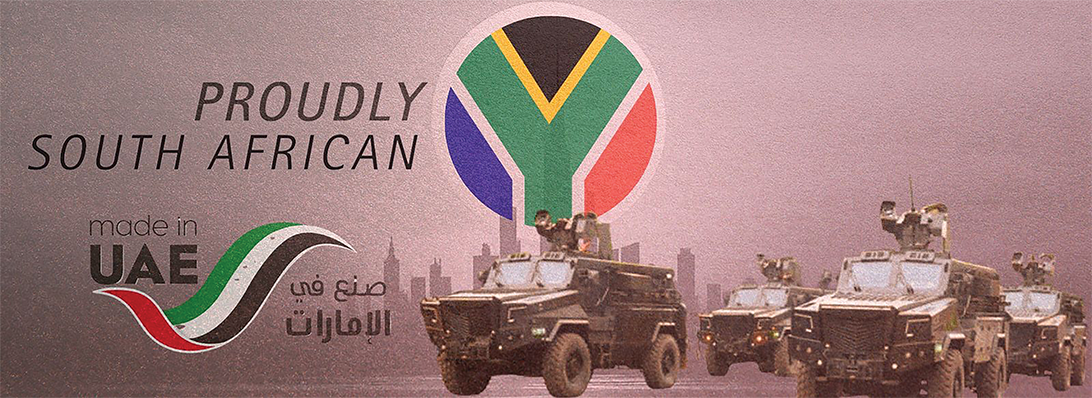
The United Arab Emirates (UAE) has been selling well-equipped armoured vehicles to African states under a confident “Made in Emirates” label. But a major investigation by the international watchdog Open Secrets—enabled by documents from a whistleblower—has revealed that these vehicles were designed in South Africa and built in the UAE by employees of Pretoria-based defence manufacturer Integrated Convoy Protection (ICP) stationed in the Middle East state.
The findings are contained in an explosive new report published yesterday, shortly after the Western Cape High Court lifted a temporary gag order that ICP had obtained earlier this month. The ruling opened the way for Open Secrets to release its months-long investigation into ICP’s exports to the UAE—an issue central to growing concerns about secrecy in the global arms trade and attempts to stifle public-interest reporting.
Open Secrets’ investigation is based on a trove of emails, trade documents, internal correspondence, and eyewitness accounts provided by a whistleblower referred to as “Casper”. The documents show that, while the vehicles are marketed internationally as Emirati products, they were in fact built from South African parts and know-how.
The vehicles, known as the Kasser II, were assembled in the UAE using components exported from South Africa and constructed by ICP staff flown into the country. According to Open Secrets, one of the central questions now under scrutiny is whether these exports were legally approved by South Africa’s arms-control regulator, the National Conventional Arms Control Committee (NCACC). Police are currently investigating.
“All this takes place in the context of the UAE sup porting warring factions in countries such as Sudan, whose people are the subject of an ongoing genocide,” Open Secrets states. The UAE has been repeatedly accused by international monitors of backing the Rapid Support Forces (RSF), a militia accused of mass atrocities.
SA Intellectual Property, UAE Branding
Although officially built by Abu Dhabi-based manufacturer M4 Industries, defence experts have long noted the uncanny resemblance between the Kasser II and the South African-made Reva V armoured personnel carrier (APC). The vehicles share nearly identical structural characteristics, with only minor aesthetic modifications.
In January 2025, DefenceWeb observed that Reva V vehicles “appear to be entering service in the Middle East as the Kasser II”. At the time, ICP responded that it could not disclose information about clients due to non-disclosure agreements but insisted it “only manufactured vehicles in South Africa”.
Open Secrets’ latest findings cast doubt on that claim. The organisation reports that ICP provided the intellectual property, parts, and manufacturing capacity for the Kasser II under a R775-million contract with the UAE’s International Golden Group (IGG). Production took place inside the UAE’s secretive free-trade zones—jurisdictions with limited oversight and high levels of confidentiality.
The report notes that ICP denies exporting weapons without proper permits. But Casper’s documentation strongly suggests the company shipped components designed specifically for armoured vehicles—items that should be classified as controlled under South African law.
ICP, also known as Reva Armoured Personnel Carriers, has supplied vehicles to conflict zones across the world. Its history traces back to founder Philippus Johannes “Flip” Marx, a former elite South African special forces operator who established the business in 2002. Marx led the company until 2022, when he suffered a severe stroke while in the UAE working on the IGG contract.
The company’s commercial breakthrough came during the United States’ 2003 invasion of Iraq, when global demand for mine-resistant vehicles skyrocketed. ICP emerged as a major supplier, building around 150 Reva V vehicles in South Africa and at temporary production facilities in Baghdad and Jordan. The company later boasted in a 2020 internal newsletter that most of these vehicles had survived the Iraq war and were redeployed for use by US law-enforcement agencies.
Beyond its military contracts, ICP manufactures armoured vehicles for South African security companies such as Fidelity and ADT, supplying patrol vehicles, cash-in-transit trucks, and units used in riot-control situations.
Its exports have reached countries including Iraq, Yemen, Somalia, Equatorial Guinea, Egypt, Nigeria, Thailand and the UAE. Vehicles have also been used domestically in South Africa.
A Network of Middlemen
Casper’s leaked documents paint a picture of a company that relied heavily on middlemen to secure international contracts. Key among these intermediaries was the Hirschowitz family—David Hirschowitz and his son, Dean. David served as a director at ICP from at least 2007 until his death in 2019.
The Hirschowitz family’s business dealings have intersected with high-level political networks. In 2019, court papers implicated David Hirschowitz in paying kickbacks to individuals linked to senior ANC politician Zweli Mkhize to secure Public Investment Corporation (PIC) funding for Hirschowitz’s Israeli company Tahal. Mkhize denied wrongdoing. The Dubai-related funding attempt failed, and the outcome of the case remains unclear.
Dean Hirschowitz did not respond to Open Secrets’ questions about his role in the IGG deal.
Were the Exports Legal?
At the heart of the investigation lies a critical legal question: Did ICP export controlled armoured-vehicle components to the UAE without proper approval? Under South African law, any item designed for military use—including parts and components—requires an export permit from the NCACC. ICP argues it legally exported full vehicles under earlier permits granted in 2015 and 2019 and that parts supplied under the 2020 contract were “off-the-shelf” or dual-use items that did not require permits.
But Open Secrets notes several indicators contradicting this claim:
• The 2020 contract title explicitly states that the parts were to be “assembled in the UAE under a new name (Kasser II)”.
• A 2021 letter from CEO Flip Marx required his sign-off for any technical changes to the Kasser II—showing clear design oversight.
• ICP staff were physically present in the UAE constructing the vehicles using the exported parts.
These details, Open Secrets argues, make it clear that the components were specially designed for military vehicles and therefore subject to export-control laws.
The NCACC did not answer detailed questions from Open Secrets about the permits but confirmed the matter “is receiving attention” and that police are investigating. The revelations expose a complex network of transnational arms production, regulatory loopholes, and opaque partnerships between private defence companies and states involved in active conflicts.
The High Court’s decision to dismiss ICP’s attempt to silence Open Secrets underscores a growing judicial concern about corporate secrecy and its impact on accountability in the arms-trade sector.
As Open Secrets director Hennie van Vuuren said after the judgment: “It’s ensured that corporations, including those involved in the global arms trade, cannot prevent public-interest investigations from being published”.
With the gag order lifted, the organisation says more disclosures will follow.- Additional reporting by GroundUp