 WeeklySA_Admin
CRISIS OF JUSTICE: The US abduction and prosecution of Venezuela’s president raises a troubling question: can justice exist when international law is violated to secure the accused?
By Alannah Travers
New York, US – On January 5 2026, the United States presented Nicolás Maduro before a New York court following what amounts to an extrajudicial military abduction.
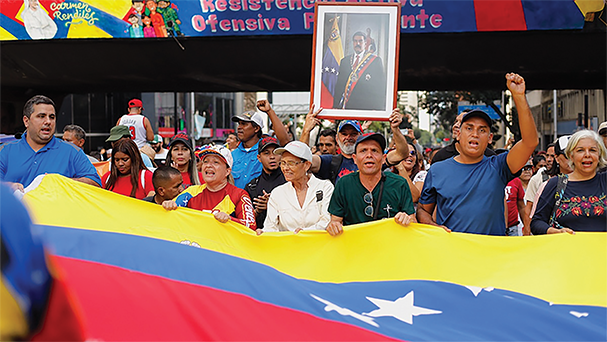
Maduro and his wife, Cilia Flores, were seized during a US operation lacking justification under international law and transported to the United States to face narcotics-related charges.
In doing so, US President Donald Trump bypassed international legal norms, the International Criminal Court (ICC), and the principle of state sovereignty. A narrow drug prosecution has been prioritised over a victim-centred reckoning for alleged crimes against humanity—crimes that have defined the Maduro era and devastated Venezuelan society.
A path to international justice cut short
In October 2025, the International Criminal Court prosecutor announced that Venezuela had made “no meaningful progress” in domestic accountability efforts. The ICC subsequently closed its Caracas office, signalling a possible shift toward international arrest warrants.
Weeks later, Venezuela’s National Assembly voted to withdraw from the Rome Statute, which the country ratified in 2000. This sequence of events has fuelled speculation that a sealed ICC warrant for Maduro—related to crimes against humanity—may already exist.
If confirmed, the situation would be legally and morally stark: a US administration that has sanctioned ICC judges would be holding a high-value suspect while preventing his surrender to face charges for mass atrocities. For Maduro’s victims, justice would once again be deferred—perhaps indefinitely.
An arraignment marked by force
At his arraignment, Maduro pleaded not guilty to charges of narco-terrorism, cocaine importation and illegal possession of machine guns. His wife appeared visibly injured. Defence counsel requested medical imaging for suspected fractured ribs allegedly sustained during the abduction.
Despite defence challenges to the legality of Maduro’s capture, the court proceeded under the Ker-Frisbie doctrine, a US legal principle that treats the manner of a defendant’s arrival before a court as irrelevant to jurisdiction—even if obtained through forcible abduction.
The Ker-Frisbie doctrine revived
The Ker-Frisbie doctrine originates from an 1886 case permitting the kidnapping of a fugitive from Peru to Illinois. It was reaffirmed in 1992, when the US Supreme Court ruled that abducting a Mexican national did not violate extradition treaties.
Its only significant limitation emerged in United States v Toscanino (1974), where jurisdiction was rejected due to kidnapping and torture by US agents. The Second Circuit—now overseeing Maduro’s case—held that jurisdiction may be declined if government conduct “shocks the conscience,” a threshold typically requiring evidence of torture or inhuman treatment.
In Maduro’s case, the injuries to Flores may yet test that boundary. But applying Ker-Frisbie to a sitting head of state places the US in direct conflict with customary international law, which recognises absolute immunity for incumbent heads of state from foreign criminal jurisdiction.
Maduro’s attorney, Barry J. Pollack, has argued that his client “is head of a sovereign state and entitled to the privileges that status ensures.”
UN Charter among the casualties
Just miles from the courthouse, the UN Security Council convened an emergency session to address the legality of the US operation, which reportedly deployed more than 150 aircraft in a strike on 3 January 2026.
Preliminary reports indicate that approximately 75 people were killed, including civilians and members of Maduro’s security detail. Most UN delegates expressed alarm at what appeared to be a unilateral act of aggression carried out without Congressional authorisation or a UN mandate.
UN High Commissioner for Human Rights Volker Türk warned that the intervention “damages the architecture of international security, making every country less safe.” He cautioned against the instrumentalisation of human rights to justify breaches of international law while sidelining those same rights when they do not serve geopolitical interests.
At stake is Article 2(4) of the UN Charter, which prohibits the use of force against the territorial integrity of any state. Legal scholars, including Professor Oona Hathaway, have argued that no valid legal basis exists for redefining drug trafficking as an “armed attack” sufficient to trigger self-defence.
The irony is acute: the abduction and strikes may themselves constitute the crime of aggression—defined at Nuremberg as the “supreme international crime.” Yet neither the US nor Venezuela is party to the ICC’s aggression jurisdiction, and any Security Council referral would be subject to a US veto.
A reckoning—or a pretext?
Outside the courthouse, legal abstractions collided with lived experience. For many Venezuelans in the diaspora, seeing Maduro in a Manhattan courtroom represented a long-awaited, if deeply conflicted, moment.
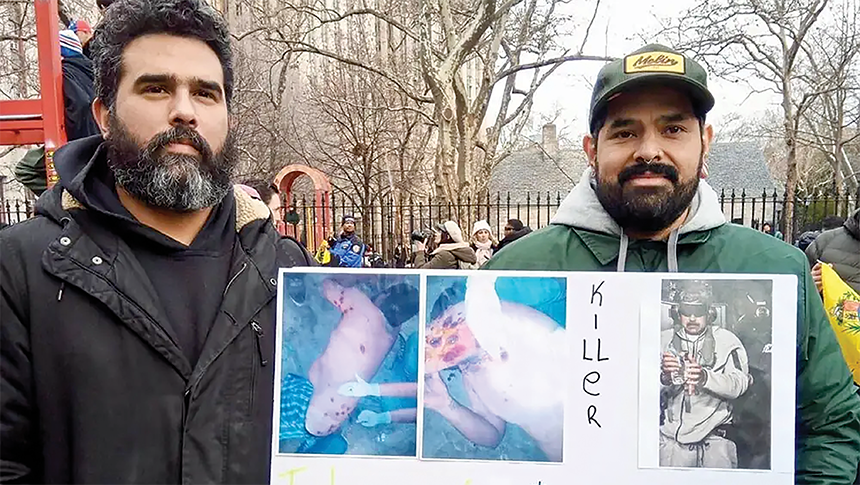
Pedro Reyes, 39, bears scars from the violently repressed 2014 protests. “I never saw the others detained with me again,” he said. For him and his friend Javier, now New York residents, the spectacle was bittersweet. Asked about the US prioritising drug charges over crimes they endured, Javier replied bluntly: “It’s not enough. But it’s something.”
Naomi Zambrano, 33, stood nearby holding her infant son. “Maduro is a killer,” she said, but expressed deep uncertainty—incertidumbre—about what comes next. She fears Venezuela could become a proxy battlefield drawing in China, Russia and Iran. “I worry my country will be treated like a mini-America,” she said, “by people who don’t understand us.”
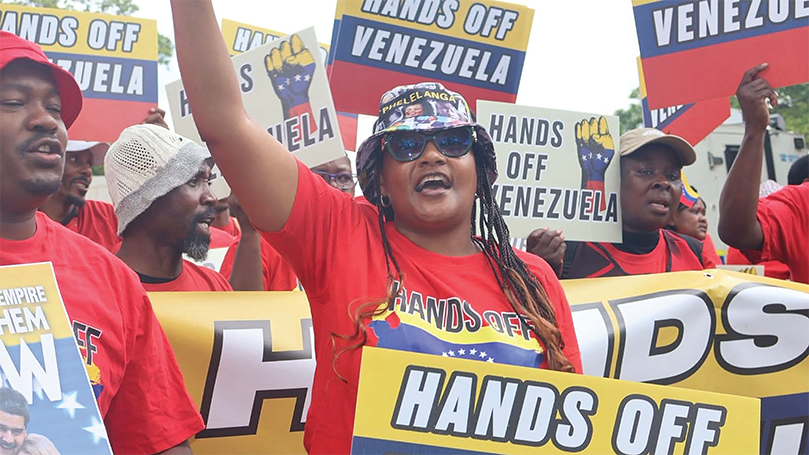
US veterans protesting nearby shared those concerns. Michael Carter of Common Defense asked pointedly: “If the US can kidnap Maduro, why can’t the EU kidnap Trump and take him to The Hague?”
Another protester, Sean Bogue, called the prosecution a “transparent bullying pretext,” drawing parallels with Iraq’s weapons-of-mass-destruction narrative. “We’ve seen what happens when we pretend to be liberators,” he said. “This could get worse for the Venezuelan people.”
What now for transitional justice?
Perhaps the most troubling absence from Monday’s proceedings was the absence of victims. The indictment addresses cocaine flows into US cities but ignores the systemic repression that led six states—Argentina, Canada, Chile, Colombia, Paraguay and Peru—to refer Venezuela to the ICC in 2018.
In 2021, ICC Prosecutor Karim Khan announced the opening of a formal investigation. That process has now been effectively sidelined.
By prioritising a narco-terrorism case enforced through military intervention, the US has displaced the possibility of a justice process owned by Venezuelans themselves. For victims of torture, arbitrary detention and extrajudicial killings, accountability must mean more than a drug conviction in Manhattan.
Whether 2026 becomes a year of genuine reckoning—or yet another chapter of gunboat diplomacy—remains uncertain. What is clear is that justice imposed by force risks becoming no justice at all. – Justice Info.net