 WeeklySA_Admin
AFTERMATH : Four years after devastating floods uprooted thousands of families, the handover of 2 600 houses at Cornubia marks a fresh start for survivors rebuilding their lives…
By Monk Nkomo
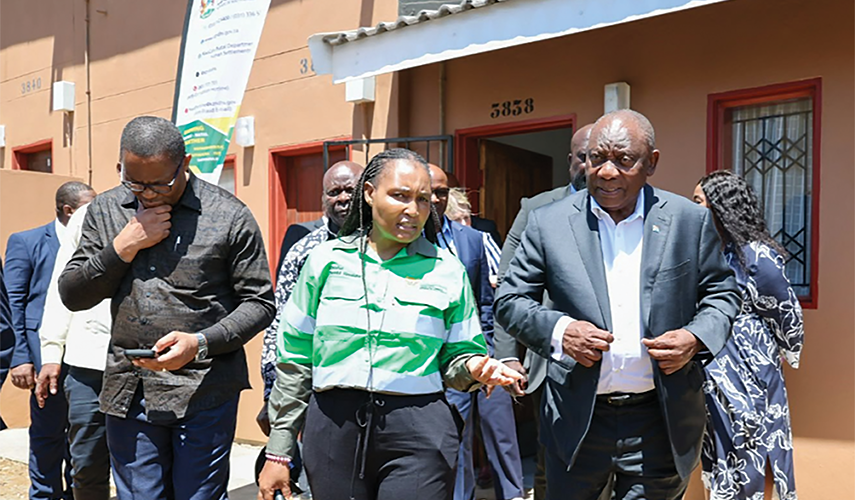
There were mixed emotions of joy and sadness this week as families displaced by the devastating KwaZulu-Natal floods of April 2022 received permanent homes at the Cornubia Integrated Human Settlement.
President Cyril Ramaphosa, who handed over 2 600 houses during a milestone celebration, said the completed Phase I project represented hope for families affected by the catastrophe.
The floods claimed more than 500 lives, left dozens missing and displaced about 40,000 people. Approximately 4 000 homes were destroyed, while schools, bridges, roads and healthcare facilities also suffered extensive damage. The total damage was estimated at R17 billion.
The development includes a permanent primary school named after executed ANC cadre Solomon Mahlangu, sports and community retail facilities, a multipurpose hall and a clinic. Plans also provide for early childhood development facilities and transport infrastructure.
Ramaphosa said phases IIA and IIB were under construction, while work on another 145 houses was launched this week. A total of 460 permanent homes are expected to be completed by mid-2027.
“This year we mark 30 years since the adoption of our Constitution which affirms the right of everyone to have access to adequate housing. Since the advent of democracy, government has delivered more than five million housing opportunities.”
He said housing must be within reach of schools, health services and transport, and close to economic opportunities and community facilities. This informed the government’s approach of building integrated human settlements.
Cornubia is expected to accommodate more than 110 000 people over the next 10 to 15 years.
“Human settlements must reverse the legacy of apartheid spatial planning. That planning forcibly displaced black communities to townships and settlements on the edge of this city. It placed them far from economic opportunity and place of work.”
In the immediate aftermath of the 2022 floods, the government provided shelter for displaced families, initially in mass care centres and later in temporary emergency accommodation.
Conditions were cramped, transport was difficult to access and many learners had to travel long distances to school. Ramaphosa said the government had been determined to find a permanent solution. The provincial government identified the Cornubia Housing Development as part of that response. “Today, they receive a permanent home they can call their own,” he said.
Beyond Cornubia, more homes had been built across KwaZulu-Natal to accommodate flood survivors. Ramaphosa stressed that emergency accommodation must never become a permanent way of life: the ultimate goal must be housing that restores dignity.
Construction jobs created
He said census figures showed that the proportion of households living in formal dwellings had increased from 65% in 1996 to more than 88% in 2022.
Few countries had provided housing on this scale, he said. Nevertheless, demand remained substantial, with population growth and rapid urbanisation contributing to nearly four million individuals remaining on the national housing needs register.
Ramaphosa acknowledged that too many houses built in the early years of democracy were far from jobs and services. The government had therefore sought to develop integrated neighbourhoods that brought homes, schools, clinics, shops, parks and transport together. Such settlements accommodated people of different income levels, reduced the time and money spent travelling to work and helped build communities.
The President commended eThekwini Municipality for upgrading wastewater treatment and electricity capacity, building a clinic and a pedestrian bridge over the R102, and advancing work on major nearby interchanges.
He also welcomed progress on Phase I of the Cornubia Business Park, now under construction. Construction had already created about 300 jobs, while the wider project was expected to generate more than 2 000.
Ramaphosa appealed to residents to protect their homes, public facilities and infrastructure.
“Today, we reaffirm that the path from emergency accommodation to permanent housing must be completed with urgency, fairness and transparency. Let us finish what we started here. Let us make sure that no family is left waiting. Let us continue building Cornubia as a place of dignity, opportunity and belonging.”