 WeeklySA_Admin
Poverty: The important instrument to ensure universal quality health access for all in South Africa…
By Monk Nkomo
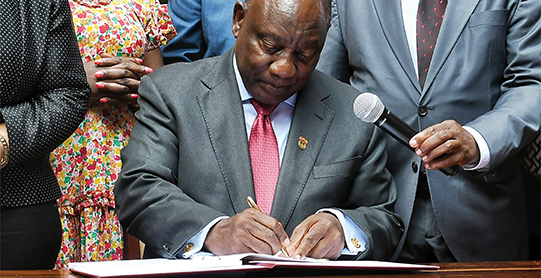
Determined to eradicate inequality and all forms of racism to which Black people had been subjected to for hundreds of years, President Cyril Ramaphosa this week signed the National Health Insurance (NHI) Bill into law amid protests and threats to challenge the Bill in a court of law.
The NHI was an important instrument to tackle poverty, said Ramaphosa . This was a milestone in the country’s ongoing quest for a more just society. The implementation of the NHI would be done in a phased approach, with key milestones in each phase, rather than an outright event.
‘’ The National Health Insurance is a commitment to eradicate the stark inequalities that have long determined who receives adequate healthcare and who suffers from neglect. We all need to embrace a future where healthcare is a shared national treasure, reflective of the dignity and value we accord to every South African’s life.’’
Ramaphosa also reminded all and sundry that South Africa was a country governed by the rule of law in which no person may be unduly deprived of their rights. ‘’ We are gathered here today to witness the signing into law of the National Health Insurance Bill, a pivotal moment in the transformation of our country’’.
This transformational health care initiative gave further effect to the country’s constitutional commitment to progressively realise access to health care services for all its citizens.The provision of health care in this country, Ramaphosa added, was currently fragmented, unsustainable and unacceptable. ‘’By putting in place a system that ensures equal access to health care regardless of a person’s social and economic circumstances, the NHI takes a bold stride towards a society where no individual must bear an untenable financial burden while seeking medical attention.
This vision is not just about social justice. It is also about efficiency and quality’’. The signing of the Bill into law has been met with mixed reactions with the Democratic Alliance announcing that it would challenge the Bill in a court of law .
The Democratic Nursing Organization of South Africa (Denosa), supported the NHI. ‘’ Everyone has equal access to quality healthcare on the basis of their health needs and not on the basis of how deep one’s pocket is’’, said spokesperson, Sibongiseni Delihlazo. Business Unity of SA, said the Bill in its current form, was unworkable, unacceptable and not in line with the Constitution. The SA Health Professionals Collaboration expressed disappointment over the signing of the Bill into law. Action SA said the NHI was going to open up a loophole to budgetary irregularities that will enable corruption and collapse the healthcare system even further. Ramaphosa said the public sector served a large majority of the population, but faced budget constraints. The private sector served a fraction of society at a far higher cost without a proportional improvement in health outcomes.
‘’Addressing this imbalance requires a radical reimagining of resource allocation and a steadfast commitment to universal healthcare, a commitment we made to the United Nations.
The real challenge in implementing the NHI lies not in the lack of funds, but in the misallocation of resources that currently favours the private health sector at the expense of public health needs.
The NHI Bill presents an innovative approach to funding universal healthcare based on social solidarity’’. The financial hurdles facing the NHI, according to Ramaphosa, could be navigated with careful planning, strategic resource allocation and a steadfast commitment to achieving equity. The NHI carried the potential to transform the healthcare landscape, making the dream of quality, accessible care a reality for all its citizens.
The NHI Fund will procure services from public and private service providers to ensure all South Africans have access to quality health care. It recognised the respective strengths and capabilities of the public and private health care systems. It aims to ensure that they complement and reinforce each other. ‘’The effective implementation of the NHI depends on the collective will of the South African people. We all need to embrace a future where healthcare is a shared national treasure, reflective of the dignity and value we accord to every South African life. The NHI will make health care in the country as a whole more affordable’’.
Through the NHI, the government planned to improve the effectiveness of health care provision by requiring all health facilities to achieve minimum quality health standards and be accredited.
Following the signing of this Bill, they would be establishing the systems and putting in place the necessary governance structures to implement the NHI based on the primary health care approach.
Ramaphosa said there been much debate about this Bill. Some people had expressed concern. Many others had expressed support. What we needed to remember was that South Africa was a constitutional democracy. The Parliament that adopted this legislation was democratically-elected and its Members carried an electoral mandate to establish a National Health Insurance.
‘’We are a country that has been built on dialogue and partnership, on working together to overcome differences in pursuit of a better life for all its people’’.