 WeeklySA_Admin
SERVICE: SA envoy assures them they, like all foreigners, will be protected by the country’s state agencies
By OWN CORRESPONDENT
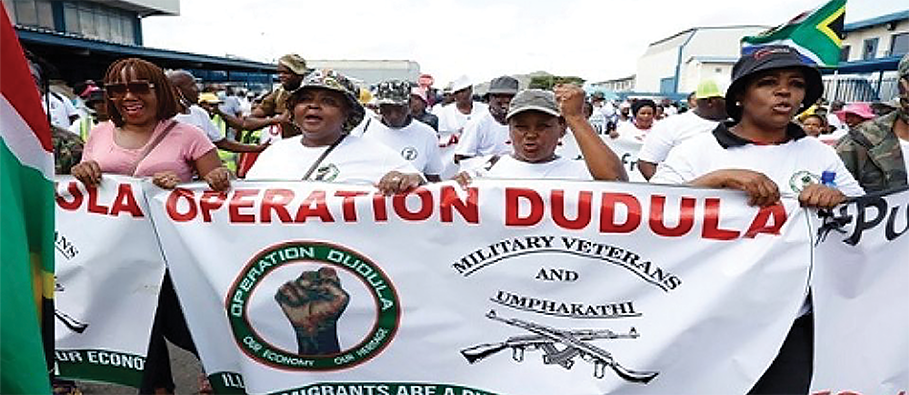
The South African High Commission in Maputo has guaranteed that Mozambicans living in South African territory will be protected by local authorities against attacks linked to the so-called ‘Operation Dudula’.
High Commissioner Puleng Chaba went on to affirm that the Pretoria government would hold criminally responsible all those involved in the movement, which in recent weeks has led to the expulsion of foreigners and restrictions on their access to basic services.
For three weeks, activist groups and some local communities have been carrying a xenophobic campaign nicknamed ‘Operation Dudula’ aimed at preventing foreigners, including Mozambicans, from seeking care in public hospitals and attending schools, in addition to promoting their expulsion from neighbourhoods.
Distancing himself from these practices, Puleng Chaba emphasised that the South African government did not support this violence, but believed that social and economic problems should be resolved through dialogue.
“The government does not support this type of approach. We have always been known as a government that seeks to negotiate and discuss problems in an attempt to resolve them.
We do not encourage crime, we do not encourage violence, but rather the enforcement of the law,” the diplomat stated.
The high commissioner stressed that all those involved in ‘Operation Dudula’ would be brought to justice and reiterated that state institutions had already been mobilised to ensure stability.
“The [South African] government will certainly use all its power to ensure that those involved are held accountable. Our goal is to continue building a society that deals with problems through dialogue and negotiation,” he added.
Chaba also assured that Mozambicans and other foreign citizens would have the same protection as South African nationals, urging that any incidents be immediately reported to local authorities.
“Mozambicans, like all foreigners, will be protected by our state agencies. They must remain calm and report incidents,” he said.
Regarding reports of deprivation of access to basic services, the ambassador assured that the government has mobilised resources to mitigate the impacts and ensure that affected communities are not left helpless while the situation is resolved.
Meanwhile, South Africa’s National Department of Health has criticised protests by Operation Dudula and other civic groups targeting healthcare facilities.
Three Operation Dudula members are on free bail a fortnight ago after allegedly storming a clinic in the south of Johannesburg early this month.
Health Department spokesperson Foster Mohale said the department had reached out to the group’s leadership for dialogue in an effort to resolve the matter.
“We have since reached out to the leadership of Operation Dudula for a sit-down meeting in order to find long-lasting solutions to these challenges. Of course, this is a societal issue, it is not mainly about health, but we believe that with sober minds we can find lasting solutions,” Mohale was quoted as saying by IOL.
The department has stressed that public healthcare services in SA are available to all who need them, regardless of nationality.
Today, according to an IOL report, National Police Commissioner General Fannie Masemola acknowledged that the South African Police Service (SAPS) does not possess a specialist unit to confront the growing threat posed by Operation Dudula and similar groups targeting undocumented foreign nationals within public health facilities.
Masemola confirmed that, while there was no dedicated task force for Operation Dudula, the police were relying on their Public Order Policing (POP) division to manage disturbances whenever they arose.
“On Operation Dudula, we don’t have a unit specifically to deal with them. We have Public Order Policing (POP) countrywide, and their job is to deal with crowd management,” Masemola told IOL.
The Public Order Policing units are tasked with managing protests and major public gatherings, but they cannot be present in clinics at all times.
“They cannot wait at a clinic in case something happens – they have a lot of other work to do. But as and when we indicate that there may be a problem, we will respond to those health institutions accordingly,” Masemola added.
Meanwhile, the national debate on illegal immigration is being dangerously distorted by vastly inflated figures and the rise of unlawful vigilantism, the head of a prominent think tank warned this week, calling for a return to evidence-based policymaking and a firm defence of state authority, according to a report in the Sunday Tribune. This sentiment was echoed by a Parliamentary committee chairperson who issued a specific rebuke of Operation Dudula’s threats to target schools.
Sunday Tribune reports that Daryl Swanepoel, chief executive of the Inclusive Society Institute (ISI), issued his warning during a Parliamentary Social Services Cluster briefing. He argued that the widespread circulation of unsubstantiated statistics was fueling social tension and undermining rational discourse. – Source: O País