 WeeklySA_Admin
SCRUTINY: On a high-stakes African tour through some of the continent’s most entrenched regimes, Pope Leo XIV walked a delicate line, challenging power without legitimising it, and raising a deeper question: can moral authority shift political reality?
By Zahra Rahmouni
They say there is no point preaching to the converted. On his recent African tour, Pope Leo XIV appeared to take the opposite approach—delivering difficult truths directly to those least inclined to hear them.
His visits to Algeria, Cameroon, Angola and Equatorial Guinea immediately drew scrutiny. For human rights advocates, the itinerary raised uncomfortable questions. Why visit Algeria while political detainees remain imprisoned for expressing dissent? Why stand beside Cameroon’s President Paul Biya, in power for over four decades, or Equatorial Guinea’s Teodoro Obiang Nguema Mbasogo, who has ruled for nearly half a century?
The concern was clear: does such a visit risk conferring legitimacy on authoritarian regimes?
The pope has done his part. What remains is whether
Africa’s leaders will listen—or simply absorb the moment and carry on…
Yet, Leo XIV did not arrive as a silent guest. Instead, he walked a careful line, keeping formal distance from political establishments while engaging meaningfully with ordinary citizens. Known for his reserved style, the pope revealed a more assertive moral voice across the continent. He has described himself as a “son of Saint Augustine,” and his decision to visit Algeria early in his pontificate carried symbolic weight. The country, where Catholics number only around 8 500, is not an obvious pastoral priority. But it was precisely this marginal setting that gave his message sharper resonance.
Before his arrival, organisations such as Human Rights Watch urged him to confront Algeria’s record on religious freedom and civil liberties, particularly the closure of Protestant churches. While the pope avoided direct public confrontation on these issues, his message was unmistakable. Standing before President Abdelmadjid Tebboune, he urged leaders “not to dominate, but to serve.”
It was a subtle but pointed intervention in a country still grappling with the leg acy of the Hirak protests, where hundreds remain imprisoned for their role in peaceful demonstrations. Leo XIV did not name names—but he did not need to.
Logic of exploitation
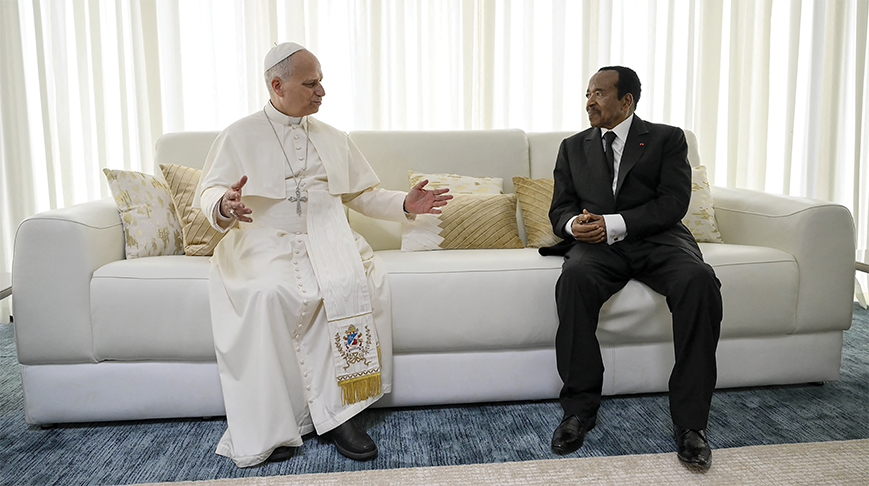
The same pattern unfolded in Cameroon. Addressing President Biya, recently re-elected amid violence and controversy, the pope spoke bluntly about corruption, describing it as a form of “idolatry.” He called for transparency, accountability and the rule of law—remarks delivered within arm’s reach of one of Africa’s longest-serving leaders.
Then came a moment that raised eyebrows: the state broadcaster abruptly cut the live feed of his speech. Officials blamed a technical fault, but the explanation was contradicted by the country’s own network operator. Whether deliberate censorship or coincidence, the interruption only amplified the significance of what had been said. In Angola, Leo XIV’s tone sharpened further. Speaking before a crowd of 100 000 faithful, he condemned the “logic of exploitation” that allows resource-rich nations to remain mired in poverty. It was a direct challenge to both domestic elites and foreign corporations profiting from the country’s oil and diamond wealth.
One-third of Angolans live in poverty despite vast natural resources—a contradiction the pope laid bare. His words appeared to resonate, at least symbolically. In the days following his visit, the government announced emergency relief measures for families displaced by flooding. A modest step, perhaps, but one that suggested a temporary shift in focus toward the vulnerable.
His final stop, Equatorial Guinea, carried the heaviest political weight. Here, Leo XIV confronted the paradox of a deeply Catholic society governed by one of the world’s longest-serving leaders. In a country of just two million people, the Church’s influence is immense—and complicated.
The pope used that platform to speak out against the global scramble for resources, warning that the pursuit of oil and minerals continues to fuel conflict and undermine self-determination. His message was universal, but its local implications were unmistakable.
Yet, the visit was not without controversy. Reports suggested that civil servants and soldiers had their wages reduced to fund preparations, while students were allegedly required to purchase uniforms for the occasion. Such accounts fed into a broader criticism: that papal visits, however well-intentioned, risk becoming tools of political theatre.
Critics argue that the presence of a global religious leader can inadvertently bolster the legitimacy of authoritarian regimes. Cameroonian theologian David Tonghou Ngong has gone further, suggesting that the Catholic Church has historically provided moral cover to entrenched leadership, particularly in moments of political vulnerability.
From this perspective, the pope’s visit—especially in conflict-affected regions—could be seen as strengthening the very systems it seeks to challenge. But that interpretation is not universally shared. In Cameroon’s Anglophone region, separatist groups declared a temporary ceasefire during the pope’s visit. Leo XIV travelled to Bamenda, the heart of the crisis, and called for reconciliation and peace. For some observers, this alone marked a meaningful intervention.
Journalist Eugene Ndi offered a more optimistic reading. The pope, he argued, spoke plainly and directly to power. By placing responsibility squarely on the shoulders of political leaders, he shifted the burden of action back where it belongs. And that may ultimately be the point.
Leo XIV’s tour did not produce dramatic policy shifts or immediate political reform. It was never likely to. The machinery of entrenched power does not yield easily to moral persuasion.
Diplomatic ambiguity
But the visit did something more subtle—and perhaps more enduring. It disrupted the script. By speaking openly in front of those in power, rather than about them from a distance, the pope reframed the conversation. He denied leaders the comfort of diplomatic ambiguity. He made silence harder to justify. At the same time, he avoided becoming a political actor himself. There were no grand gestures of confrontation, no direct endorsements of opposition movements. Instead, he relied on the weight of moral authority—an increasingly rare currency in global politics.
Whether that is enough remains an open question. Africa’s political landscape is shaped by complex histories, economic pressures and deeply entrenched systems of power. A single visit, however symbolic, cannot undo decades of structural inequality or governance failures. But symbolism matters. In societies where dissent is often suppressed, even carefully worded criticism can create space—however small—for broader conversations about accountability, justice and leadership.
Leo XIV’s African tour may not have transformed governments. But it has sharpened expectations. The real test now lies with those who were listening—not in the crowds, but in the presidential palaces.
The pope has spoken. Whether his words take root—or are quietly absorbed and forgotten—will depend on what happens next. – Africa is Country
Zahra Rahmouni is an independent French-Algerian journalist who covers Algerian political, economic and social news
Comment
Migration: fear, failure and distortions
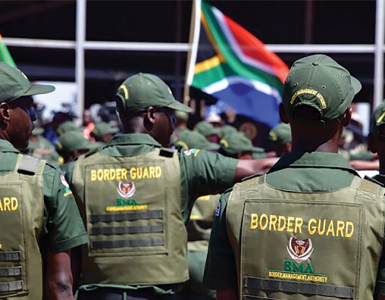
South Africa’s rising tide of anti-immigrant sentiment did not emerge in a vacuum. It is the product of a combustible mix of economic frustration, governance failure and political opportunism. But while the anger may be real, its target is dangerously misplaced. At the heart of the issue lies a simple truth: the state has lost control of key aspects of migration management. Porous borders, inconsistent enforcement of immigration laws and a sluggish, often dysfunctional asylum system have created a perception — and in some cases a reality — of disorder. Communities see this and draw their own conclusions. When systems fail, suspicion fills the gap.
Yet, it is here that the first distortion takes root. The failure of the government to manage migration effectively does not justify the persecution of migrants themselves. It is a leadership problem, not a human one. Economic pressure is the second accelerant. South Africa’s persistently high unemployment rate, particularly among the youth, has created a climate of deep insecurity. In such an environment, competition for scarce opportunities — whether real or perceived — becomes a flashpoint. Informal trading spaces, low-skilled jobs and small business niches often become the visible battlegrounds.
But the narrative that migrants are “taking jobs” is, at best, incomplete. Many migrants operate in sectors where local participation is limited or bring entrepreneurial energy that sustains township and inner-city economies. The deeper issue is not who occupies these spaces, but why the economy is failing to create enough opportunities for all. Crime further complicates the picture. In communities already burdened by violence and lawlessness, the presence of undocumented individuals can heighten fears, fairly or unfairly. Criminal networks do exploit weak border controls. That reality cannot be ignored.
However, conflating criminality with migration as a whole is both inaccurate and dangerous. It shifts focus away from policing failures and allows systemic issues to fester. What we are witnessing, then, is not simply xenophobia. It is the misdirection of legitimate grievances. Anger that should be aimed at ineffective governance, stalled economic reform and inadequate policing is instead turned on the most vulnerable. Political actors have not helped. Some have chosen to inflame tensions, presenting simplistic solutions to complex problems. This may yield short-term support, but it risks long-term social fracture.
South Africa stands at a crossroads. Restoring order to migration systems, securing borders and ensuring fair, efficient legal processes are essential. So too is rebuilding an economy that offers dignity through work. But none of this will be achieved through scapegoating. History has shown that fear-driven movements burn brightly but briefly. The real test is whether leadership can rise above the noise — to address the causes, not just the symptoms, of public anger.
Because in the end, a nation that turns on the vulnerable does not solve its problems. It deepens them.