 WeeklySA_Admin
GRAFT: In The Super Cadres, author Pieter du Toit examines the legacy from the early halcyon days the democracy through to what he terms a disappointing Ramaphosa presidency…
By Jacob Mawela
From the author of 2019’s bestselling non-fiction tome, The Stellenbosch Mafia, follows the just hot-off-the-press The Super Cadres: ANC Misrule in the Age of Deployment, a critique on how state capture exposed the ills of cadre deployment.
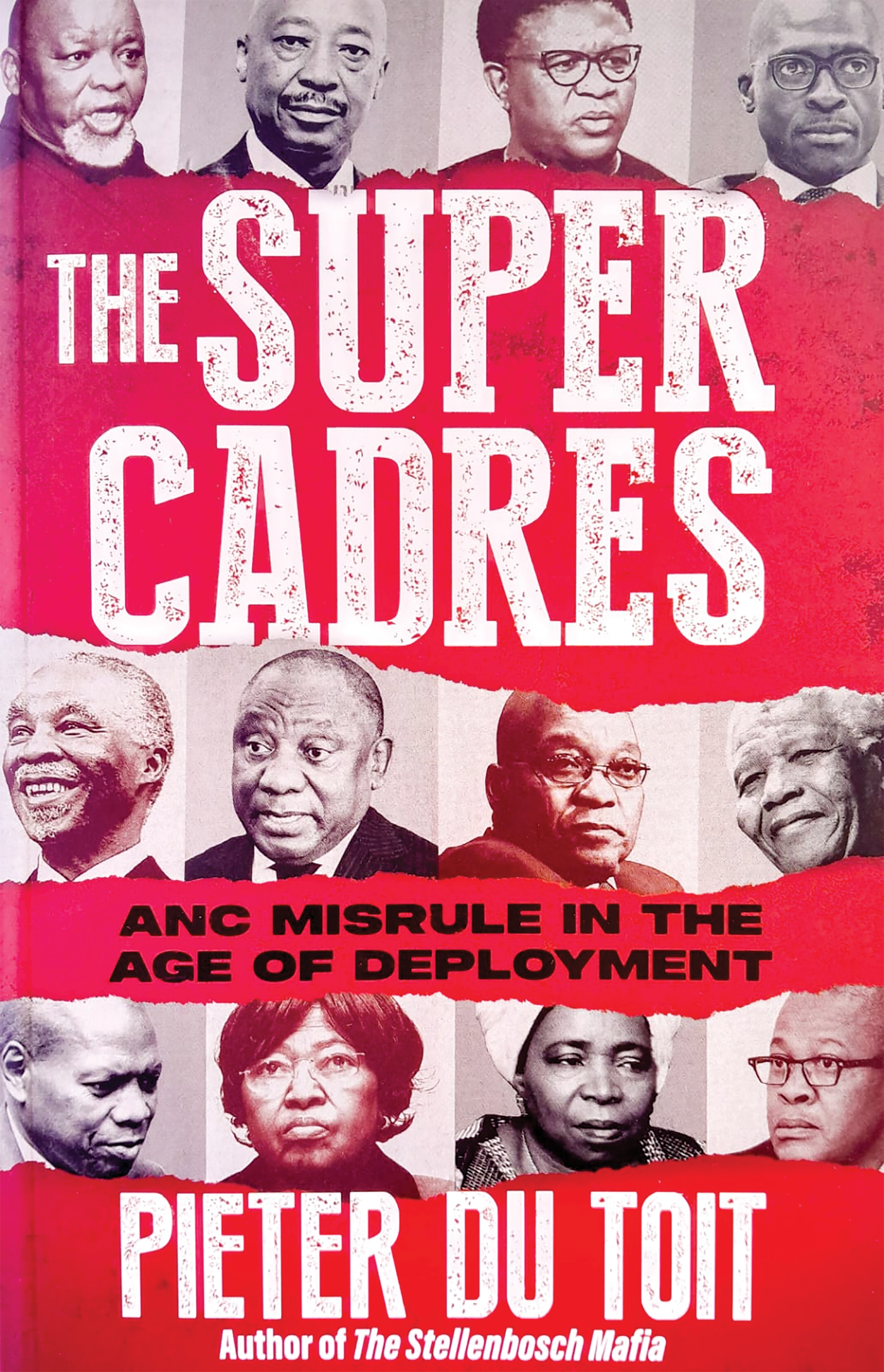
Written by NEWS24 journalist Pieter du Toit, the revelatory literature references documented history and the author’s observations of the past 30 years of the democratic epoch, to reveal how Nelson Mandela and Thabo Mbeki laid the foundation for complete ANC control of the state; how Jacob Zuma’s faction exploited it and why Cyril Ramaphosa was complicit in the subsequent destruction.
In exploring how an ex-liberation movement which regarded itself as the proxy of disenfranchised Africans’ aspirations for freedom from apartheid ended up falling from grace, as proven by its electoral decline to 40.18% in the recent May 29, 2024 polls after garnering successive parliamentary majority margins since the watershed April 27 1994 elections – Du Toit drew upon inputs of fellow journalists, historians, political analysts, politicians and even ANC apparatchiks, et al!
Du Toit’s offering focuses on the ANC’s policy of cadre deployment, which he identifies as the cause of the party’s 30 year-long descent to misrule, corruption and state capture.
In tracing signs of what would had caused an organisation which once boasted moral authority, to find itself, post-1994, entangled in ignominy, the author mentions historian Stephen Ellis – author of External Mission, the chronicle on the history of the organisation in exile – who cited an ANC cadre who revealed that during the exile years “some leaders were using ANC personnel and facilities to indulge in illegal activities such as drug smuggling, car theft and illegal diamond mining.” “Smuggling convoys were even protected by soldiers from uMkhonto we Sizwe,” the source allegedly divulged.
Quoting Tim du Plessis – a journalist who covered South Africa’s apartheid era and the transition to democracy and beyond – the veteran reporter, with Ellis’ insights about the organisation, claimed that back in 1994, there’d been no sign whatsoever that it would turn out to occupy the centre of misrule and state capture.
According to du Plessis, when the newly installed President Nelson Mandela addressed a throng around Cape Town City Hall on May 9 1994 and averred: “We place our vision of a new constitutional order for South Africa on the table not as conquerors prescribing to the conquered”.
Mandela himself and fellow colleagues were convinced of the ANC’s bona fides and reported its steering of the new dispensation thus!
Collating the administrative records of the tenures of the quartet of state presidents (Mandela, Mbeki, Zuma and Ramaphosa) drawn from ANC’s ranks since 1994 to 2024, and commencing with Mandela, Du Toit observed that despite his assurance during the May 9 speech that “the government will not govern the country as it pleases”.
Mandela assented to the implementation of the ANC’s policy of cadre deployment, with corruption and avoidance of accountability becoming part of the party’s culture during his presidency – an unfolding of events then parliamentary opposition leader Tony Leon observed thus: “Warning bells rang loudly during Mandela’s term but he did not do much to answer the alarm”.
As examples of the venerated statesman’s apparent complicity, the writer mentions scandals such as the R143 billion Strategic Defence Procurement Package arms deal (which ended up in an ANC cover-up); Mandela’s defence of his then cabinet ministers, Nkosazana Dlamini-Zuma in the R14.3 million Sarafina 2 HIV/Aids awareness play scandal and cover-up of corruption claims against Stella Sigcau involving gaming mogul Sol Kerzner; as well as his apparent defence of cleric Dr Allan Boesak, by calling charges against his misappropriation of funds “baseless”.
Regarding Mbeki, Du Toit places the incumbent as the enforcer of a policy whose implementation was expedited by the promulgation of the Public Service Amendment Act in 1999, resulting in the deployment of ANC apparatchiks into every leadership position across the state. To this extent, Du Toit quotes IDASA’s Dr Frederick van Zyl Slabbert as having said Mbeki used ‘authoritarian and undemocratic’ methods to entrench his control of party and government – in order to realise his vision of a South Africa to achieve the objectives of the National Democratic Revolution. The system ensured that the party’s rent-seeking (the practice of individuals financial profiteering from positions in government and the public service) culture flourished through the placing of cadres in all strategic positions in the state such as cabinet, civil service, agencies such as the National Prosecuting Authority, parastatals such as Eskom and the SABC.
The author recalled that, once entrenched with his acolytes at the helms of the party and government, Mbeki proceeded to taint his legacy through his intransigence on the HIV/Aids crisis which resulted in an estimated 320 000 people (who included his then spokesperson, Parks Mankahlana and ANC big hitter Peter Mokaba) dying of the pandemic. The author says Mbeki made such an impression among a so-called consultative group composed of Black elites that when disapproving individuals – among them Barney Mthombothi and Moeletsi Mbeki – started pushing back against the ANC’s excesses, their dissent was apparently simply ignored!
Came Jacob Zuma’s turn, the ANC co-opted South Africa into an epoch of state capture and misrule which manifested in the dissolution of the Scorpions; “dismantlement of SARS”; capture of crucial parastatals; mollycoddling with the Gupta brothers; adverse classification by international ratings agencies of South Africa’s status as junk; tolerance of ‘tenderpreneurism’; the building of Zuma’s multimillion-rand Nkandla homestead with public money; all of which, concluded du Toit, rendered Zuma the worst leader the country had produced in any era! As for Cyril Ramaphosa, Du Toit’s exposé places him in the driving seat of cadre deployment as well as the machinations of the ANC’s parliamentary capture, with the journalist tracing his involvement to 1994 when, as ANC secretary-general, he compelled party MPs to sign a code of conduct which forbade any “attempt to make use of parliamentary structures to undermine the ANC’s decisions and policies”.
Came 2012, as the party’s recently elected deputy president, he’d be appointed to a five-year term as head of its deployment committee upon which he allegedly pledged to do his damnedest to ensure Zuma’s bidding – rhetorically promising: “We are going to get some of the best attributes coming through from our cadres, who will have total commitment to their service of South Africa”.
Alas, despite his committee’s meddling in executive structures of parastatals – the interventions became key to state capture by those beholden to the Guptas or other criminal networks.
The abrupt ditching of the Reconstruction and Development Programme (through which the ANC promised its supporters the provision of millions of jobs, houses, piped water and electricity) after two years due to its being deemed unworkable; the devaluing of the State’s biggest shares on the JSE by R290 billion upon the ill-advised appointment of Desmond van Rooyen as finance minister; t ANC proxy Chancellor House’s scoring of R97 million, through interference in the tendering process, from BEE partner Hitachi’s R38.5 billion winning bid to supply Eskom with boilers for the Kusile and Medupi power stations – these and more are resuscitated in Du Toit’s account.
On the afternoon of May 30 2024, Du Toit observed Gwede Mantashe, he pronounces as being responsible for the misrule of South Africa since 2007, cutting a forlorn figure whilst disconsolately scanning the results board at the IEC results centre at Gallagher Estate – which confirmed the ANC’s electoral decline to 40.18% in the May 29 polls!
* A trade paperback, The Super Cadres is published by Jonathan Ball Publishers. Available at leading bookstores countrywide, it retails for R330