 WeeklySA_Admin
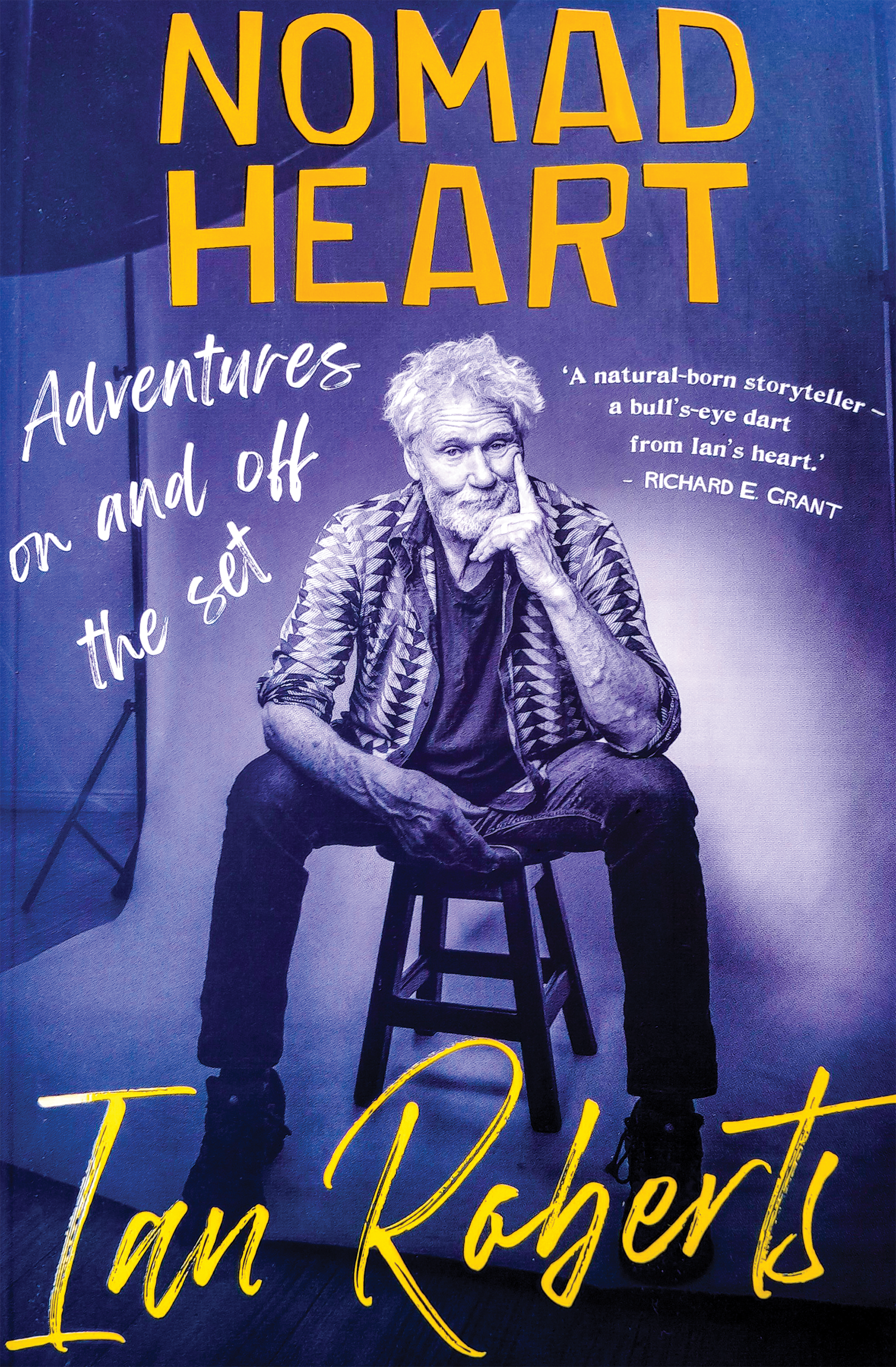
NOMADIC: A wonderfully woven tale of the renowned South African showbiz celebrity’s tumultuous journey – from running a helter-skelter and directionless life to settling for a truly enriching TV and film acting career…
By Jacob Mawela
“You would only be allowed to fill out an application form after you have walked alone on foot, let’s say from Madrid to Kiev, a distance of about five thousand kilometres. While walking, write. Write about your experiences and give me your notebooks. I would be able to tell who had really walked the distance and who had not.”
These words – of German film director, Werner Herzog – were in response to him being asked whether he would consider starting a film school.
In turn, South African thespian-cum-musician Ian Roberts recounts in his autobiography that he has always responded pretty much the same way to young people’s constant queries about how to become an actor.
Very few South Africans, of whichever pursuit, can claim the mantle of being household names as the farm-raised Roberts – from his casting in numerous Afrikaans television dramas since the commencement of his enduring acting career, to his instant recognition as one of the stars (as Boet) of the local Castrol television commercials.
Even very few local entertainers can boast a versatile résumé, including being a theatre actor-director-playwright as well as a guitar-strumming member of the music band Radio Kalahari Orkes.
To the zenith of involvement in theatre and film productions with Academy Award-nominated actor, Richard E Grant (of Game of Thrones-fame) and Patrick Swayze (with whom he featured in the film, King Solomon’s Mines), Roberts’ pre-fame existence had developed under the care of his parents and companionship of three siblings, an older brother and sister and kid sister, on the farm Baddaford Citrus Estates in the rural Eastern Cape.
Beyond his childhood domestic cocoon, initial impressions of his fledgling experiences were augmented by his companionship with Xhosa[1]speaking Coloured boys from the farm labourers’ community he refers (himself included) to as ‘Hunter-Gatherers’, the curiously-named Pieter Trompetter, Pese and Kununu Piet and Djonni Kieghlaar.
A quartet Roberts describes as descendants of Khoi soldiers granted land by the British for assisting them fight Xhosas during the Frontier Wars, their association (which comprised adventures such as bush camping along with a Wilson’s toffees-loving baboon); with the English-speaking future actor would result in him becoming fluent, aged six, in the Xhosa language.
His taste for acting – and probably storytelling ability – emanated from encounters such as with his fellow Hunter-Gatherers around the labourers huts’ campfires where he would listen to stories being told.
Although ‘the son of the lord of the manor’ (his dad, Llewellyn co-owned and managed the farm), the young Roberts preferred to spend most of his time among the huts around where some of his memory trove entailed: the 9-year-old guitar-playing ‘chief of the tribe’ and two of his Hunter-Gatherers forming a music trio which played for pennies at ‘tea meetings’ at the huts’ weekend gatherings. His account includes reminiscences about sipping of sweet tea from jam tins and imbibing of excessive sweet Jerepigo wine, witnessing a worker’s stabbing to death during a rugby match fracas on his family’s farm; beholding a Black worker’s open and loud vocal jubilation at the roadside’s kiosk, upon learning of news of Prime Minister Hendrik Verwoerd’s assassination.
After primary schooling at St Andrews Preparatory School in Grahamstown, where he first learnt that acting was a career and wrote and produced his first play aged 10, and high school at St Andrew’s College, where he had to break with his clan’s tradition by quitting rugby after incurring a serious injury and almost got expelled for an infringement in his last year.
Thereafter, Roberts served a year’s national service in the then South African Defence Force posted at Voortrekkerhoogte, where he once had to summon the boxing skills he had earlier on honed during his years at St Andrew’s in order to annul the arrogance of a loud-mouthed Southern Transvaal champion who used to repeatedly taunt opponents in Afrikaans thus: ‘Is daar Niemand in hierdie f – – ken kamp wat my kan aanvat nie?’ (Is there no one in this f – – ing camp who can take me on?)
The period between his discharge from the army at the end of 1971, to enrolling for a BA in Speech and Drama at Rhodes University in early 1976 had Roberts dabbling in activities which included studying photography at the College for Advanced Technical Education in Port Elizabeth and working at different places and various occupations such as an apprentice quantity surveyor for a construction company, then building the University of Port Elizabeth’s new library; a manager of a factory; a travelling salesman selling books and magazines subscriptions, as well as a farmer.
This was during a time when Roberts intimates that he didn’t yet know what he wanted to become in life. As the machinations of destiny would have it, while working as a manager of a clothing store in PE, he happened to notice a newspaper advertisement (he mentions that it was ‘calling me . . . it was as if it had my name on it’) for auditions for a play titled, “What the Butler Saw”, whose director Roy Sargeant happened to be the head of Rhodes University’s drama department. He ended up casting him in its lead’s role.
About that time, as if on cue regarding where his next move lay, his father had informed him: “I’ve had a good year with the citrus, Ian, so I’m putting this money away in the bank in case you ever find out what you want to be.”
It was then that he decided to take up his offer by studying towards a university degree – averring in this stikkende memoir: “There had been a lot of misdirected helter-skelter, but I now knew that I wanted to become an actor!”
Commencing his studies aged 24 among a class of mostly teenagers, Rhodes became preparatory ground for the celebrated thespian Roberts would evolve into, with the plaasjapie (bumpkin) assimilating well beyond the rigours of what it took to realise his aspiration while, along the way heeding his father’s warning, that: “If you fail once, you’re on your own.”
In between were experiences appertaining to students such as Roberts and a buddy traveling, during a varsity break, to Umtata to witness Kaizer Matanzima’s inauguration as the prime minister of the newly independent Transkei in 1976. Then fellow student and now renowned artist Penny Siopis’ putting into perspective his emotional breakdown and convincing a dean of a faculty to let him write final exams for a course critical to his progress to the following academic year.
The year 1978, which marked Roberts’ final as a drama student, heralded his emergence into mainstream theatre when the Cape Performing Arts Board (CAPAB) head of drama Pieter Fourie hired him based on his performance during auditions held at Rhodes Theatre.
From thereon, the newcomer would set about chalking up credits in the country’s notable productions as the industry witnessed his star ascend.
His fortune would edify further when, one time in the early 1980s a bespectacled, bearded stranger introduced himself to him backstage after one of his theatrical performances with an offer of a role in his television series.
The brief encounter would lead to the most fruitful and enduring partnership – involving Roberts and the venerated Afrikaans filmmaker Manie van Rensburg – ever beheld on South African television, with the duo accounting for most of the relatable productions (i.e. Dokter Con Viljee se Overberg) known to local viewers.
It would be Roberts’ career-long casting in Afrikaans language screen productions, which resulted in him becoming a recipient of the most popular artist in Afrikaans accolade, in a Rapport newspaper[1]run competition.
Conversely, Roberts mentions that a journalist once posed the following question to him: “Mr Roberts, as an actor who was raised in an English family, how do you feel about having acted in so many TV series in the language of the oppressor?”
Furthermore, his fortuitous links to the Afrikaner creative community extended to fellow actor Michele Botes (of Isidingo-fame) capturing his heart – with Roberts one time eavesdropping on a phone conversation between his future wife and her mother in which she revealed in Afrikaans: “Ek het my kerel gevind, Ma. Ons gaan trou. (I have found my guy, mom. We’re going to marry)”.
* A trade paperback, NOMAD HEART is published by Jonathan Ball Publishers. Available at leading bookstores countrywide, it retails for R330