 WeeklySA_Admin
HISTORIC: More than 10 million bottles are produced annually, and enjoyed locally and abroad…
By Len Maseko
This year, marking the 50-year celebration of the advent of Cap Classique in South Africa, might have already been celebrated with umpteenth toasts by now.
Thanks to the late Frans Malan of Simonsig Estate in Stellenbosch who made the first bubbly wine in the country in 1971. This historic step followed the legendary Stellenbosch winemaker’s visit to the home of sparkling wine – the Champagne region of France in 1968. His first sparkling wine, released in 1973 under the name Kaapse Vonkel (“Cape Sparkle”), started a movement that has over 250 South African bubbly producers crafting different styles of bubbly throughout the Cape winelands today.
Today, more than 10 million bottles of South African sparkling wine are produced annually, and enjoyed locally and abroad. For their part, South Africa uses the term Méthode Cap Classique (MCC) for the locally produced bubbly, instead of Champagne, which is a designation exclusively reserved for sparkling wine made from the French winemaking region of that name.
According to Forbes magazine, the production of sparkling wine in France is around 550 million bottles. Of this, around 60% is Champagne. 43% of the production is exported. France exported approximately 240 million bottles of sparkling wine in 2019, of which 156 million was Champagne.
Still, the bubbly story can confuse with further difference – and that is that not all sparkling wine made in South Africa can be termed MCC. There being two types of sparkling wine – the MCC which is clearly stated in the bottle, confirming that the bubbly inside has undergone the second fermentation to create bubbles.
The second type of bubbly, just termed ‘sparkling wine’, has had carbon dioxide induced into the bottle of still wine to produce the fizz. Such bubbly tends to be cheaper than its MCC counterpart, which is more expensive since it takes longer to produce. So, not all sparkling wine made in South Africa is MCC.
As is the case in France, not all sparkling wine made in that country can be called Champagne, a specific reference to a bubbly made in a particular region. A French sparkling wine made outside Champagne is classified crémant, which costs a fraction of the price of the world-acclaimed Champagne, but is arguably considered to be just as good.
Yet, the story goes further that crémant actually originated from Champagne, which used the term crémant to describe bubbly that had less fizz as opposed to ‘fully sparkling’. An interesting aspect and similarity are that crémant also undergoes a second fermentation as Champagne.
Still, crémant is not made the same as the non-MCC South African bubbly, which gets its fizz through the injection of carbon dioxide. This means this type of bubbly differs from Champagne which gets its bubbles from the introduction of sugar and the yeast in the bottle.
Yet, still, there is another method of producing sparkling wine – charmant, whereby the second fermentation takes place in the stainless-steel tanks rather than in the bottle. This method is used in other countries as well as to make Italy’s bubbly, Prosecco, which has been trouncing Champagne in sales in some markets since it is priced at a lower point between the two. Back home as we celebrate 50 years of making bubbly, there is a winery that has had long and illustrious association with bubbly and the grape varietals that make this category of wine. And, that is Haute Cabrière in Franschhoek.
This family-owned winery in Franschhoek, has been creating quality wines from Burgundian and Champagne varietals of Chardonnay and Pinot Noir since the 1980s. In fact, family’s patriarch, Achim von Arnim, emblazoned his name in local MCC lore when he became the first in 1986 to create and release a South African Cap Classique exclusively from Chardonnay and Pinot Noir— grape varietals that are still the core of Haute Cabrière’s winemaking success today.
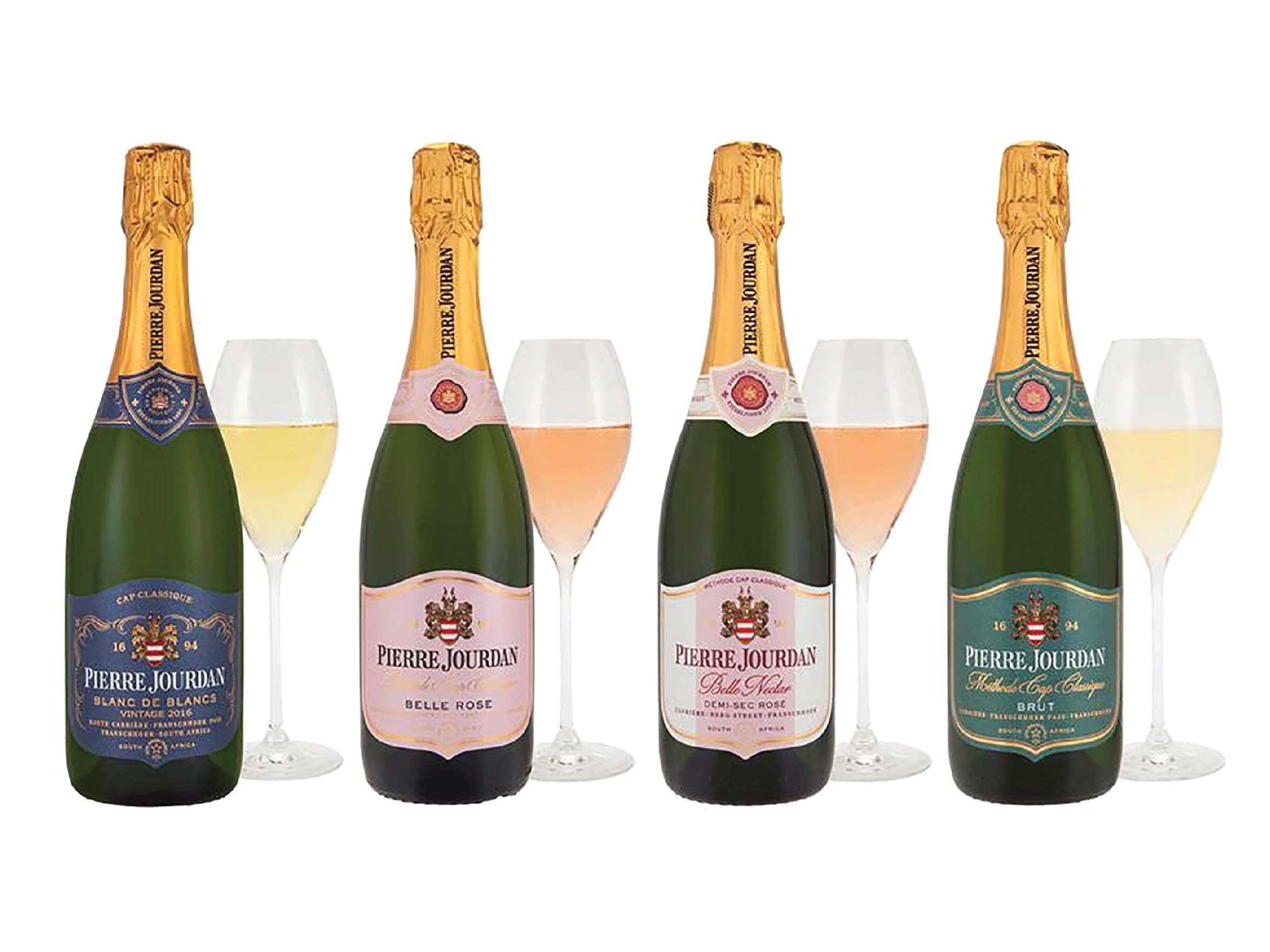
The family’s history began in 1982 when Von Arnim purchased first land to create Haute Cabrière and planted Chardonnay and Pinot Noir, and later building the cellar. In 1986 he launched Pierre Jourdan Brut Cap Classique, using a blend of exclusively Chardonnay and Pinot Noir grapes, setting the foundation for the winery and its association with the history of Cap Classique in this country. Today, 35 years later, the Pierre Jourdan range of Cap Classiques comprises the Brut, Blanc de Blancs, Belle Rose rosé, and the Belle Nectar Demi-Sec rosé, dearly loved locally in South Africa and abroad.
Now semi-retired, Achim has handed the reins to one of his sons, Takuan von Arnim, who has given the Haute Cabrière brand impetus and some snazziness while pioneering his own legacy – all under his dad’s beady eye. “My father uncovered and cut a diamond, and I am here to polish it,” comments Takuan, espousing the challenge ahead in redefining the winery’s future.
*For those who want to learn about bubbly’s mystic, the Cape Wine Academy has launched a three-level course which starts soon.