 WeeklySA_Admin
FAILURE: So-called leaders pretend to fight the system, but never risk anything real. They act tough while staying cosy with capitalists. They act fierce, but they are safe and obedient—selling radicalism without ever leaving their comfort zone…
By Themba Khumalo
In the suffocating haze of 24-hour news and social media posturing, the language of radical change is cheap as chips—hawked by grifters, parroted by algorithms, and slapped on the banners of every self-serving fraud with a Wi-Fi connection.
“Revolution.” “Liberation.” “The people.” These words are nothing but worn-out stage props, recycled endlessly by demagogues, who flog “disruption” as if it were a new brand of detergent.
Yet for all the shrieking and self-congratulation, these so-called leaders deliver precisely nothing. They are mirrors, not hammers—reflecting the old order with a fresh coat of marketing gloss, leaving the country as untouched as ever.
Welcome to the world of deceptive radicalism—a theatre of revolt that parades in revolutionary costumes but quietly props up, and sometimes even fortifies, the very structures it claims to loathe. This is the pantomime of revolution. The language of radical transformation is used as camouflage, masking a preservationist strategy. Beneath the slogans, the old order sits smugly, polished by every new round of performance.
South Africa is crawling with self-declared revolutionaries—shouting, posturing, trading in the currency of revolution. Yet for all their noise, the country is starved—utterly starved—of actual revolutions. Not this endless pageantry and pose.
The air is thick with the stench of radical talk—fiery slogans and lofty speeches poured like petrol across campaigns, rallies, and social media, but nothing ever actually burns. Political parties did not just master this art of deception; they industrialised it. They set off decorative fireworks while the citadel of power stands, unscorched, unthreatened, unmoved.
The fires are pure theatre. The smoke is all an illusion. What we witness is not transformation, but impersonation—rebellion as costume, anger as a commodity, liberation hawked like a cheap product.
This is deceptive radicalism: the art of sounding dangerous while remaining harmless, of performing rupture while preserving order, of selling the intoxicating thrill of revolution without ever delivering the inconvenience of real change. It is not simply the failure of radical language. It is its weaponisation, its abuse, its transformation into a tool for keeping the old order perfectly intact.
The ANC was first in line to inherit the machinery of deception and wielded it with the cynicism of seasoned con artists.
Decades of empty promises, transformation dangled like a carrot before the poor, while wealth and property are guarded with the devotion of a dragon atop its hoard. “Radical Economic Transformation” was nothing but a branding exercise for palace politics—raw ambition masquerading as rebellion.
The house of power was never torn down; they just swapped the door nameplates. Continuity is dressed up as revolution. Promises are shrink-wrapped as progress.
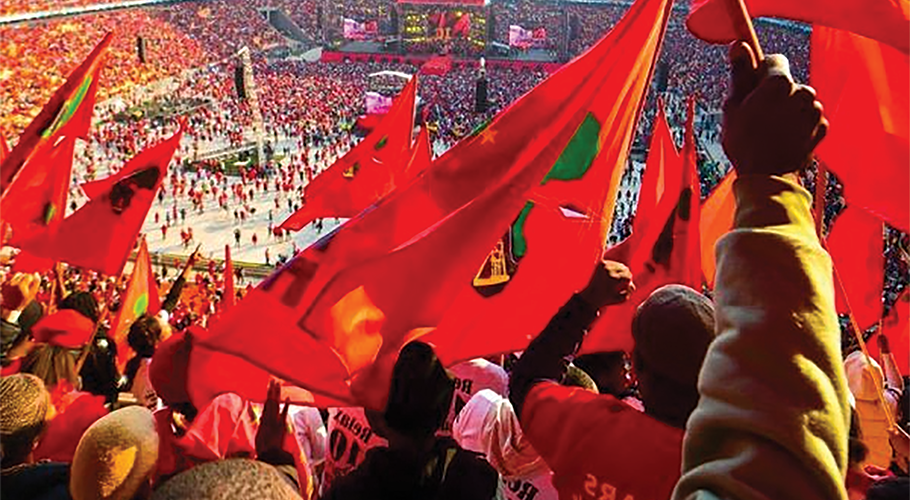
Then the EFF swaggered in—South Africa’s self-anointed revolutionaries. All theatre, all volume, all threat—none of it real. Red on the streets, red in parliament, red on every glowing screen. Their crusade to dismantle capitalism? A mime. What they truly want is a place at the table, not the table’s destruction. They bellow at the gates of power, then slip inside to feast. Dismantling hierarchy? No, just scrambling to the top of it. Their radicalism is a shakedown operation, calibrated to squeeze concessions—not to upend the system, but to take over the levers for themselves. Their revolution is simply a hostile takeover bid—dressed in borrowed struggle, performed for the cameras, sold to the highest bidder.
And now the MK Party—the final, festering mutation of this political disease—staggers onto the stage, no longer even pretending. MK has no real ideology; it is simply grievance with a microphone. It offers nothing except the spectacle of bruised egos masquerading as the public good. Not a new economic vision—just a personal vendetta, camouflaged as politics.
It does not seek to transform the state; it seeks to be at the table. Justice is not on the menu—only absolution for its own, and a return to the feeding trough. The leader, once the nation’s head, presided over decay with a smirk and now wants to return to the crime scene. Hierarchies are untouched. The economy is a corpse. Transformation? Left to rot in the sun, ignored even by the undertakers.
MK wraps itself in the moth-eaten banners of struggle. Still, its agenda is as conservative and self-serving as they come: defend the old hierarchy, shield the guilty, dodge accountability at every turn. Its radicalism is a joke—a reactionary tantrum. It does not face forward; it trudges backwards, wielding resentment like a club and calling it politics. Personal grudges are laundered as public purpose, nostalgia weaponised as vision.
What binds the ANC, EFF, and MK is not a vision, but slavish loyalty to the very structures they claim to hate.
They are actors in a pantomime, each with a different costume, but all reading from the same script. Not one of them will ever dare to tear down the architecture of power.
Economic order? Untouched. Ownership? Untouchable. Capital? Pampered. Their attacks are fireworks for the crowds—symbols, not systems; scapegoats, not architects; corruption, not the engines of theft; whiteness, never the fortress of ownership—all thunder, no lightning—a noisy con that leaves the bastion of privilege unscathed.
This is the anatomy of deceptive radicalism: furious punching, but only sideways or down—never up. Shouting for the microphones, but never into the heart of the beast. It is confrontation as choreography—a ritual of rage that leaves the architecture of domination glistening, polished by the hands that pretend to claw at it.
Real radicalism is not loud; it is lethal. It fractures alliances, terrifies capitalists, detonates markets, and provokes backlash that cannot be managed with press statements. It produces enemies, not followers. It costs power—sometimes everything. It spits on applause, shreds comfort, and sets profit on fire. It never, ever survives intact.
Deceptive radicalism is the system’s pressure valve: it soaks up anger and spits out spectacle. Suffering is packaged as content; pain is repurposed for branding. Despair becomes a marketing asset. Hope is reissued as an empty slogan. There is no liberation for the poor—just management. The dispossessed are not mobilised; they are tranquilised. Power is never threatened—only fattened by those who circle closest to it.
South Africa’s tragedy is not silence—it is the toxic overdose of fake radicalism. The country is now a marketplace of counterfeit fire: slogans that burn on the tongue but never touch the rot beneath, speeches that scorch the ear but leave the economy cold, movements that thunder about rupture while keeping their arms protectively around the very foundations they are paid to despise.
The poor are not being mobilised—they are being strip-mined. Their anger is harvested at election time, then dumped right back into the barren soil of their own misery. Suffering is chewed up and spat out as campaign fodder. Their lives—fixed, brutal, untouched—are the raw material for speeches and marches, but never for change. This is not representation; it is extraction. It is not leadership; it is despair, managed with clinical cynicism.
Deceptive radicalism thrives because it sells the cheapest drug in politics: the illusion of resistance, minus the risk. Leaders pose as firebrands while cowering in the establishment’s lap. Movements pose as dangerous but are house-trained. Voters get the sedative of being “heard” while their chains are buffed to a shine. Catharsis is sold as justice—because outrage is cheap, and real change is a threat to every merchant in the palace. Progress is a performance; real change is quietly strangled backstage.
But catharsis never redistributed a single acre. It never restructured an economy, never built a school, a hospital, or a shred of dignity. It does not return stolen ownership. Only structural confrontation does—and none of these movements will ever risk it, because they are all too busy cashing in on the system’s survival.
South Africa is not ruled by enemies of the system. It is ruled by the system’s most committed actors—radicals in fancy dress, revolutionaries by branding, conservatives by consequence. As long as this circus of fake fire runs the show, the country will remain trapped in an endless loop: rage without rupture, power without justice, politics without a whiff of transformation.
* Themba Khumalo is a political commentator and former editor