 WeeklySA_Admin
BETRAYAL: Official failure to recognise the dire situation and offer adequate protection persists, say two University of Johannesburg researchers
By Monk Nkomo
Scores of whistleblowers in South Africa have been overwhelmingly subjected to unbridled intimidation and reprisals, including murder, due to woeful limitations and inadequacy of the government’s legal framework.
By fulfilling their public duty of reporting corruption, fraud and other illegal activities, they have actually placed themselves at great personal risk and many had lost their lives as a consequence of disclosure.
This eerie scenario is painted in a recent report on the safety and protection of whistleblowers, compiled by Ugljesa Radulovic, Senior Postdoctoral Research Fellow at the University of Johannesburg and Tina Uys, Professor of Sociology at the University of Johannesburg.
The report notes that the frequency and severity of retaliation against whistleblowers in South Africa was alarming. The killings of those who exposed corruption had raised concerns about their safety as many faced retaliation, loss of livelihood and even loss of life.
Their plight points to the personal cost of whistleblowing in this country and the lack of legal, security, financial and psychological assistance they received as they exposed corruption in government and state-owned enterprises.
The Global Initiative Against Transnational Organised Crime had counted a total of 1971 assassination cases in South Africa between 2000 and 2021, with whistleblowers accounting for many of the targeted individuals.
“The problem resides in a failure of the government to recognise the dire situation South African whistleblowers find themselves in, compounded by lacklustre whistleblower protection legislation. There has, however, been a signal of intent (and some action) in wanting to reinforce or rebuild South Africa’s whistleblower protection legislation.
“But this has to be accompanied by political will to adequately implement the new legislation. There also has to be steadfast broader governmental sanctioning against those who do wrong,’’ according to the report.
In his 2025 state of the nation address, President Cyril Ramaphosa promised the Government would finalise the Whistleblower Protection Framework and introduce the Whistleblower Protections Bill in Parliament during this financial year.
Last month, Democratic Alliance (DA) called on Justice Minister Mmamoloko Kubayi to table the long-promised Whistleblower Protections Bill in Parliament without delay.
Months later after the president’s promise, nothing had happened, the DA lamented.
Meanwhile, whistle-blowers, lawyers, prosecutors and police officers are being assassinated in plain sight.
“The brutal murder of Bouwer van Niekerk, shot dead at his law firm while working to expose corruption, has confirmed what South Africans already know: we are now living in a mafia state” the party said.
According to Amnesty International, whistleblowers exposed acts of criminality and abuse by governments, corporations, organisations and individuals. Without them, evidence of large-scale human rights violations would never surface.
One such law is the Protected Disclosures Act No. 26 of 2000, amended by way of the Protected Disclosures Amendment Act No. 5 of 2017. The law was designed to protect individuals who exposed perceived wrongdoing to an authority that has the capacity to remedy the wrongdoing.
‘’Yet, it has offered inadequate protection. South African whistleblowers have been overwhelmingly subjected to reprisals – from murder to social, work-related and legal retaliation’’.
The killings, perpetrated mostly by hitmen, were a dire warning of the lengths that organised criminals and corrupt politicians will go, to avoid accountability. The lives of whistleblowers have also been compromised by corrupt police officers and company managers who colluded with criminal syndicates to commit these crimes.
The six police officers were eventually arrested in November 2000, nearly a full three years after the incident occurred. On the day of their arrest, the video footage was broadcast on national television. The policemen were charged and received prison sentences of four to five years.
During 2009-2018, South Africa graduated from “ordinary” corruption. Private firms and individuals exploited corrupt public officials to manipulate key state structures for their personal benefit and this would come to be understood as State Capture. Much of what was detailed during this time was the result of whistleblowers’ disclosures. Two anonymous whistleblowers, “Stan” and “John”, furnished landmark evidence to support the State capture allegations.
They provided Brian Currin, a human rights lawyer, with hard drives containing hundreds of thousands of emails that detailed the nefarious relationship between the Gupta family, senior government ministers and heads of state-owned enterprises. The Gupta family – three influential siblings and businessmen Atul, Ajay and Tony originating from India – were fingered as the key drivers behind state capture.
Stan and John’s disclosure became known as the Gupta Leaks. They were used as official evidence at the Zondo Commission of Inquiry into State Capture. The two Gupta Leaks whistleblowers remain anonymous and have relocated abroad for their physical safety.
A number of whistleblowers have lost their lives as a consequence of disclosure. Failure by the government to deal effectively with the killing of whistleblowers in South Africa as well as their unrestrained intimidation, is expected to make it very difficult for the authorities to combat corruption and fraud.
‘’ While the country has robust laws designed to protect whistle-blowers, including the Protected Disclosure Act and the Witness Protection Act, gaps in the legislative framework and the problems with the practical implementation of these mechanisms, prevent them from being effective’’, said Amnesty International.
THE SIEGE: WHISTLEBLOWERS FAILED BY THE SYSTEM
Following are the heartbreak stories of whistleblowers who fled the country and others who paid the ultimate price after fulfilling their duties of acting as honest citizens and reporting these serious crimes in this country included:
• Pamela Mabini, a community activist and whistle- blower who was shot and killed outside her home in Kwazakhele in Gqeberha in March 2025. Through her non- profit organisation, Maro Foundation, she was known for her charitable work aimed at restoring dignity and reducing crime and violence in her community.
• Cloete Murray, accountant and liquidator who was working on the financial accounts of a company that was heavily implicated in allegedly bribing government ministers and others to win lucrative State contracts. He was shot in the head while driving with his son on the N1 highway just outside Johannesburg in March 2023. His son, Thomas Murray, who was working with him, died on the scene. Cloete Murray later died in hospital.
• Jimmy Mohlala, the Speaker of the Mbombela Municipality, was murdered in front of his home after he exposed tender irregularities related to the construction of the Mbombela Stadium for the 2010 FIFA World Cup. His son was injured in the attack.
• Moss Phakoe, an African National Congress municipal councillor since 2002, was also shot in front of his home. He and a colleague had compiled a dossier that exposed corruption in the Bojanala Platinum District Municipality. Phakoe’s report implicated a senior councillor whose murder conviction was later overturned after several state witnesses retracted their testimonies.
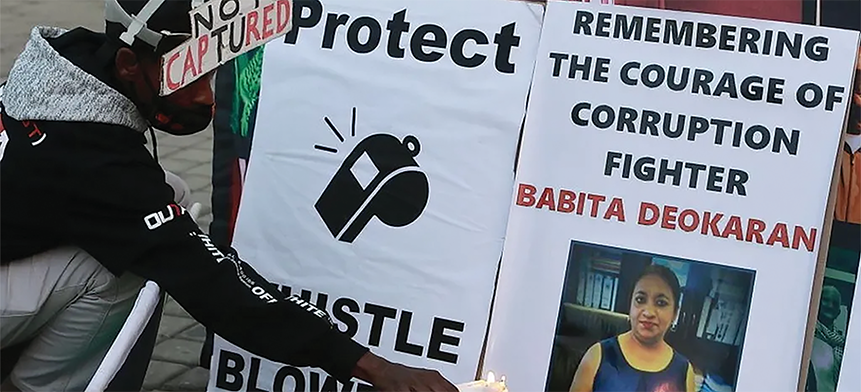
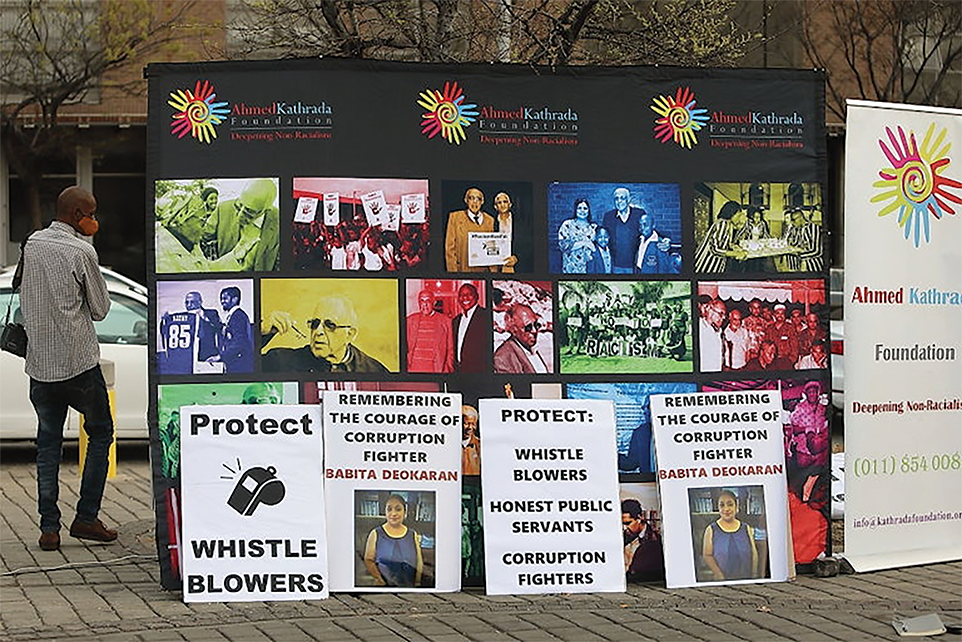
• The murder of Babita Deokaran, Acting Chief Financial Officer of the Gauteng Department of Health at the time of her death, attracted nationwide attention. She had uncovered extensive corruption in the Department and submitted evidence of this to the relevant authorities. She would later investigate corruption related to the procurement of personal protective equipment during the COVID pandemic.
Deokaran was on the brink of making a disclosure pertaining to the COVID-related corruption when assassins shot her after she had dropped her child off at school. Six hitmen were arrested for the assassination, but the mastermind remains at large.
• Adam Klein: He was one of the rare whistleblowers who made a disclosure under apartheid rule. In 1980, Klein, a prosecutor in the Bantu Commissioner’s Court, refused to prosecute five black men under the pass regulations. These were a cornerstone of apartheid legislation, serving as an internal passport system to restrict the movement of non-whites and thus racially segregate the country.
He immediately faced retaliation. He was arrested under trumped-up charges, faced threats to his physical well-being and became subjected to surveillance. He then made a public disclosure to a Sunday newspaper, exposing severe abuses at the Pretoria Bantu Commissioner’s Court. The disclosure revealed the inhumane nature of the pass laws, like detention of black people who failed to produce passes.
Klein faced further backlash and had to temporarily relocate to Namibia for his safety. On his return to South Africa, he continued to be subjected to surveillance and interrogation. He passed away in 2011, unacknowledged and without posthumous recognition. – Monk Nkomo