 WeeklySA_Admin
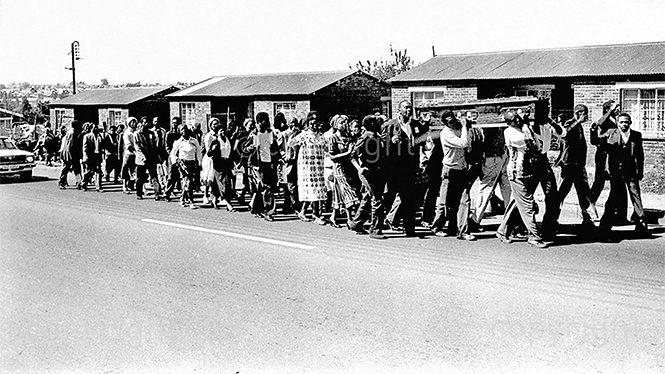
Photos: Bongani Mnguni / african.pictures:: The youth of 1976 did not face down the barrels of apartheid guns just to hand their grandchildren a 60% unemployment rate…
By Themba Khumalo
Every single year on 16 June, South Africa’s political elite gather to spit on the graves of martyrs with a nauseating piece of theatre.
They drape themselves in the borrowed courage of the dead, using the blood of 16 June 1976 as political currency to mask the socioeconomic rot. Outside the VIP marquees, away from the hollow speeches and calculated nostalgia, the betrayal is absolute.
The liberation dividend has been looted, leaving a generation of young South Africans trapped in a democracy that gave them the right to vote but condemned them to economic starvation.
Fifty years ago, the rebellion of the youth of Soweto was an act of pure, volcanic fury. Thousands of schoolchildren marched into a hail of state-issued bullets because they refused to be reduced to compliant manual labour for an oppressive machine.
Their sacrifice was seismic. It broke the myth of National Party invincibility, triggered capital flight, ignited domestic resistance, and forced a horrified international community to witness the regime’s brutality as captured by journalists.
Those pupils did not die so that their grandchildren could inherit a country where the national unemployment rate has climbed to a staggering 32.7%, or where the expanded definition reveals a nightmarish 43.7% of citizens completely abandoned by the economy.
Youth unemployment statistics are a national emergency that is treated with bureaucratic indifference. Young people aged 15 to 24 face a soul-destroying unemployment rate of 60.9%. For those aged 25 to 34, the figure is 40.6%.
This is not just a collection of numbers on a Statistics South Africa spreadsheet; it is a calculation of human ruin. It translates to millions of young South Africans spending their prime years sitting on township street corners or pacing high-street pavements, their dignity slowly eroding, as they wait for a government food parcel or a temporary Expanded Public Works Programme (EPWP) contract that never materialises.
This forced idleness is an aggressive eraser of human potential, slowly scrubbing out the ambitions of young people who have been told since infancy that education is the key to their liberation.
Geographic periphery
This economic excommunication is manufactured directly by a dual basic education system that acts as a production line for inequality. While a tiny, hyper-resourced tier of private and functional public schools effortlessly pipelines affluent youth into tertiary institutions and white-collar careers, the underfunded tier is left to rot.
Township and rural schools remain defined by crumbling infrastructure, high dropout rates, and literacy deficits that permanently cripple a child’s prospects before they even sit for their matric exams. The state has swapped the overt violence of Bantu Education for the passive, structural violence of systemic neglect.
By failing to provide a functional foundation, the state effectively locks millions of black children out of a modern, skills-driven economy before they even turn eighteen, guaranteeing that the class divides of apartheid remain perfectly preserved.
The result is a society fractured into hostile, parallel universes, completely dissolving the myth of the Rainbow Nation. Spatial apartheid remains completely untouched. The working class remains banished to the geographic periphery, enduring dry taps, frequent blackouts, and collapsing municipal transport, while the wealthy classes buy their way out of state collapse entirely.
Affluent suburbs exist behind high walls and electric fencing, insulated by private security, solar grids, and access to medical aid. We do not have a shared national identity; we have a system of economic segregation where the rich survive independently, and the poor are left to navigate the debris of failed governance.
The promised common ground has long evaporated, replaced by a deep-seated resentment that bubbles beneath the surface of everyday life.
In the vacuum where economic liberation should have taken root, a predatory and vicious populism has taken hold. Because the ruling elite cannot deliver jobs or functional infrastructure, political opportunists have weaponised public desperation. We watch as vigilante groups and populist movements traverse the country, misdirecting the legitimate rage of the dispossessed away from government corruption and towards foreigners and undocumented migrants, most of whom are of African origin.
Toxic rage has become the ultimate distraction technique—turning the desperate against the vulnerable in a bloody scramble for the crumbs falling from the elite’s table, fracturing social solidarity along ethnic and national lines.
Instead of holding the state accountable for failing to build factories, maintain water systems, or expand the economy, poor communities are being manipulated into fighting one another for survival.
The ultimate tragedy of contemporary South Africa is the profound, heavy political apathy it has beaten into its youth. The generation of 1976 possessed an unshakeable belief that their actions could alter the trajectory of history; they were driven by a collective agency that made the state tremble.
Today, their grandchildren look at the institutionalised corruption, the captured state enterprises, and the shameless self-enrichment of the political class, and they simply log out.
Voter registration and turnout among eligible youth continue to plummet because they have realised that the mainstream political theatre is a rigged game played by a parasitic elite.
The brave youth of 1976 fought the apartheid regime to claim their future; today, millions of young South Africans are left with no choice but to survive on the margins of a country that turned its back on them, entirely disillusioned by a political class that values them only as statistics and voting fodder.
Themba Khumalo is a former editor and publisher