 WeeklySA_Admin
LEGACY: South Africa’s epidemic of GBV violence cannot be understood as a policing or policy failure alone, argues Professor Pumla Gobodo-Madikizela. She contends that the country continues to live with apartheid’s unresolved trauma, passed from one generation to the next through silence, denial. Until those histories are confronted, she warned, the cycle of violence will persist…
By Zandile Mbabela
South Africa’s gender-based violence crisis is rooted in apartheid’s unspoken trauma, not policy failure alone, Templeton Prize laureate Professor Pumla Gobodo-Madikizela argued in a landmark recent Freedom Month lecture at Nelson Mandela University in Gqeberha.
Her argument has implications that go well beyond the academic debate held on 23 April 2026. If Gobodo-Madikizela is correct, then every declaration of a national crisis and every institutional commitment to transformation that stops short of confronting apartheid’s inherited violence is not only inadequate but is itself a form of the evasion it claims to oppose.
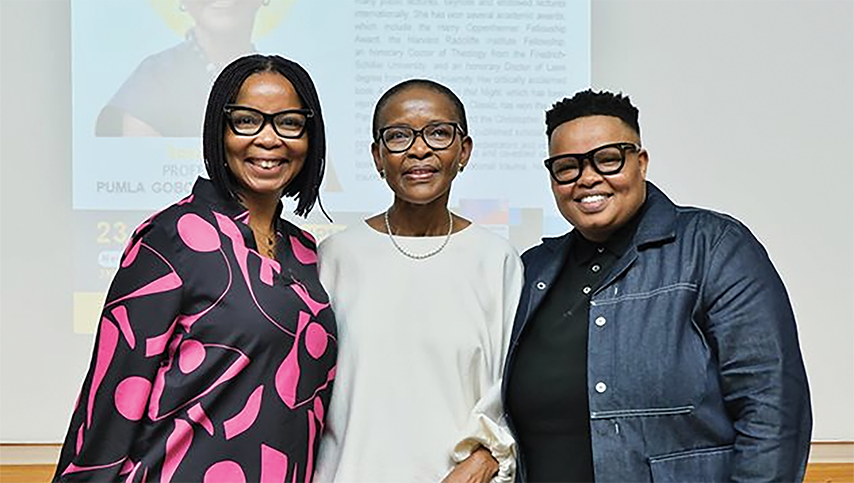
From left, professors Pumla Dineo Gqola, Pumla Gobodo-Madikizela and Babalwa Magoqwana at the Nelson Mandela University Centre for Women and Gender Studies lecture
The Truth and Reconciliation Commission was an opening rather than a closure. The task it started has simply been passed on…
“There’s a lot of talk and less action,” she said in a post-lecture discussion, spelling out what it would mean concretely for a president who has declared gender-based violence a national crisis to demonstrate that commitment where it matters most.
“What are you doing in these communities where these stories are happening?” she asked, suggesting tangible interventions such as “increase constant police presence in this area, lighting up the streets to improve safety, and starting programmes in vulnerable environments where women can seek safety.”
Gobodo-Madikizela holds the DSI-NRF Research Chair in Violent Histories and Transgenerational Trauma at Stellenbosch University and won the Templeton Prize in 2024, one of the world’s most prestigious intellectual honours.
She served as the Chair of the Human Rights Violations Committee in the Western Cape regional office of the Truth and Reconciliation Commission in the 1990s, which was responsible for victims’ hearings, and in this role facilitated victim-perpetrator dialogues.
Her award-winning book A Human Being Died That Night, based on her interviews with Eugene de Kock, commander of the state’s assassination squads, has been staged as a play in New York, London and Cape Town.
Delivering the lecture hosted by Nelson Mandela University’s Centre for Women and Gender Studies, 30 years after the TRC opened in what was then East London, she returned to a sound she has spent two decades studying: the scream of Nomonde Calata, whose husband was murdered by the apartheid police, his body burned and discovered on the outskirts of Port Elizabeth.
Testifying at the TRC’s opening, she screamed into the public audience as she described finding his remains. Archbishop Desmond Tutu called it the “defining sound” of that political moment in South Africa. Prof Gobodo-Madikizela called it something more: “a staging of a future of violence to come”.
That future is now. Mrs Calata’s son, Lukhanyo Calata, who was three years old when his father died, has now been giving testimony at the third inquest into the 1985 murders of the Cradock Four: his father Fort Calata, Matthew Goniwe, Sparrow Mkhonto, and Sicelo Mhlauli.
This is what Prof Gobodo-Madikizela described as the “transgenerational errand”, a term she drew from psychoanalysis: a task passed on not through conscious decision but through what psychoanalysts Maria Torok and Nicolas Abraham called “the crypt”.
These are memories buried so deeply in the unconscious that they cannot be articulated, but they are carried over, and the next generation inherits them as unresolved.
“What is passed on is precisely what is hidden,” she said. When it erupts, it does so in ways that are uncontrollable, because it has never found a way to be expressed.
Gobodo-Madikizela interrogated the late former president FW de Klerk’s posthumous video apology for apartheid, which was recorded before his death and released in November 2021.
Framing it as a “closed text”, she argued that an apology delivered after death shuts down any response from victims. This was because it “offers the appearance of closure while leaving intact the structures” of denial and unequal historical responsibility.
The apology, in effect, modelled evasion for the next generation, offering the beneficiaries of apartheid a language to avoid rather than confront uncomfortable truths.
The consequences of that evasion are visible in the present, she said in a post-lecture interview: “The scale of the violence against the bodies of women, the way that women are violated, it’s almost as if the woman is killed and then she’s got to be killed again. The violence is extreme, it is unspeakable.”
The national response to this was, she said, “disorganised,” oscillating between presidential declarations and inertia, never producing the tangible interventions that the most vulnerable and most exposed women required.
Despite policy frameworks and public commitments, higher education institutions also reflect the country’s high level of violence against women, seen in the number of cases of GBV reported each year.
Gobodo-Madikizela made it clear that they have both the platform and the responsibility to create spaces where traumatic histories are confronted, spoken about, and the conditions for genuine transformation can take root. It is work that is incremental, often uncomfortable, and never complete.
“This is your time,” she told the younger generation in the room, acknowledging both the burden and the agency that comes with it, while also conceding that the work of repair may never fully end in South Africa.
On her own campus at Stellenbosch, Gobodo-Madikizela described being part of a facilitated panel working with male students in a residence, creating structured spaces for men to confront, in the presence of women, how their behaviour causes harm.
“When you bring these men into conversation with women, and they hear how women are affected by their behaviour, there really is a shift,” she said. Men encountering their own vulnerability in an accountable but safe space were, she observed, capable of change. Institutional commitment that did not reach this depth risked becoming, she warned, a “tick-box exercise”.
The lecture drew a large audience of academics, students and community members. In the Q&A session, Fort Hare University historian Professor Neil Roos said her words cast a clarifying light on his own research into white perpetrators and beneficiaries of apartheid.
Gobodo-Madikizela closed without false consolation. Quoting the French philosopher Simone Weil, she proposed that the very act of conceiving something different from what exists “constitutes a reason to hope”.
That hope, she insisted, must be radical: one that looks fear in the eye and refuses the self-protective strategies of denial, rationalisation and evasion, choosing instead a deeper concern for the human dignity of others.
The TRC, she said, was “an opening rather than a closure”, as the task it started was not yet resolved. It had simply been passed on.
The author, Zandile Mbabela, is a media manager at Nelson Mandela University