 WeeklySA_Admin
PROTRACTED: Airstrikes in north-west Nigeria may disrupt militants, but enduring insecurity stems from failed governance, weak institutions and eroded public trust, argues a peace and security academic…
By Obasesam Okoi
US military airstrikes on Islamic State-linked militants in north-western Nigeria on Christmas Day 2025 attracted global attention. The focus was on the international legal implications and whether the Nigerian government had consented to the strikes.
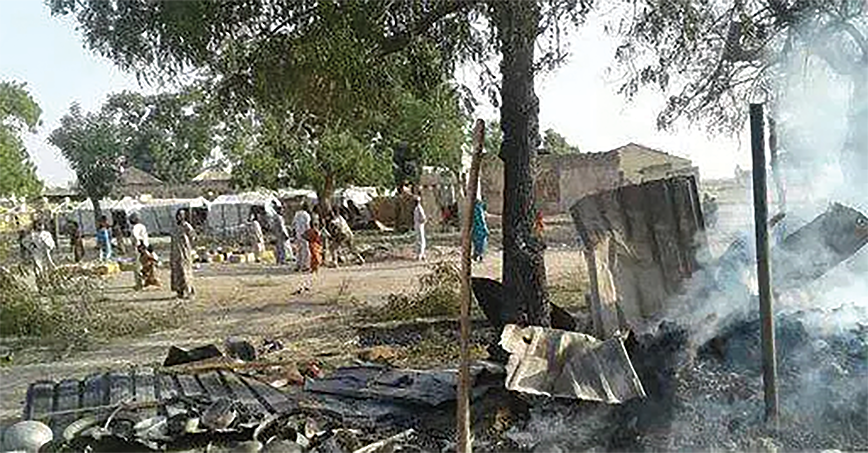
I’m a scholar of peace and security and have carried out research on Boko Haram’s protracted campaign of violence. The research shows that the group’s activities have produced extensive loss of life and material destruction, as well as large-scale internal displacement. This calls for integrated security, humanitarian and governance responses.
In my view, focusing on the airstrikes risks obscuring the real question: why does terrorism continue in Nigeria?
My argument is that it’s not the absence of military force. My research shows that the problem of continuing violence is rooted in the failure of governance at every level of society. Airstrikes don’t address the political, economic and social conditions that allow armed groups to survive, adapt and recruit.
Armed violence has expanded where state authority is exercised in predatory, selective or unaccountable ways. Terrorism in Nigeria has thrived because the state has too often failed to govern justly, consistently and credibly.
In north-east Nigeria, for example, counterterrorism efforts have been undermined where displaced civilians remain unable to return safely, and land disputes go unresolved. What’s needed is investment in civilian protection, and local reconciliation processes that rebuild trust between communities and the state.
Similar lessons can be seen in parts of the Lake Chad Basin, where humanitarian support and local governance reforms have proven more effective at stabilising communities than military operations alone.
Military force can play a role in containing armed groups. But it must be embedded in a broader project of political reconstruction, institutional accountability and social trust building. This means restoring the state’s presence not only through soldiers, but through reliable public services in communities most affected by violence and displacement.
Narratives, legitimacy and insecurity
Following the strike, President Donald Trump announced the operation in a social media post in moral and religious terms. He described the attack as retaliation against militants who had been killing Christians. He portrayed the strike as both morally necessary and strategically decisive.
That framing, reported widely by Reuters, and amplified through US media and social platforms, resonated strongly in Washington political discourse. Major US outlets, including CNN, noted that the reality of violence in Nigeria was more complex than a simple religious binary.
For their part, Nigerian officials emphasised sovereignty, coordination and the non-sectarian nature of insecurity in the country. In a statement reported by Reuters, the Ministry of Foreign Affairs emphasised that terrorism in Nigeria affected citizens regardless of religion or ethnicity. It warned against narratives that could inflame sectarian divisions. According to the Nigerian Ministry of Foreign Affairs, terrorist violence in any form, whether directed at Christians, Muslims or other communities, remains an affront to Nigeria’s values and to international peace and security.
Where governance is fragile, externally imposed moral framing can deepen mistrust, sharpen social divisions and offer armed groups new narratives to exploit.
Framing insecurity as a religious war is analytically inaccurate. It is also strategically dangerous. Armed groups frequently rely on ideas like that to recruit, radicalise and justify violence.
External validation of these ideas, even unintentionally, can become a propaganda asset for militants operating in contexts of weak state legitimacy like Nigeria.
Military success is not security success
US military statements described the strike as having destroyed militant infrastructure and disrupted operations. Reports by Premium Times and Reuters indicated that camps and facilities had been hit. Yet, public information about leadership casualties, command and control disruption, or financial networks remains limited.
Without clarity about what happened, claims of success offer little to Nigerians who continue to live with insecurity.
Tactical disruption can interrupt planning and movement, but it does not dismantle networks embedded in local economies of coercion, taxation and protection.
Getting to the heart of the problem
Militant violence in Nigeria is embedded in a wider landscape of state retreat, informal authority and survival economies. Large areas of rural territory in the north-east remain effectively ungoverned.
Security and justice are provided by armed actors and criminal networks, not the state. In such environments, terrorism is less an external invasion than a symptom of systemic institutional collapse.
Military interventions can disrupt these systems temporarily. But without restoring governance, they leave intact the structures that reproduce violence.
Government can restore governance by doing the following:
Political reconstruction: Rebuilding local institutions in ways that involve displaced populations, traditional leaders, women and youth, rather than relying solely on centralised state authority. Unemployment, land disputes and political exclusion have created conditions in which violence thrives. What’s needed is to reinvest in livelihoods, education and fair land governance.
Institutional accountability: This means restoring trust in the Nigerian state, particularly in conflict-affected communities where security forces are perceived as abusive or corrupt. Accountability mechanisms for investigating abuses and compensating victims are necessary. This requires transparent systems for managing humanitarian activities and reconstruction funds. Citizens can be more confident in state authority when they see corruption confronted and justice applied.
Social trust building: Community-based peacebuilding and inclusive reconstruction processes are essential for repairing social fractures. When people experience safety and dignity in their everyday lives, confidence in security institutions can return.
Counterterrorism success in Nigeria should not be measured solely by the number of insurgents neutralised, but by whether state authority emerges more legitimate than before.
Durable peace will depend less on tactical military gains than on the restoration of public trust. That will happen through accountable governance, civilian protection and inclusive economic recovery. – The Conversation
* Obasesam Okoi, Associate professor, University of St. Thomas
Comment
RURAL SCHOOL KIDS FORSAKEN
The recent floods, which wreaked havoc in several provinces especially in the rural areas where scores of lives were lost, houses and schools destroyed, have exacerbated the plight of local school children some of whom have been walking long distances to get education.
While South Africa’s Constitution proudly guarantees every child the right to basic education, this promise rings hollow for thousands of schoolchildren growing up in rural areas. Far from the spotlight of urban development, these learners face daily hardships that make quality education feel like a distant dream rather than a lived reality.
In many rural communities, the school day begins long before the first bell rings. Children wake up before sunrise to walk long distances—often 5 to 10 kilometres—along unsafe roads and through harsh weather conditions just to reach school. This exhausting journey alone places them at a disadvantage compared to their urban counterparts who enjoy nearby facilities. By the time lessons begin, many rural learners are already tired, hungry and struggling to concentrate. The condition of rural schools themselves is another stark reminder of inequality. Dilapidated classrooms, broken desks, leaking roofs and, in some cases, the continued use of pit toilets paint a troubling picture. Despite repeated promises and well-publicised plans by government to eradicate unsafe infrastructure, progress has been painfully slow.
Equally concerning is the shortage of qualified teachers and learning resources. Rural schools often struggle to attract and retain skilled educators due to isolation, poor accommodation and limited professional support. As a result, learners are sometimes taught by underqualified teachers or face frequent staff shortages.
Poverty compounds these challenges. Many rural learners come from households where unemployment is high and food insecurity is common. For some children, the meal provided through the school nutrition programme is the only guaranteed meal of the day. Basic Education Minister, Siviwe Gwarube, was spot on when she recently remarked that an equitable education system began with equitable staffing. Educator allocation must be fair, data-driven and responsive to learners needs. Overcrowded classrooms undermined learning and perpetuated inequality. These were not unavoidable realities, they were distortions that must be corrected.
Despite the hardships they endured daily, rural learners display remarkable resilience and determination. Their commitment to learning, often under the most difficult circumstances, is a powerful reminder of the untapped potential that existed in these communities. What they lack is not ability or ambition, but opportunity.
Addressing the plight of rural schoolchildren requires more than policy statements—it demands urgent, sustained action. Until the South African government confronts the deep inequalities embedded in its education system, the promise of equal education for all will remain unfulfilled. And history will judge those who denied these rural children their right to better education.