 WeeklySA_Admin
MANDATE: Failure to act against those named in the State Capture report risks cementing the perception that justice in South Africa is applied selectively…
By Sekola Sello
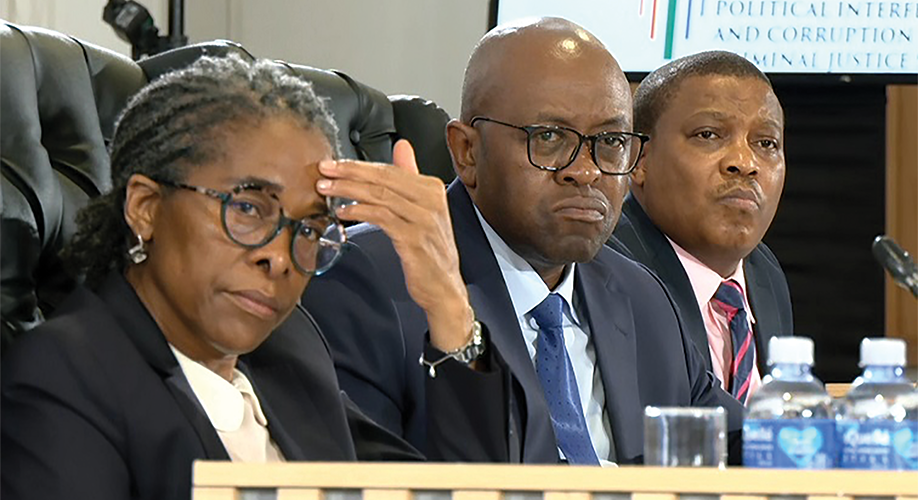
The Madlanga Commission has taken a well-deserved break for about two weeks.
By all accounts, the commission has been doing sterling work since its inception six months ago. Although President Cyril Ramaphosa announced its establishment in July last year, it only began its work in September.
The commission, headed by retired Constitutional Court Justice Mbuyiseli Madlanga, was established after KwaZulu-Natal police head Lieutenant General Nhlanhla Mkhwanazi made damning allegations at a press conference on 25 July last year. Its mandate is to investigate Mkhwanazi’s claims of criminality, corruption, and political interference in the criminal justice system.
This week, at least 12 senior police officers were arrested and charged with various counts linked to the allegedly irregular awarding of a R360-million contract to a company owned by Vusimuzi “Cat” Matlala.
The arrests have also led to National Police Commissioner General Fannie Masemola being charged under the Public Finance Management Act. As the most senior accounting officer in SAPS, he faces charges of failing to exercise due diligence. Acting Police Minister Firoz Cachalia has emphasised that Masemola is not charged with corruption.
The swift action against these police officers contrasts sharply with what appears to be near paralysis by the National Prosecuting Authority (NPA) in acting against high-ranking ANC leaders implicated in wrongdoing by the Zondo Commission into State Capture. That commission was established in 2018 and concluded its work in 2022.
The only senior ANC member to have been charged and convicted so far is Vincent Smith, who was sentenced in early March this year to an effective seven-year prison term after pleading guilty to receiving gratification from Bosasa — a company that secured several government tenders. As an ANC Member of Parliament, he received R680 000 from Bosasa and failed to declare it.
These payments formed part of Bosasa’s strategy to buy political influence among the ruling party elite. Another ANC heavyweight who benefited from Bosasa is the party’s current First Deputy Secretary-General, Nomvula Mokonyane. At the time, she was a Cabinet Minister.
Former Bosasa CFO Angelo Agrizzi told the Zondo Commission that Mokonyane received R50 000 per month from the company. She also allegedly benefited from high-end groceries, car rentals, home maintenance, luxury goods, and a security system — all intended to secure political influence.
ANC national chairperson Gwede Mantashe also had security upgrades done at his Gauteng residence, as well as at two homes in his Eastern Cape village, at a combined cost of R650 000.
Former Deputy Minister Thabang Makwetla was similarly found to have received security upgrades at his Johannesburg residence without paying for them. His explanation was striking: he said he was still waiting to be billed.
There is overwhelming evidence suggesting that Mokonyane, Mantashe, and Makwetla should face charges. Why, then, this apparent paralysis? Mantashe attempted to have the Zondo findings against him reviewed and set aside, but the Johannesburg High Court dismissed his application last October.
While the police and prosecuting authorities are to be commended for acting against Masemola and his subordinates, why is the same urgency not being applied to the ANC figures named above?
Failure to act against these individuals — and others implicated in the State Capture report — risks reinforcing the perception that South Africa’s laws are applied selectively.
Let me be clear: I hold no brief for the arrested police officers. If found guilty, they must face the consequences. In fact, I believe that Lieutenant General Shadrack Sibiya, Lieutenant Lesetja Senona, and Sergeant Fannie Nkosi — all currently suspended — should be formally charged. This would give them the opportunity to clear their names, which are currently being dragged through the mud. There appears to be sufficient evidence to test in court.
However, this brings us back to the central question regarding Mantashe, Mokonyane, and Makwetla. I cannot shake the sense that something is amiss.
Are these police officers being positioned as fall guys in a larger game that is not yet fully visible?
The unit leading the charge — the Investigating Directorate Against Corruption (IDAC), which sits within the NPA — is itself under scrutiny. Nhlanhla Mkhwanazi has levelled serious allegations against it during the Ad Hoc Committee hearings.
He has claimed that the unit operates as a rogue entity, taking sides in internal SAPS battles, interfering in police investigations to protect unnamed businessmen, individuals, and politicians, and disrupting organised crime investigations in Gauteng. He further alleged that IDAC was involved in the arrest of Lieutenant-General Dumisani Khumalo and members of his team, and that it has targeted and undermined the Political Killings Task Team.
As expected, IDAC head Advocate Andrea Johnson has vehemently denied these accusations. However, it must be said that she did not emerge from the parliamentary hearings unscathed.
There is only one credible way for IDAC and the NPA to dispel perceptions of bias and restore public trust in the criminal justice system: act decisively and consistently.
That means charging those implicated in wrongdoing by the Zondo Commission into State Capture — without fear or favour.
* Sekola Sello is a retired veteran journalist
Comment
Mbalula: Accountability or foreign kow-tow
There is nothing wrong with demanding accountability from those in power.
In fact, it is the lifeblood of any functioning democracy. But when that demand begins to outsource justice beyond national borders, it stops being about accountability — and starts raising serious questions about motive.
Hence, the so-called ANC secretary-general “Fikile Mbalula Dossier”, compiled by AfriForum, crosses that line.
At face value, it presents itself as a fight against corruption.
Yet, its central thrust is not to strengthen South Africa, but to invite foreign intervention — specifically from the United States — through mechanisms such as Magnitsky-style sanctions. And that should concern anyone who takes South Africa’s sovereignty seriously.
No democracy can outsource its justice system without weakening itself. If the National Prosecuting Authority is failing, the answer is to fix it, pressure it — not to bypass it in favour of Washington.
Once you normalise foreign arbitration of domestic politics, you open the door to something far more dangerous: external influence over internal political outcomes.
Insidious thread
Beyond the corruption claims — many of which have circulated for years — the document places heavy emphasis on Mbalula’s ideological positions, particularly his criticism of West and alignment with BRICS. That framing is telling. It suggests that the issue is not only alleged misconduct, but political agenda.
South Africa is not a client state. Its foreign policy — whether one agrees with it or not — is shaped by its own history, alliances, and democratic processes.
To recast ideological disagreement as grounds for international sanction is to turn politics into a geopolitical battleground.
As the ANC edges toward its 2027 elective conference, interventions like this do not emerge in a vacuum. They feed narratives, shape perceptions, and subtly attempt to influence outcomes. Then there is the deeper, more insidious thread.
Right-wing formations have long framed the ANC failures as not simply the shortcomings of a governing party, but of Black majority rule itself – a dangerous and intellectually lazy view-point. In any democracy, voters are not a monolith, and governments are not racial proxies.
Yes, corruption must be confronted, and political leaders held accountable.
But accountability that undermines sovereignty, weaponises foreign relations. It’s all politics — dressed up as principle.