 WeeklySA_Admin
REFORM: As high-profile inquiries dominate headlines ahead of local elections, the real question is whether they will deliver consequences—or simply reinforce a political culture where scandal is noise and accountability is optional…
By Ido lekota
As South Africa inches closer to this year’s local government elections, the political landscape is saturated with noise: televised hearings, parliamentary committees, dramatic testimonies, and media sound-bites that blend scandal, strategy and spectacle.
At the centre of this fog sit two high-profile processes – the Ad Hoc Committee on Lieutenant General Nhlanhla Mkhwanazi allegations about the infiltration of the criminal justice system by criminal syndicates and the Madlanga Commission of Inquiry into those allegations.
Officially both are meant to illuminate wrongdoing, restore public confidence, and hold the powerful to account. Yet, in practice, they risk becoming another chapter in the theatre of accountability, where scrutiny is loud but consequences are muted.
The deeper crisis is not only that facts have become negotiable and governance reduced to performance, but when the electorate learns to live with this anomaly. We protest when our preferred party is targeted, we rationalise when our leaders are exposed; and we tune out when explanations become too complicated. In that quiet resignation lies the real danger: the erosion of the moral bar, the normalisation of deception, and the quiet surrender of power that belongs to voters.
The real test of accountability is not whether information
is exposed, but whether it is acted upon…
The Ad Hoc Committee and the Mandlanga Commission are not just political events; they are potential turning points. If handled with integrity, they can show that even the most powerful – whether the executive, judiciary, or law enforcement – can be investigated, exposed, and, where necessary, removed. If they are managed as political theatre, they will deepen the public’s cynicism and confirm the belief that accountability is nothing more than a seasonal show mounted before elections.
The question is not whether these processes will produce findings but whether those findings will have teeth. Will the Ad Hoc Committee offer more than procedural reassurances, naming specific failures and recommending concrete personal, institutional, and policy reforms?
Will the Mandlanga Commission resist the temptation to obfuscate, and instead deliver a clear, unambiguous account of how criminal and political networks have operated within the criminal justice system, including enforceable recommendations for cleansing and rebuilding.
How these processes are designed, conducted, and ultimately received will shape the way voters see the upcoming elections. If citizens see that the majority party and its allies are willing to protect the status quo, distort the narrative, or bury uncomfortable truths, the ballot box becomes the only real instrument of correction.
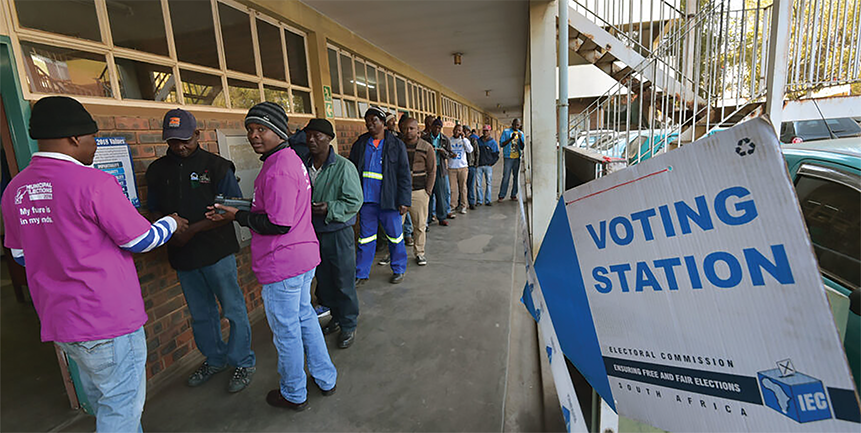
The local government elections are not a rehearsal: they are the moment where the electorate can signal whether it still believes in accountability – or whether it has reconciled itself to impunity.
There is a dangerous adaptation at work in South African politics. When opponents are caught in a scandal, we call it a crisis. When allies are implicated, we call it “strategy” or “context.” This selective outrage is not harmless, but how “kakistocracy” sets in. Dishonesty is no longer exceptional; it becomes part of the expected toolbox. Accountability is no longer a principle; it becomes a tactical weapon.
In this context, the Ad Hoc Committee and the Mandlanga Commission run the risk of being absorbed into the same pattern. The opposition may use them to amplify the failures of the rulers, while the governing alliance may use them to dredge up convenient past transgressions, all while the current beneficiaries of the status quo remain largely unscathed. The public, watching from the sidelines, may be left confused, fatigued and ultimately disengaged.
The real test of accountability is not whether information is exposed, but whether it is acted upon. Can voters still muster the moral clarity to say: “It does not matter which party you belong to; if you are implicated in corruption, sabotage, or the protection of criminals, you should not be in power at any level?” That is the kind of moral bar that can prevent descent into a system ruled by the worst, the most cunning and the least accountable.
The advantage of the local government elections is their proximity to people’s lives. Municipalities control water, electricity, waste management, housing etc. When services collapse, when infrastructure decays, when corruption siphons off resources, it is the local level that bears the first and most visible scars.
That also means it is the local level where voters can most directly express their expectations. Rather than treating the Ad Hoc Committee and Mandlanga Commission as distant dramas, voters can treat them as a kind of covenant with their candidates and political parties.
They can demand:
• Clear commitments to implementing the recommendations of both processes, not in broad statements, but specific policy and budget choices.
• Transparent timelines for clean-up operations in municipal police, procurement, and municipal contracts.
• Mechanisms for public reporting on follow-up actions, so that accountability is not a one-time performance, but an ongoing condition
Where parties have been implicated in the patterns exposed by the two processes, voters can ask: Why should we trust you with local power when you failed at the provincial and national level?
The risk in South Africa is that the narrative will remain in the hands of the powerful. They can spin findings, cherry-pick the evidence and frame criticism as persecution. The public can be told that the real enemies are not the corrupt officials but the whistleblowers, the investigators, or the opposition who use of accountability as a weapon will be dismissed as posturing. Confusion then becomes the ally of the status quo: when facts are blurred, outrage is diluted.
The way to resist this is to insist on continuous civic engagement beyond the hearings. Media houses, civil society and community-based organisations, street committees, community radios, social media platforms, as well as faith-based groups can all keep the hearings findings alive, translate them into local experiences and track how municipalities respond.
Both the Ad Hoc Committee and the Mandlanga Commission do not have to become part of political theatrics but test cases of accountability – benchmarks against which political parties and their candidates are measured.
If the electorate uses the local government elections to reward those who accept the findings, implement the reforms, and rebuild trust, then the power of these processes will survive beyond the headlines.
The truth is simple: the power still lies in the voters’ hands. The committees and commissions can investigate, document, and recommend. But only people, through the ballot box and through sustained civic pressure, can ensure that those findings translate into real change.
In a democracy, the theatre of politics cannot replace the real work of accountability. The voters are – and should be – the ultimate directors of that script.
* Ido Lekota is a veteran journalist and political commentator