
 WeeklySA_Admin
UNILATERAL: A Labour Court ruling recently delivered a blunt message to business: if a bonus is in the contract, it must be paid — no shortcuts, no unilateral changes…
By Roy Bregman
In an economy where cost-cutting has become a corporate reflex, South Africa’s Labour Court has issued a timely and unequivocal warning: employers cannot rewrite employment contracts on their own terms.
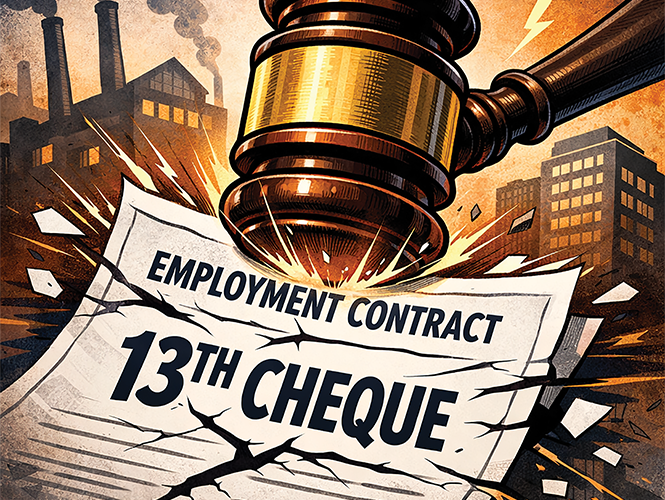
At the centre of this legal clarity is the February 2 2026 ruling in Chemical Energy, Paper, Printing, Wood and Allied Workers Union obo Members v Avacare Health Group, which confirms that a 13th cheque — when embedded in an employment contract — is not a discretionary perk, but a binding obligation.
The case cuts through a grey area that has long been exploited by some employers: the attempt to blur the distinction between contractual rights and workplace practices.
The court’s reasoning rests on a foundational principle of labour law — an employment contract is not a suggestion. It is a legally enforceable agreement.
Where a 13th cheque is expressly provided for in a contract, it becomes part of an employee’s remuneration package. It cannot be withdrawn, replaced, or diluted without consent or a lawful process.
This may sound obvious. But in practice, employers often attempt to sidestep this obligation by reclassifying benefits as “customary” or “discretionary”. The Labour Court rejected this manoeuvre outright.
In the Avacare case, the employer sought to abolish the 13th cheque and replace it with a performance-based bonus. The move was accompanied by a familiar corporate tactic: incentivising compliance with salary increases while discouraging resistance.
The court saw through it.
Perhaps the most striking aspect of the judgment is not just its legal clarity, but its tone.
The court took a dim view of what it described as a “stick-and-carrot” approach — offering financial incentives to employees who accepted the change, while effectively isolating those who did not.
This, the court suggested, undermines collective bargaining and edges into coercion.
In a labour market already tilted in favour of employers, such tactics risk eroding the fragile balance of power between capital and labour. The judgment signals that courts will not tolerate attempts to pressure employees into surrendering contractual rights.
Practice vs Promise
The distinction between a workplace practice and a contractual benefit is not merely academic — it is decisive.
A workplace practice may evolve over time and can, in certain circumstances, be altered. But a contractual benefit is anchored in agreement. It carries legal weight.
The Avacare ruling reinforces that employers cannot simply relabel a contractual obligation to escape it. Courts will examine substance over form.
In other words: what matters is not what the employer calls it, but what was agreed.
This ruling arrives at a moment when many businesses are under financial strain. The temptation to restructure remuneration packages — especially guaranteed bonuses — is real.
But the judgment makes one thing clear: financial pressure does not justify legal shortcuts.
If employers wish to change contractual benefits, they must do so properly — through consultation, agreement, and, where necessary, formal restructuring processes. Failure to do so opens the door to breach-of-contract claims, reputational damage, and costly litigation.
A Broader Message
Beyond the specifics of the 13th cheque, the ruling speaks to a broader principle: trust.
Employment relationships are built on the expectation that agreements will be honoured. When employers unilaterally alter those agreements, they undermine not only legal certainty, but workplace stability.
For employees, the judgment is empowering. It affirms that contractual rights are enforceable — and that the courts remain a viable avenue for redress.
For employers, it is a cautionary tale.
Contracts matter. Words matter. And in the eyes of the law, promises made on paper are promises that must be kept.
Frequently Asked Questions
Does my employer have to pay a 13th cheque by law?
No. There is no automatic statutory right to a 13th cheque, but if your contract provides for it, the employer is contractually bound to pay it.
Can my employer unilaterally stop paying my 13th cheque?
If the 13th cheque is a contractual term, your employer cannot lawfully withdraw it without your consent or a proper process; doing so may amount to breach of contract.
What is the difference between a contractual benefit and a workplace practice?
A contractual benefit is written into the employment contract or clearly agreed, while a workplace practice is an informal custom that has developed over time without being contractually guaranteed.
What should employers do before changing a bonus or 13th cheque?
They should determine whether the benefit is contractual, consult with employees, obtain agreement to any variation, and avoid coercive tactics or mischaracterising the benefit as a mere practice. – GoLegal (article edited)