 WeeklySA_Admin
TURN-AROUND: South Africa edges toward a year without load shedding, but questions remain over the price, coal dependence, and the pace of the energy transition…
By Lehlohonolo Lehana
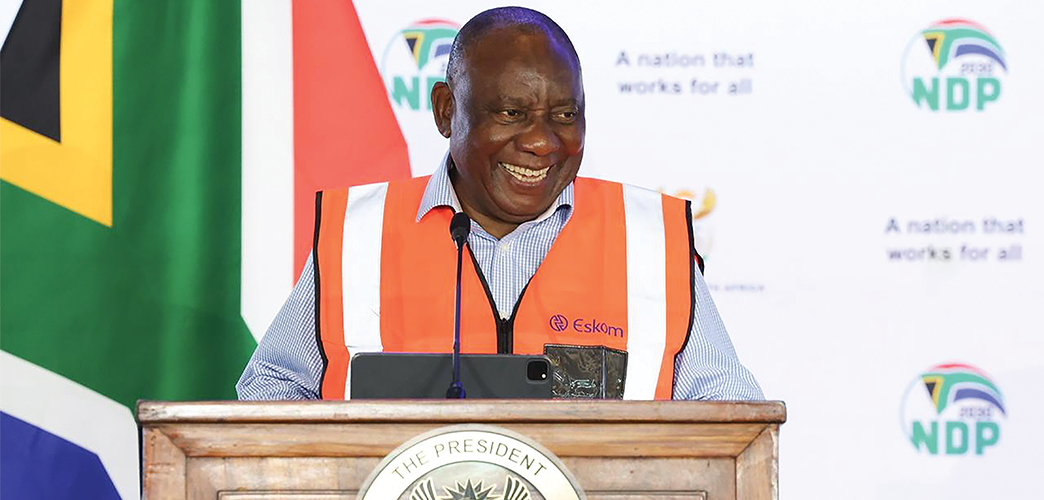
President Cyril Ramaphosa has credited Eskom’s leadership and workforce for pulling the utility back from the brink, hailing what he called the “Magnificent Three” behind its recent recovery.
But his visit to the Kusile Power Station — now fully operational after years of delays — also cast a spotlight on one of the most expensive and troubled infrastructure projects in South Africa’s democratic history.
Joined by Electricity and Energy Minister Kgosientsho Ramokgopa, Eskom board chair Mteto Nyati and CEO Dan Marokane, Ramaphosa praised the team’s role in stabilising power supply and restoring confidence in the grid.
Yet Kusile’s completion comes at a staggering cost of R233 billion, following years of delays, technical failures, contractor issues and corruption linked to state capture.
“The State Capture Commission uncovered widespread corruption and looting at Kusile that nearly brought Eskom to financial ruin,” Ramaphosa acknowledged.
R233bn Kusile nearly brought Eskom to financial ruin — now it stands as a symbol of recovery…
Now fully synchronised, the six-unit plant adds 4 800 megawatts to the national grid — a key factor behind South Africa’s improved energy availability, with the country nearing a full year without load shedding.
“This is a welcome relief for millions of households and businesses,” said Ramaphosa.
Still, the celebration is tempered by deeper structural concerns.
South Africa remains heavily dependent on coal, with Eskom’s fleet among the largest contributors to greenhouse gas emissions globally. Even as older plants are scheduled for decommissioning, Kusile and Medupi are expected to remain operational for decades — locking in coal dependence even as the country commits to a just energy transition.
Under a COP26 agreement, developed nations pledged $8.5 billion to support South Africa’s shift away from fossil fuels. But progress has been uneven.
Efforts to expand renewable energy — particularly through private sector participation — have been slowed by regulatory bottlenecks, legal disputes and infrastructure constraints.
Energy experts warn that replacing ageing coal capacity will require a dramatic scale-up of renewable generation, with estimates suggesting capacity must more than triple in the coming years.
Ramaphosa urged Eskom’s leadership to safeguard the utility’s recovery, calling for “integrity and foresight” in managing strategic assets.
“Energy security is vital to the security and well-being of our nation. It underpins economic growth, job creation and social stability. It shapes prospects of families and communities across our country.
But as the lights stay on, the bigger test lies ahead: whether South Africa can sustain energy stability while navigating the costly and complex transition away from coal.
KUSILE: FROM CRISIS TO COMPLETION
• Cost: R233 billion
• Capacity: 4,800 MW (6 units)
• Delays: Originally due 2016–2023, completed in 2025
• Challenges: Corruption, cost overruns, technical faults
• Impact: Key contributor to reduced load shedding
• Concern: Long-term coal dependence vs climate commitments
MIRROR Briefs
NEW TURN IN PHALA PHALA SAGA
An Independent Police Investigative Directorate (Ipid) report has found that the presidential police security detail deliberately concealed the theft of US Dollars from Phala Phala game farm.
The Phala Phala saga began in June 2022 when criminal charges were laid against President Cyril Ramaphosa and members of his security.
Former director-general at the State Security Agency, Arthur Fraser alleged that Ramaphosa and his team had covered up a February 2020 burglary at his game farm, where large sums of foreign currency—allegedly concealed in furniture—were stolen.
The money was around 580,000 dollars was said to be a payment from Sudanese businessman Hazim Mustafa for 20 buffalo.
The report, compiled by the IPID and declassified after a legal battle led by ActionSA, concludes that no case docket was registered, no official investigation initiated. Instead, state resources were deployed in what IPID determined to be an unlawful investigation into what was effectively a private matter.
Police Minister Firoz Cachalia said the report was declassified on February 2, 2026.
The Ipid report had been classified as ‘top secret’ to protect the integrity of the investigation, witnesses and South African Police Service members who might have been implicated and to ensure that Saps members do not see their names in public platforms before their trial commenced.- Lehlohonolo Lehana.
NEW JUDGES FOR CONCOURT
President Cyril Ramaphosa has appointed Justice Nambitha Christabel Dambuza-Mayosi and Justice Katharine Mary Savage as Judges of the Constitutional Court with effect from May 1, 2026.
President Ramaphosa has made these appointments after consultation with Chief Justice Mandisa Maya and leaders of political parties represented in the National Assembly. The appointments were made in terms of section 174(4) of the Constitution.
Justice Dambuza-Mayosi currently serves as a Judge of the Supreme Court of Appeal – a position she has held since June 2015 and which included an extended period of acting as President of the Supreme Court of Appeal. Justice Dambuza-Mayosi’s career spans more than three decades in legal practice, academia and the judiciary.
Justice Savage became a Judge of the Western Cape High Court in 2015 and has served as a Judge of the Labour Appeal Court since 2024.
Ramaphosa has wished the new judges of South Africa’s apex court well in their new roles.
“Judge Dambuza-Mayosi and Judge Savage have for decades served the cause and practice of justice with great diligence, foresight and, most importantly, clear commitment to our Constitution.
They join the Constitutional Court in the year in which we mark 30 years since the adoption of our democratic Constitution.’’ – SAnews.
LEADERS REMOVED FROM TOP MK STRUCTURES
Umkhonto weSizwe (MK Party) has dismantled leadership structures in Gauteng, Western Cape, and Northern Cape, with KwaZulu-Natal and Mpumalanga provincial structures, removing figures including Willies Mchunu and Busisiwe Mkhwebane.
According to a letter from MK Party secretary-general Sibonelo Nomvalo to the party’s provincial and regional leaders, decisions were made by party president Jacob Zuma and other national officials during a meeting held from March 22 to 23, 2026 in Durban.
Mchunu was heading KwaZulu-Natal to advance the party’s programmes as it heads to the local government elections in 2026. Mchunu left the ANC early this month after he criticised the party for not involving the MK party in the government of national unity (GNU) constituted after the 29 May election.
Mkhwebane was serving as the Mpumalanga convener after she dumped the Economic Freedom Fighters (EFF).
She was removed from the office of the Public Protector in 2023 by President Cyril Ramaphosa on the grounds of misconduct and incompetence.
Former Secretary-General, Bongani Mncwango, meanwhile, has defected to the Inkatha Freedom Party and Nomvalo was appointed as his successor, the eighth person in this role.
The party faces challenges with members calling for the disbandment of the national leadership and reports of mass resignations. – Lehlohonolo Lehana.
NEW LAWS TO PROTECT WHISTLEBLOWERS
Government has unveiled sweeping reforms aimed at strengthening protection for whistleblowers, acknowledging that fear of retaliation, financial ruin and even death has deterred many from exposing corruption.
Minister of Justice and Constitutional Development, Mmamaloko Kubayi, has released the Protected Disclosures Bill for public comment, describing it as a critical intervention to safeguard individuals who come forward with information on wrongdoing.
Speaking at a media briefing in Pretoria, Kubayi said government convened the briefing to present the Protected Disclosures Bill to the people of South Africa.
The proposed legislation arises largely from the findings of the Judicial Commission of Inquiry into allegations of State Capture, commonly known as the Zondo Commission, as well as the recommendations of the National Anti-Corruption Advisory Council (NACAC).
Kubayi painted a stark picture of the risks faced by whistleblowers, noting that existing laws have failed to adequately protect them.
“While the current legislation exists, there have been numerous instances of whistle-blowers suffering occupational detriment, including suspension and dismissal. In some cases, dismissals are used to punish employees, payouts of benefits are delayed, and tragically, some whistle-blowers have lost their lives.”
She cited high-profile cases, including Babita Deokaran, Martha Ngoye, Athol Williams and Mpho Mafole, as examples of individuals who suffered for exposing corruption.- SAnews