 WeeklySA_Admin
PIVOT: African nations being forced into difficult choices — accept new conditions or absorb the shock, with South Africa reeling from consequences already hitting the ground, disrupting lifesaving health services…
By Kerry Cullinan and Marecia Damons
A dramatic shift in United States global health policy is rippling across Africa, especially in South Africa, forcing governments into stark choices between sovereignty and survival — and leaving vulnerable communities exposed as funding dries up.
While countries like Ghana are pushing back against new US conditions tied to health assistance, South Africa is already grappling with the fallout of reduced aid, with disruptions to critical programmes now filtering down to clinics and patients.
At the heart of the crisis is a broader policy pivot in Washington towards what it calls a “trade over aid” model — one that ties health support to strategic and economic interests, including access to natural resources and sensitive health data.
For some African nations, the terms are a step too far. Ghana recently rejected a proposed bilateral health agreement with the US, reportedly objecting to requirements that would compel it to share sensitive health data without guaranteed access to resulting medical innovations.
The move echoes earlier resistance from Zimbabwe, and reflects a growing unease across the continent about what critics describe as a transactional approach to global health.
Yet, while some countries are asserting their independence, others are finding themselves with fewer options.
South Africa, once a major beneficiary of US-backed health programmes, is now feeling the strain after being effectively frozen out of funding. The consequences are already visible — not in policy papers, but in the daily struggles of patients.
South Africa is home to the world’s largest HIV population, and disruptions to treatment and prevention programmes could trigger a resurgence of infections, particularly among vulnerable groups such as young women and children.
A recent report by global health organisations warns that the withdrawal of US funding is already undermining South Africa’s HIV response — one of the largest in the world.
The country has long relied on US support for antiretroviral treatment, prevention programmes and cutting-edge research collaborations. The sudden pullback has “damaged critical health services” and jeopardised decades of progress, according to the report.
The loss of US funding has “dismantled HIV prevention programs, and disrupted world-class South Africa-US research collaboration,” according to the report, which was published last week by Physicians for Human Rights (PHR), Advocates for the Prevention of HIV in South Africa (APHA), and Emthonjeni Counselling and Training.
“Our report illustrates what an ‘America First’ approach to global health looks like: Lifesaving programs shuttered, world-class research jettisoned, decades of progress against HIV/AIDS jeopardised. All to the harm of, not only South Africans, but to Americans and the global public as well,” said Thomas McHale, director of public health at PHR and a report co-author.
Co-author of the report, Emily Bass, warned: “Short-sighted, sudden withdrawal of funds for critical components of the HIV response will cause long-term harm to infants, children, adolescent girls and young women, and other groups at the highest risk of HIV.”
The report mentions two scientific breakthroughs that came from US-South African research partnerships, namely the clinical trial of lenacapavir, an injectable pre-exposure prophylaxis (PrEP) that is almost 100% effective in preventing HIV, and updated global guidelines for treating drug-resistant tuberculosis (TB).
These breakthroughs “directly benefit Americans”, the authors argue. “By freezing research funding to South Africa, the Trump administration is sabotaging the United States’ own future health and national security.”
The report is based on interviews with South African doctors, researchers, people living with HIV, and others involved in South Africa’s HIV response efforts.
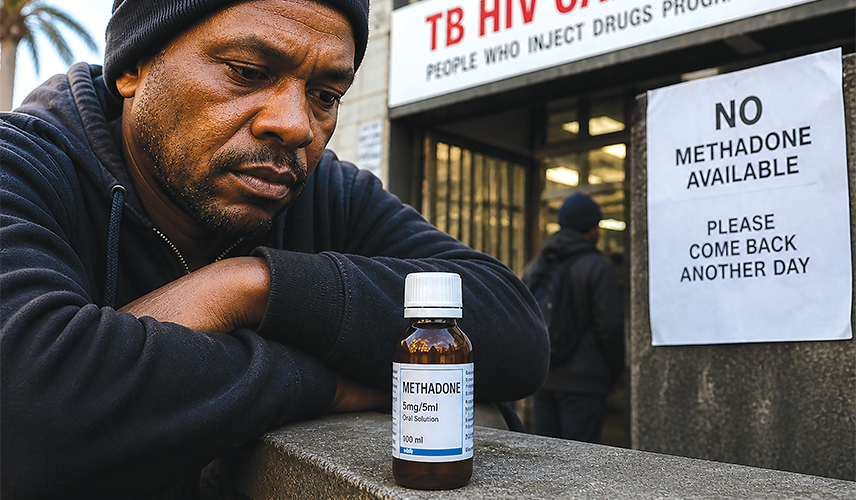
In Cape Town, disruptions to a methadone programme — used to treat opioid dependency — have left recovering users vulnerable to relapse.
Jade Lewis (44) knows the impact first-hand. When he arrived at a TB HIV Care drop-off site earlier this year to collect his medication, he was turned away due to lack of supply. The interruptions continued for weeks, with inconsistent access forcing him to return to heroin use to manage withdrawal symptoms.
“I had to let a job opportunity go because I couldn’t secure enough medication,” Lewis said, describing how the instability derailed his recovery.
Methadone is widely recognised as a life-saving treatment for people battling opioid addiction. But supply disruptions — linked to funding uncertainty — have made access unreliable. Outreach workers say the consequences are predictable.
“When people can’t access methadone, they go back to heroin because it’s cheaper and more accessible,” said Rudie Basson, a peer facilitator working with affected communities. The programme, previously supported through US-linked funding channels including PEPFAR and the Global Fund, has been caught in the wider funding squeeze.
With US contributions reduced and competition for remaining funds intensifying, organisations have struggled to maintain services. South Africa’s latest Global Fund allocation, for example, is only a quarter of what it was in the previous cycle.
Although TB HIV Care says service delivery has since stabilised after operational adjustments, the episode underscores how quickly funding shocks can translate into human consequences.
And the risks extend far beyond addiction services. The country’s strained relationship with the US — linked to geopolitical tensions and domestic policy disputes — has compounded the funding challenges, leaving it exposed at a time when demand for health services remains high.
Experts warn that the long-term costs of the current approach could be significant.
Beyond the immediate disruption to services, the breakdown of research partnerships threatens future medical breakthroughs. Collaborative work between US and South African scientists has previously delivered major advances in HIV prevention and tuberculosis treatment.
Now, those gains are at risk. – Health Policy Watch/GroundUp
What’s Changing in US Global Health Policy?
• Shift from aid-based support to “trade over aid” agreements
• Health funding increasingly tied to economic and strategic interests
• Pressure on countries to share data or open resource sectors
• Reduced funding for major programmes like HIV/AIDS and TB
• Growing pushback from African nations asserting sovereignty