 WeeklySA_Admin
Recovery: South Africa’s municipalities are collapsing under a neoliberal model that treats water, electricity, and sanitation as commodities to be sold rather than rights to be guaranteed …
By Siyabulela Mama and Lily Manoim
It was in May 1979—47 years ago—that Margaret Thatcher came to power in the United Kingdom. What followed was Thatcherism: the gospel of the market, the shrinking of the state, the insistence that even survival must pay for itself.
Across the Atlantic, Ronald Reagan was doing the same thing from 1980. What is less often remembered is how eagerly South Africa’s post-apartheid government took notes.
In 1996, then deputy president Thabo Mbeki openly called himself a Thatcherite, and the government introduced the decidedly conservative Growth, Employment and Redistribution (GEAR) strategy as the country’s new economic framework. The democratic government was, in other words, fawning over the Iron Lady.
That inheritance sits at the centre of South Africa’s municipal crisis today. The core assumption that people can pay market rates for basic services in an economy with the highest unemployment rate in the world was always flawed.
The state is visibly failing to deliver services—but handing that failure
to the private sector will not fix it. It will simply shift who bears
the consequences, and poor people will bear them most…
With expanded unemployment above 40%, the model of cost-recovery finance that Thatcherism inspired, where municipalities depend on selling water, electricity, and sanitation to residents, is not just impractical, but is also fundamentally anti-poor and anti-working class.
For millions of South Africans, survival is already stretched to its limit. Households juggle transport costs just to access work, rent or bond payments to keep a roof overhead, school fees and transport for their children, and the rising cost of food.
In this daily arithmetic, a municipal bill is not simply another expense. It is often the tipping point between eating and going hungry.
The government itself keeps publishing evidence of municipal dysfunction—leaking infrastructure, billions in irregular expenditure flagged by the Auditor General, vast sums lost to interest payments on debt, and the outsourcing of basic functions that the state should be delivering directly. Austerity budgets are allocating less and less to municipalities.
Yet, rather than confront these failures honestly, the response has been to deflect—to blame poor residents and double down on cost recovery as the solution.
When residents cannot afford to pay, municipalities respond predictably: service restrictions, disconnections, and escalating debt. What politicians frame as a “culture of non-payment” is in fact a crisis of affordability, one rooted in structural unemployment and inequality that the state itself has failed to address.
Instead of spending on service delivery, municipalities are wasting growing sums on what they call “revenue protection”, hiring contractors to harass and disconnect poor households.
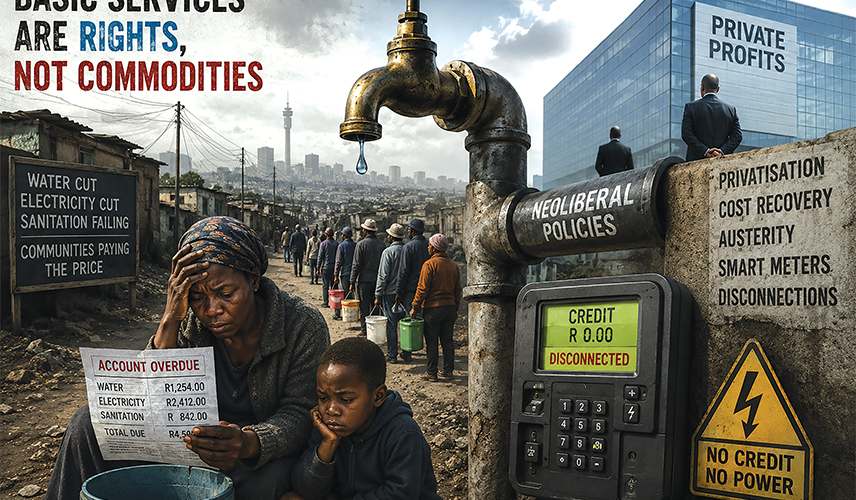
At the national level, budget reallocations have gone toward installing prepaid smart meters that automatically cut people off when they can’t pay. In the 2024/25 Municipal Financial Management Act Budget Circular, Treasury confirmed that R2 billion was reprioritised from the integrated national electrification programme to fund a new smart meters grant. The electricity-poor are being made to fund the infrastructure of their own disconnection.
The state’s fall-back is indigent policies, supposedly a safety net for the poor. But these policies reproduce the injustices they claim to address. To qualify, households must prove their poverty through bureaucratic processes that are often invasive and degrading.
Many are excluded because of documentation requirements, administrative failures, or arbitrary income thresholds. As poverty deepens, the net is getting smaller, not bigger.
Across working-class communities, residents are also reporting inflated and inconsistent water bills that bear little relation to what they actually consumed. The meters are highly sensitive to water pressure fluctuations. When supply is unstable—which, in many communities, it frequently is—the meters record usage inaccurately.
When water returns after a shutdown, the surge in pressure can cause meters to over-record consumption dramatically. Residents report being charged three to four times their normal usage, even during periods when the water supply was intermittent or completely cut off. The cruelty of this is almost geometric: communities suffer water shortages and then receive bills as though the taps never stopped running.
Operation Vulindlela doubleo-down
Local governments receive only around 10% of the national budget and are expected to generate the rest through service charges. This forces municipalities to operate like businesses in a society defined by deep inequality. That was always going to fail. What is new is how aggressively the state is doubling down on this approach rather than rethinking it.
Operation Vulindlela—the capstone policy of President Cyril Ramaphosa’s administration—is the latest iteration of a familiar South African story. We had RDP, then GEAR, then ASGISA—each representing a steady retreat from social responsibility toward market-friendly policy.
As the name suggests, Operation Vulindlela is about “opening up” the economy to private investment, locally and internationally. In the realm of basic services, this means private companies gaining ownership and control over water, electricity, and sanitation.
The problem is straightforward: private companies exist to generate profit. Once water becomes a profit-generating commodity, only those with enough money will reliably have access to it. The state is visibly failing to deliver services—but handing that failure to the private sector will not fix it. It will simply shift who bears the consequences, and poor people will bear them most.
The policy changes driving this shift are already underway: amendments to the Water Services Act; simplified legislation around public-private partnerships at both municipal and national levels; the creation of a National Water Resource Infrastructure Agency; the establishment of a National Water Partnership Office explicitly designed to turn water provision into “bankable projects.” Similar restructuring is happening across the electricity sector.
Municipalities receive most of their operating budgets through national government grants—funded, ultimately, by our taxes. A recent change ties those grants to conditions: metros can only access certain conditional funding if they have a “business plan” and begin restructuring their trading services—water, sanitation, electricity, and solid waste—in ways that open the door to private sector involvement.
Revenue collection from households is itself a condition for receiving the grant. Municipalities are, in effect, being incentivised to squeeze their residents harder.
In his recent budget speech, South Africa’s Finance Minister Enoch Godongwane confirmed that R27.7 billion (more than 1.5 billion USD) has been allocated over the medium term to this performance-linked Metro Trading Services Reform, with budgets cut for metros that miss targets. The programme is also backed by a $925 million World Bank loan, which comes, as World Bank loans always do, with its own conditions.
Universal access to services
Local government elections in November 2026 make this the right moment to ask what a just alternative actually looks like. The path forward is not complicated to describe, even if it will be hard to win. A new municipal finance model must guarantee universal access to basic services—not as a commercial transaction but as a right.
That means significantly increasing national transfers to municipalities, implementing progressive taxation so that large corporations and wealthy households pay proportionally more, and fixing the broken billing systems that are currently penalising people for water they never received.
Right now, big corporations benefit from cheap water and electricity tariff agreements while poor households face rising fees and the threat of disconnection. The state spends money and resources on disconnecting people who cannot pay and on servicing World Bank loans.
That money should be going toward expanding infrastructure and fixing leaking pipes, not installing smart meters designed to automate exclusion. – Africa is Country