 WeeklySA_Admin
TARGETED: Hundreds of Vatsonga Machangani marched to the South African Human Rights Commission in Johannesburg, saying they are being harassed, profiled and forced to prove their citizenship amid rising anti-immigrant sentiment. They have given the commission 15 days to act…
By Kimberley Mutandiro
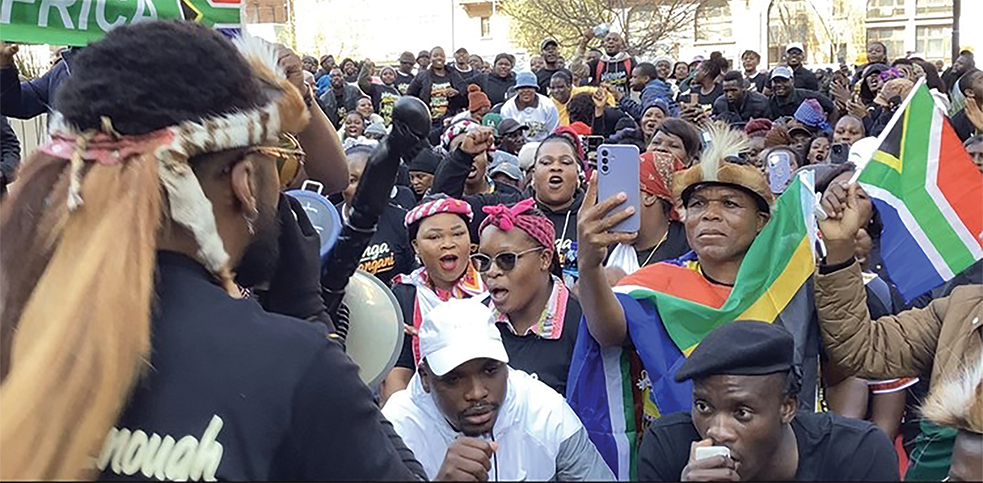
On Friday, hundreds of Vatsonga Machangani from across South Africa marched from Beyers Naude drive to the Human Rights Commission (SAHRC) in Parktown, Johannesburg. They were demanding an end to human rights violations faced by their people during recent marches and amid anti-immigrant sentiment fuelled by March and March.
Organised by the Vatsonga Machangani Association of South Africa, most marchers were people originally from Bushbuckridge and Tzaneen, Limpopo.
The protesters said Vatsonga Machangani are being attacked and accused of being undocumented. Marchers we spoke to said they are now afraid to speak their language in public. Some said they’d been forced on multiple occasions to produce documents to prove their South African identity during protests.
“We are tired of hearing the phrase ‘Mashangani Abahambe’ in our community. I am a South African citizen, but I’m treated as a foreigner in my own country,” said Tinyiko Cossa, from Elandsfontein informal settlement. She said when she wears her traditional attire, anti-immigrant groups label her a foreigner.
I am a South African citizen, but I’m treated as a foreigner in my
own country. We are tired of hearing, ‘Mashangani Abahambe’…
A memorandum presented to the SAHRC expressed concern over a growing crisis where Vatsonga Machangani are being subjected to discrimination, harassment, violence, and intimidation due to their language, identity and cultural expression.
“These injustices are rooted in misidentification, ignorance, and unlawful vigilantism, which have in some instances escalated to fatal incidents,” read the memorandum.
The memo referred to the killing of 19-year-old Nhlamulo Sambo, originally from Limpopo, in Mossel Bay, Western Cape, during a protest in May. Demands included the public condemnation of the targeting of South African citizens based on language, ethnicity, or cultural identity and the recognition of Vatsonga Machangani traditional leaders. The marchers also demanded perpetrators be given harsh sentences.
Nhlamulo Makhubela and Leonard Ngobeni joined the march calling for an end to the harassment of Tsonga-speaking South Africans.
National coordinator of the Vatsonga Machangani Association Civic Movement Wandile Malileke said, “The commission has the responsibility to educate other tribes of the existence of the Vatsonga Machangani people to avoid further violations.”
He said it is unlawful for ordinary people to go around asking for documents. Nhlamulo Makhubela, from the Banthu Movement, said attacks on immigrants are unjustified. He called on vigilante groups to stop taking the law into their own hands.
“People are being beaten, anti-migrant marches are taking a wrong turn, and lives are being lost. This should stop,” Makhubela said.
The SAHRC was given 15 days to respond to the memo. Representatives of the commission promised to address the marcher’s concerns.
500 Malawians stranded
Meanwhile, about 500 Malawians, mostly women and children, were left stranded due to permit issues with the buses meant to repatriate them.
The crisis began when people, who thought they were being repatriated to Malawi on four buses from Cape Town and three from Durban, were taken to Johannesburg instead, because the buses lacked the permits required to cross the border. They were dropped at the Malawian consulate in Sandton on the weekend. The group has since found temporary shelter at a church, while authorities work to finalise their journey home.
This comes as the Department of Home Affairs is scrambling to accommodate, process, and either repatriate or thousands of immigrants in Durban.
According to Tessa Dooms, a representative of community organisations and NGOs assisting the group, Home Affairs officials said they were initially unaware of the situation, believing all repatriation buses had already left the country.
Dooms said NGOs immediately stepped in to provide food and water for people who had expected to already be across the border.
The group was first accommodated at a small church in Newlands, offered by a Malawian pastor, but the venue soon proved too small to reasonably accommodate hundreds of people, and the sudden arrival raised concerns among Joburg residents who gathered at the church, according to Dooms.
The group was moved to another church. – GroundUp
MIRROR Briefs
JUDGE’S PROPERTY FROZEN
The National Prosecuting Authority (NPA) secured a preservation order for R6-million Hartebeespoort house registered to the embattled Judge Portia Phahlane.
Phahlane has been released on R50 000 bail after being arrested by the Hawks on allegations of accepting a multi-million rand bribe linked to a long-running IPHC church leadership dispute.
The IPHC, founded by Frederick Modise in the 1960s, became the subject of intense litigation after the death of his son, Glayton Modise, in 2016. Three factions are vying for the position of IPHC “comforter”: Modise’s sons Tshepiso and Leonard, who are contesting each other and a third contender, Mike Sandlana, who claims to be Modise’s biological son.
The preservation order, granted by the Gauteng High Court in Pretoria, prevents the sale, transfer or disposal of the property while forfeiture proceedings are underway. The property has also been placed under the control of a curator bonis pending the outcome of the case.
The Asset Forfeiture Unit obtained the order as part of an ongoing criminal prosecution before the Specialised Commercial Crimes Court in Pretoria, where Phahlane and five other accused face corruption-related charges.
The National Director of Public Prosecutions Andy Mothibi described the seizure as part of an ongoing operation to restore trust in criminal justice in the country. – Lehlohonolo Lehana.
R1,9B TO BOOST SERVICE DELIVERY
The Gauteng Department of e-Government has been allocated R1.9 billion for the 2026/27 financial year to advance the province’s digital transformation agenda and improve government service delivery. The funding will be used to modernise information and communication technology (ICT) infrastructure, expand digital government services, strengthen cybersecurity, improve digital resilience, support ICT skills development, enhance e-waste management and establish an Artificial Intelligence (AI) Office.
As part of the programme, the department plans to build and connect 300 Gauteng Provincial Network (GPN) sites, extending broadband connectivity to schools, healthcare facilities, libraries and community centres, particularly in townships, informal settlements and hostels.
The department said it will continue developing the Gauteng Digital Platform as a single access point for government services while enhancing digital platforms including the e-Recruitment System and the Gauteng Matric App.
Implementation of the e-Indigent Register System has already been completed in Mogale City, Rand West City Local Municipality and Merafong City Local Municipality. Development in Midvaal, Lesedi and Emfuleni local municipalities is nearing completion.
The department now plans to expand the system to metropolitan municipalities, including the City of Johannesburg, City of Tshwane and City of Ekurhuleni, following consultations and system gap analyses. To encourage greater use of digital government services, the department will appoint 75 e-Ambassadors to help residents access online platforms and government services. – SAnews
CITY BOSS FACES SUSPENSION
The City of Tshwane manager Johann Mettler has been given seven days to explain why he should not be placed on precautionary suspension.
Mettler is facing allegations of financial misconduct, maladministration and gross dereliction.
Tshwane Mayor, Nasiphi Moya tabled a report before council recommending that the allegations be investigated. The complaint penned by the Economic Freedom Fighters against Mettler contains allegations relating to procurement processes, labour disputes, appointments of senior officials and governance failures. It also refers to findings by oversight institutions, including the Public Protector and the Auditor-General.
Among the issues raised are allegations relating to irregular expenditure, the implementation of lifestyle audits, disciplinary action against municipal employees and the handling of procurement matters within the city.
On March 31, 2026, the Public Protector (PP) released a report finding there were irregularities in the appointment of Moshema Mosia to the position of Tshwane’s chief of Emergency Services.
The report found, among others , that the position was not properly advertised with the qualification requirements written ambiguously.
The report also found that the Selection Panel also failed to conduct background and reference checks of candidates, as required by legislation. – Lehlohonolo Lehana.
CALL TO EXPEDITE GENDER EQUALITY
South Africa, as Chair of the Southern African Development Community (SADC), has called on member states to accelerate efforts to achieve gender equality, warning that less than five years remain to meet the targets of the 2030 Agenda for Sustainable Development.
Opening the Ordinary Meeting of SADC Ministers Responsible for Gender and Women’s Affairs on Friday, Minister of Women, Youth and Persons with Disabilities Sindisiwe Chikunga urged Ministers to assess progress in implementing regional gender commitments while addressing the challenges that continue to hamper development. Chikunga said SADC’s gender agenda – rooted in the 1997 SADC Declaration on Gender and Development and strengthened by the SADC Protocol on Gender and Development – provides clear obligations for member states to eliminate discrimination, combat gender-based violence (GBV) and ensure equal access to justice.
She called on Ministers to evaluate implementation of regional gender instruments and develop strategic interventions to achieve Sustainable Development Goal 5 on gender equality and the empowerment of women and girls.
Referring to decisions taken in Harare in 2025, Chikunga urged member states to mobilise resources to implement the Revised Strategy on Gender-Based Violence and the Framework for Achieving Gender Parity in Political and Decision-Making Positions, saying the region was “not faring well” in these areas.- SAnews