 WeeklySA_Admin
INFRASTRCTURE: About 700 learners at a Soshanguve primary school have relied on 13 mobile toilets for three years. Parents say irregular servicing, a lack of handwashing facilities and mounting health concerns may force them to keep their children at home…
By Keletso Mkhwanazi
Parents at a Soshanguve primary school in Pretoria have threatened to keep their children at home over mobile toilets they say pose serious health and safety risks to learners.
The warning comes as the Gauteng Department of Education faces an estimated R27 billion backlog in addressing occupational health and safety problems at schools across the province.
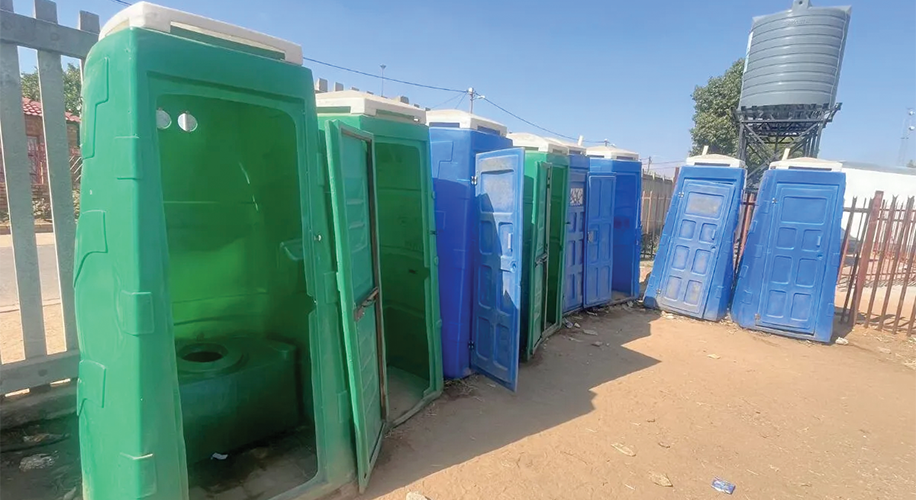
About 700 learners at Rivhoningo Primary School in Soshanguve Block JJ have relied on 13 mobile plastic toilets since the school’s main toilet block, comprising 15 flush toilets, became permanently blocked and unusable in 2023.
Parents who spoke to Health-e News said the temporary toilets were not serviced regularly and that learners had no nearby taps at which to wash their hands.
They fear the unhygienic conditions are making children ill.
School governing body member James Kekana said three girls had been treated for urinary tract infections at the Soshanguve Block JJ Clinic this year.
“The toilets are acidic, and my biggest concern is female learners who are exposed to these unhygienic conditions,” Kekana said.
The governing body said school staff cleaned the toilets twice a week, while an external service provider was responsible for removing waste. Parents alleged that the contractor did not always arrive when the units were full.
One mother, identified as Kgomotso* to protect her daughter’s identity, said her Grade 3 child developed a urinary tract infection in April.
“My daughter didn’t say anything immediately. I believe it was out of fear,” she said.
“Days later, I noticed she couldn’t walk properly and saw bloodstains on her underwear. I took her to the doctor because I suspected she had been sexually assaulted. But the doctor explained that it was a urinary infection, probably from the toilets.”
Kgomotso said her daughter had since become afraid of using the school toilets.
“My other worry is that she now holds in her urine for the whole day, and that might damage her bladder. We plead with the Department of Education to intervene.”
Residents living near the school have also complained about the stench and an infestation of flies.
Ward 11 resident Mummy Ledwaba, who lives opposite the school, said the conditions had become unbearable.
“I hardly open my windows. I can’t breathe because the smell is terrible,” she said. “I’ve endured this for months. MEC of Education, we kindly seek your intervention. It has been going on for far too long.”
Ledwaba said she was shocked when she allegedly heard a teacher instructing a learner to urinate behind the toilets.
“Those toilets are mainly used temporarily at funerals for a few days, not for primary school learners to use every day,” she said.
Parents were told in January 2023 that the mobile toilets would be used only while a new flushing system was installed. Three years later, the school’s sanitation system has still not been restored.
School staff have also raised safety concerns about the plastic units.
A security guard, who asked not to be named, said a Grade 2 learner was once trapped inside a toilet for several hours. Police were nearly called after staff believed the child was missing, only for him to be found asleep inside the unit.
“The boy had to inhale the chemicals and waste from the toilet for hours,” the guard said.
When Health-e News visited the school on July 23, the main bathrooms were abandoned, with missing doors, a damaged roof and broken taps. There was no running water for learners to wash their hands.
The guard said staff had been told they might begin using buckets to flush the blocked toilets because the drainage system remained unrepaired. He questioned why new classrooms were being constructed before the sanitation crisis was resolved.
“The school could have rebuilt the toilets first. Learners have been suffering for far too long,” he said. Residents raised the issue during a community outreach meeting in June hosted by Gauteng MEC for Education, Sports, Arts, Culture and Recreation Lebogang Maile.
The meeting formed part of the department’s “It Takes a Village to Raise a Child” programme, launched in May.
Maile reportedly told parents that a team would be deployed to assess the school and determine whether the toilets could be repaired. Parents say no departmental team had visited the school two months later.
At a media briefing on Monday, August 10, Maile said Gauteng needed about R27 billion to address occupational health and safety concerns in school infrastructure. Problems with ablution facilities were among those identified through the outreach programme.
“We need R27 billion to deal with occupational health and safety. We need money, and that’s the problem,” Maile said.
He said the department was prioritising emergencies, particularly schools considered uninhabitable, while exploring alternative sources of funding. Parents at Rivhoningo Primary School, however, say they cannot continue waiting. Unless the toilets are serviced and a permanent solution implemented, they may keep their children at home to protect their health and safety. – Health-e News
*Kgomotso’s name has been changed to protect her daughter’s identity.
MIRROR Briefs
ZIM FERRY TOLL HITS 46
A survivor of Zimbabwe’s Lake Kariba ferry disaster has described watching helplessly as passengers drowned after the overloaded vessel capsized in choppy waters, killing at least 46 people.
Chance Siyamavhu, 45, lost his best friend and seven relatives in Tuesday’s tragedy. He said a wave pushed the sinking ferry upwards, allowing him and others to climb onto its overturned hull.
From there, they watched passengers struggle in the water. Many scrambled for life jackets but did not know how to use them, he said at a memorial service in Kariba, near the Zambian border.
“Our relatives were swept in another direction and they sank because we were not in a position to help them,” Siyamavhu said. Dozens of mourners gathered before 44 coffins at the service as police confirmed that the death toll had risen to 46. The victims’ names would be released later, authorities said. Officials said the government ferry, an important transport link for villagers and fish traders around the lake, was authorised to carry 90 people. However, it was carrying 114 adults, five crew members and an unspecified number of children.
The Civil Protection Unit said 77 people had been rescued, although authorities feared others remained unaccounted for.
Survivors said they had pleaded with the captain to turn back as water entered the boat. Security official Anymore Chambati said he managed to distribute fewer than 10 life jackets before heavy winds forced water into the engines, causing all but one to fail during the ill-fated lake crossing.
MOZAMBIQUE BORDER UPGRADE
Mozambique will launch construction of the Ressano Garcia One-Stop Border Post with South Africa on Monday, a major upgrade aimed at improving the efficiency of the Maputo Logistics Corridor. The 980-million-meticais (about R250-million) project will be financed by Gestão de Terminais e Serviços Aduaneiros, concessionaire of the KM4 freight terminal. The development includes new passenger-processing facilities, three-lane entrances and exits at the freight terminal, dedicated access routes for mineral trucks travelling to the Port of Maputo, and housing for state employees stationed at the border.
Digital systems used by immigration, customs and other state agencies will also be integrated and automated. Once completed, travellers will undergo South African and Mozambican immigration and customs procedures at a single facility, eliminating separate stops and reducing crossing times.
Express lanes will reduce processing times for mineral trucks from up to an hour to about five minutes, while general cargo could be cleared within 30 minutes. National Logistics Director Fernando Ouana said shorter queues would reduce fuel and labour costs, improve business predictability and support tourism.
He stressed that the concessionaire would build and maintain the facilities and manage vehicle access, while immigration and customs controls would remain entirely under state authority.
MBEKI FOUNDATIONS CONSOLIDATE
The Thabo Mbeki Foundation (TMF) and WDB Trust have consolidated to establish the Thabo and Zanele Mbeki Foundation (TZMF), an institution focused on intellectual discourse, public policy and women-led grassroots development across Africa.
The restructuring creates a dual-entity model rather than absorbing one organisation into the other. The WDB Endowment Trust, reconstituted from the original WDB Trust, will serve as capital steward and manage TZMF’s funding. Although the legal restructuring is complete, regulatory, tax, governance and operational integration will proceed in phases. TZMF will be publicly launched in November, with full operations scheduled to begin on March 1, 2027. Existing teams, programmes, grants, partnerships and community commitments will continue during the transition.
The consolidation combines TMF’s pan-African mandate, policy research, intellectual leadership, political heritage and convening platforms with WDB Trust’s three decades of experience in women-led community development, financial inclusion and micro-enterprise support.
WDB Trust chairperson Gloria Serobe said the merger would broaden both legacies while keeping women’s leadership central. TMF chairperson Geraldine Fraser-Moleketi said TZMF would connect ideas and dialogue with implementation, evidence and policy influence, advancing the African Renaissance across the continent.
Further details on governance and the consolidated programme framework will be announced ahead of the launch. – Anga Jamela/Fullview
CHARGE SEXTORTION AS CORRUPTION
Public Protector Advocate Kholeka Gcaleka has called for perpetrators of sexual extortion, or “sextortion”, to be charged with corruption under South Africa’s existing anti-corruption law.
Gcaleka made the call on Wednesday at Stellenbosch University’s second Symposium on Gender Inequality and Anti-Corruption in Bellville, Cape Town. The three-day gathering, hosted by the university’s School of Public Leadership, forms part of its Women’s Month programme.
She argued that the Prevention and Combating of Corrupt Activities Act did not require gratification to have monetary value and could therefore cover demands for sexual favours.
“Sexual corruption is arguably already corruption under existing law,” Gcaleka said. “What is missing is not the offence but the charge, the prosecution, the record and the count.” International organisations, including Transparency International and the International Association of Women Judges, define sextortion as the abuse of entrusted power to obtain a sexual, rather than financial, benefit. Gcaleka also urged authorities to establish safe, independent reporting channels outside the offices of alleged perpetrators. This, she said, would reduce the risk of intimidation, obstruction or interference when victims attempted to report abuse and seek accountability.
Her proposal seeks to ensure that sexual demands linked to official power are formally investigated and prosecuted.