 WeeklySA_Admin
ENFORCEMENT: Immigration protests in South Africa have exposed deep public anger over jobs, poverty and failing services. But evidence suggests undocumented migrants are becoming the visible face of structural problems rooted in decades of inequality, economic stagnation and weak governance…
By Nicholas Mwangi
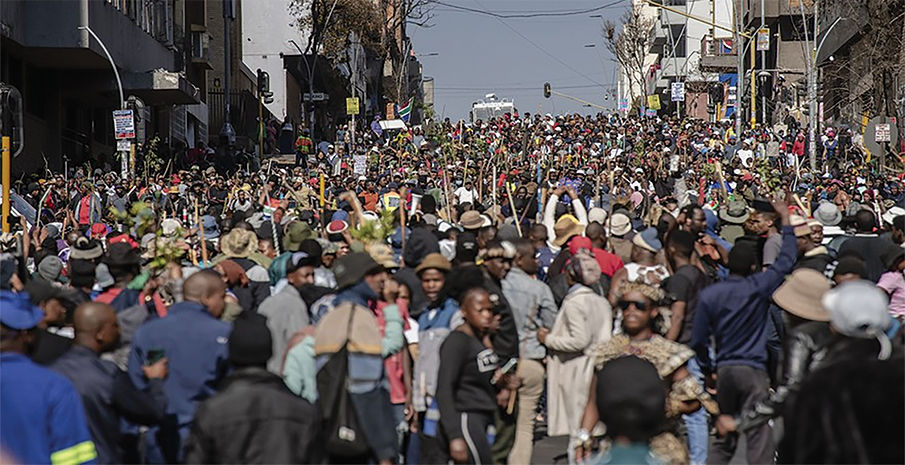
South Africa’s deadline of June 30, set by anti-immigrant groups for undocumented immigrants to leave the country, came and went under heavy police deployment, closed businesses, and widespread anxiety.
While fears of large-scale violence prompted heightened security across several provinces. Some demonstrations remained peaceful, while other areas experienced looting, isolated attacks, and arrests, like KwaZulu-Natal and Western Cape. It is the latest in a growing movement that has gathered momentum throughout 2026, with anti-immigrant groups organizing marches, blocking access to public institutions, and demanding the removal of undocumented migrants. The movement has already announced that protests will continue every Thursday.
What is really driving the protests?
South Africa continues to struggle with one of the world’s highest unemployment rates, particularly among young people, alongside persistent inequality, rising living costs, deteriorating public services, and slow economic growth. These conditions have created fertile ground for narratives that portray migrants as competitors for scarce jobs, housing, healthcare, and social services.
When jobs remain scarce and public services fail, frustration seeks visible targets. Migrants often become the easiest ones…
Throughout the year, anti-immigrant activists have or attempted to block hospitals and schools, demanding that South Africans receive priority treatment. Others have stopped individuals in communities, asking them to produce identity documents, actions the South African government has repeatedly declared unlawful, insisting that immigration enforcement remains the responsibility of state agencies rather than citizens.
For many, the protests are driven by a genuine belief that undocumented migration has worsened unemployment, crime, and reliance on state benefits. But whether those perceptions are supported by evidence is highly contested.
Read more: Anti-immigrant protests and violence escalate in South Africa
“Citizens vs state”
Speaking to BreakThrough News, South African youth activist Moeketsi Phatsoane argues that the crisis should first be understood as one between the state and the citizens.
“There is a conflict between the citizens and the state,” he explains. “Some believe they have the right to conduct citizen arrests by identifying undocumented migrants themselves. But the state has responded that this is not permitted under South African law. Immigration enforcement is the responsibility of state institutions, not ordinary citizens.”
According to Phatsoane, government engagement with organizers before the June 30 protests sought to discourage vigilantism while allowing peaceful demonstrations to proceed under police supervision. In several locations this approach prevented major violence, although isolated incidents still occurred. The deeper issue, however, extends far beyond policing. “There is no substantial evidence that migration causes unemployment,” Phatsoane says. “That is largely a myth. South Africa’s unemployment crisis is structural.”
He notes that while many South Africans believe migrants are taking jobs in retail, agriculture, construction, and commercial sectors by accepting lower wages, official unemployment statistics primarily measure South African citizens, making direct correlations difficult to establish. Migrants themselves represent diverse age groups rather than a single influx of unemployed youth.
Crime presents a similar debate.
“Crime is committed by everyone,” he says. “There is a stronger relationship between crime and poverty or unemployment than between crime and immigration.”
This distinction matters because public perception has increasingly shaped politics regardless of statistical evidence. South Africa’s immigration debate cannot also be separated from global political trends. Across Europe and North America, far-right parties have successfully mobilized economic frustrations by presenting immigration as the central explanation for declining living standards. Similar narratives have increasingly entered South African political discourse, where some parties like Action SA, IFP, Patriotic Alliance, and the DA have adopted harder positions on migration ahead of elections.
But South Africa’s circumstances carry additional historical complexity.
The country’s economy remains deeply unequal three decades after apartheid, with wealth concentrated in a relatively small section of society while millions continue to experience unemployment, informal work, and inadequate public services.
As economic reforms have increasingly emphasized fiscal restraint and reduced public spending, access over healthcare, education, housing, and municipal services has intensified.
Phatsoane believes these conditions have transformed migrants into convenient political targets.
“What capital has done in South Africa is create insufficient structural transformation,” he points out. “Austerity limits public spending while private interests continue to receive support. Because migrants are constitutionally entitled to access services like healthcare and education, communities facing shortages begin to see them as competitors. That creates conflict.”
In this case, migration is less the source of the crisis than the terrain upon which deeper economic contradictions are expressed. When hospitals lack staff, schools become overcrowded, or jobs remain scarce, public frustration seeks visible targets. Migrants often become the easiest ones.
This also explains why immigration has become such a powerful organizing issue. It offers immediate and identifiable explanations for problems whose origins lie in decades of unequal development, slow structural transformation, and persistent economic exclusion. The protests therefore raise uncomfortable questions not only for South Africa but for the continent.
As the African Continental Free Trade Area seeks greater regional integration and mobility, rising hostility toward African migrants threatens broader Pan-African aspirations. South Africa has long attracted migrants from Zimbabwe, Mozambique, Malawi, Ethiopia, Nigeria, the Democratic Republic of Congo, Somalia, and elsewhere, many fleeing conflict or seeking economic opportunity.
The challenge facing South Africa is not just managing migration. It is addressing the conditions that make migrants appear responsible for crises they did not create. – Breakthrough News
Comment
The Infantino Evasion
FIFA President Gianni Infantino’s latest statement on the suspension of United States forward Folarin Balogun is intended to reassure the football world that the governing body’s judicial system remains independent. Instead, it exposes a growing problem that has increasingly dogged his presidency: the widening gap between institutional principle and public perception.
Nobody disputes that FIFA’s disciplinary bodies are designed to operate independently. Nor is there evidence that Infantino personally influenced their decision. But leadership is measured by more than constitutional arrangements. It is measured by public confidence that decisions are made—and seen to be made—without political influence or preferential treatment.
That confidence has been steadily eroded.
Infantino acknowledges receiving a telephone call from United States President Donald Trump while the disciplinary process was under way. He insists he simply explained that the matter rested with FIFA’s independent judicial bodies. Yet by revealing the conversation, he has reinforced the very concern he sought to dismiss: that powerful political figures enjoy privileged access to FIFA’s highest office while sensitive cases are unfolding.
In modern governance, perception matters almost as much as procedure. Even where no rules have been broken, poor judgement can inflict lasting reputational damage.
This controversy also does not stand alone. It follows months of criticism over what many observers see as an increasingly close relationship between Infantino and President Trump, including the unprecedented decision to present him with a FIFA “Peace Prize”. Whether intended as diplomacy or symbolism, the award blurred the line between football administration and political theatre, inviting inevitable questions about FIFA’s impartiality. Against that backdrop, Infantino’s insistence that he merely respects independent institutions sounds less like decisive leadership than an attempt to distance himself from an uncomfortable controversy.
The FIFA president cannot enjoy the prominence and influence of his office while stepping aside whenever difficult questions arise. Leadership requires ownership—not only of football’s triumphs, but also of controversies that threaten the organisation’s credibility. The 2026 FIFA World Cup should be remembered for the football, not recurring debates about governance, political proximity and unequal treatment. Every controversy chips away at the trust FIFA has spent years trying to rebuild after its darkest scandals.
Infantino often speaks about protecting football’s integrity. Integrity, however, depends not only on independent committees and carefully crafted statements. It also requires leaders to exercise sound judgement, maintain visible distance from political power, and understand that appearances carry consequences.
The question is no longer simply whether FIFA’s disciplinary process was independent. It is whether football’s governing body still appreciates that credibility, once damaged, cannot be restored by disclaimers alone.