
 WeeklySA_Admin
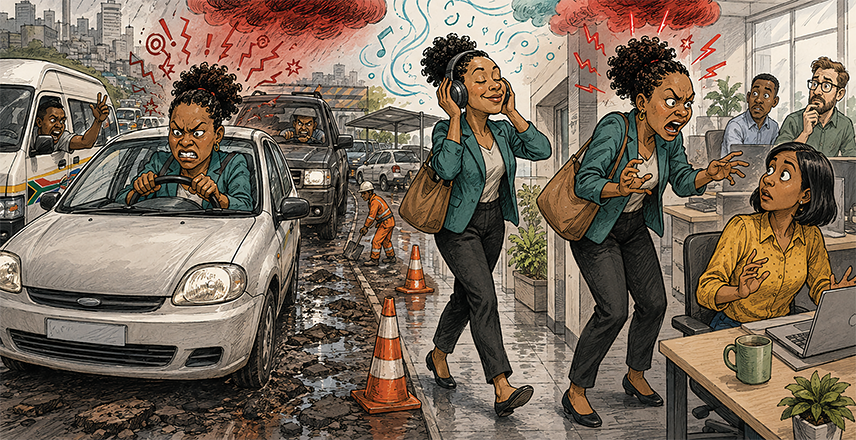
EDGE: Daily traffic frustrations can leave employees irritable and more likely to lash out at colleagues—but researchers say a few minutes of calming music could help break the cycle…
By Own Correspondent
Pothole season, summer construction season, or maybe bad weather. No matter the time of year, it’s no surprise commuters who drive to work may start their day already feeling a bit on edge.
Unlike a single stressful event, commuting can be made up of small, cumulative annoyances that build over time, often without people fully realizing it. That feeling doesn’t always reset at the door.
Previous research suggested stress from commuting didn’t carry into the workplace. Jake Gale, an assistant professor of management at the Kelley School of Business Indianapolis, and a team of researchers are challenging that idea.
This research, “From Road to Rage: Why Commute Demands are Associated with Interpersonal Counterproductive Work Behaviours (and What to Do About It)” was published by the Journal of Applied Psychology in May.
Jake worked alongside Trevor A. Foulk and Amir Erez of the University of Florida, Satish Krishnan of the Indian Institute of Management Kozhikode and LUT University, Hae-Lyeng Rose Kim of Oklahoma State University, and Binyamin Cooper of Morgan State University.
Their work shows subtle frustrations can follow employees into their day and shape how they interact with others. Rarely does that feeling leave a person when they enter work. Jake and his colleagues determined the best definition for that lingering emotion is “irritability.”
“When you’re driving and someone brake checks you or rides your tail, those are subtle annoyances that cumulatively create a negative experience,” Jake said. “Literature did not have a clear answer or definition as to why humans act this way.”
What makes irritability especially impactful is it doesn’t have a clear, identifiable cause. Instead, people often misdirect frustration toward the people around them rather than recognizing it stems from their commute. Jake’s research revealed that commutes can make everyone in a work environment counterproductive. Employees may be more likely to snap at a colleague or respond more negatively than they otherwise would.
Jake and his co-authors conducted a 15-day study of more than 80 full-time employees, capturing their commute experiences and workplace behaviour in real time. Daily surveys before and after work helped researchers link commute stress to irritability and on-the-job interactions.
This research expands beyond simply connecting a bad commute to negative workplace behavior.
“I didn’t want this research to just say: Yeah, your commute makes you mad and here’s why,” he said. “I wanted to find a way to prevent this from occurring.”
The solution, researchers discovered, is surprisingly simple: listening to relaxing music before heading into work. Participants who spent a few minutes listening to music significantly improved their mood before starting the workday—and disrupted the carryover effect from their commute.
“Days they listened to what I describe as elevator music helped alleviate some of the irritability people experienced,” Jake said.
Researchers believe this works because calming music helps the body reset after a stressful drive, reducing the intensity of those lingering feelings before they spill into workplace interactions.
This example of listening to music before walking into work was the most surprising element to researchers.
“Adding the listening of music element felt like a shot in the dark. Research proves something like this should work, but we were shocked at how strong of an effect listening to relaxing music can have on improving outcomes,” he said.
For business leaders, the findings offer an important reminder: Factors outside the workplace can shape team dynamics in powerful ways. Even small, low-effort interventions can help employees show up more focused, collaborative, and ready to engage.