 WeeklySA_Admin
FUTURE: CAF conference urges stronger investment, sharper preparation and sustainable football structures to build on the continent’s record 2026 performance…
By Own Correspondent
African football leaders have set their sights on challenging for the 2030 FIFA World Cup title, with CAF President Patrice Motsepe urging the continent to turn its ambitions into measurable results.
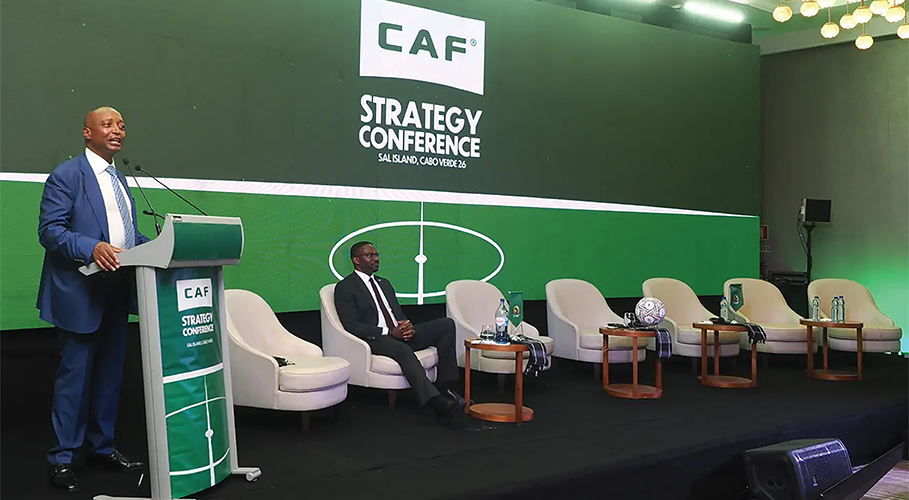
The three-day CAF Strategy Conference ended on Friday in Santa Maria, Sal Island, Cabo Verde, after discussions on football development, investment and the lessons of Africa’s record performance at the 2026 World Cup.
Presidents and senior officials from CAF’s 54 member associations joined national team coaches, technical leaders and international experts to examine how to strengthen African football’s global competitiveness.
Motsepe, FIFA President Gianni Infantino and Cabo Verde’s acting President, Janira Hopffer Almada, were among the leading figures who addressed delegates.
We have to win the World Cup. We are going to win the World Cup. One of the nations from Africa will win the World Cup…
The gathering followed Africa’s strongest collective World Cup showing, with a record 10 countries participating in the expanded tournament and nine advancing beyond the group stage.
Morocco reached the quarter-finals, while Cabo Verde progressed to the knockout rounds on its World Cup debut. Those achievements framed discussions about what African teams must improve before 2030.
From ambition to action
Motsepe stressed that progress must be measured through investment and results.
“There is a big gap between good plans, good intentions and what we do practically in terms of investments and results. We are judged by results,” he told delegates.
He also made Africa’s ultimate ambition clear.
“We have to win the World Cup. We are going to win the World Cup. One of the nations from Africa will win the World Cup,” Motsepe said.
CAF identified stronger, self-sustaining member associations as a central objective, alongside improving the quality and international competitiveness of its competitions.
Discussions covered investment in coaching, youth development, administration and infrastructure, as well as stronger commercial and broadcasting partnerships.
Infantino highlighted the contrast between Africa’s recent World Cup campaigns: no African team advanced from the group stage in 2018, compared with nine of the continent’s 10 representatives in 2026.
He called for continued investment in infrastructure and opportunities, saying African talent was already shaping world football but needed stronger pathways to flourish.
“The road to 2030 begins now,” he said.
Wenger highlights the decisive margins
The final day focused on technical analysis, with FIFA’s chief of global football development, Arsène Wenger, joining coaches and analysts to examine tactical organisation, chance creation, counter-pressing, transitions and late-game management.
Wenger identified improved discipline and organisation as major reasons for Africa’s progress. “In the past, African teams sometimes lost because of a lack of compactness, too much distance between the lines and inconsistent concentration,” he said.
“At this World Cup, it was difficult to beat any African team because the discipline and organisation were at the top level.”
However, he cautioned that small weaknesses could still determine results.
“We are very close, but a small percentage can cost you the game. Most of these games were lost by one goal, so every detail in the modern game becomes absolutely vital.”
His assessment pointed to the importance of refining preparation and execution as African teams seek to compete consistently with the world’s best.
Coaches including Pedro Brito, known as Bubista, Hossam Hassan and Sébastien Desabre brought practical tournament experience to the discussions.
Their contributions explored preparation, the management of international windows, tactical adjustments and the pressures of World Cup football.
Bubista, who guided Cabo Verde through its historic debut campaign, emphasised clear objectives and tactical flexibility.
“We cannot think about only one strategy,” he said. “We have to have more than one strategy — one when we don’t have the ball, another when we have the ball, and another when we cannot attack quickly.”
Cabo Verde advanced from its group before losing 3–2 to Argentina after extra time, making its campaign one of the tournament’s notable African stories.
A platform for sustained progress
Cabo Verde’s achievements also gave the conference a fitting backdrop. Its emergence as a World Cup knockout-stage participant illustrated the possibilities available to smaller football nations.
Hopffer Almada drew on that experience to emphasise that talent must be supported by structure, organisation and confidence in African expertise.
The conference closed with stronger systems, better preparation and sustainable development at the centre of Africa’s plans for 2030.
The challenge now is to translate the continent’s record participation and improved tournament results into lasting progress across all 54 member associations — and a serious challenge for football’s biggest prize. – CAFonline