 WeeklySA_Admin
HERITAGE: By transforming discarded animal bones into nutrient-rich bone broth, East London entrepreneur Phumeza Stuurman proving that ancient African food traditions can become a modern engine for rural economic development and women’s empowerment…
By WSAM Reporter
An East London entrepreneur is turning one of agriculture’s most overlooked by-products into a thriving rural enterprise, demonstrating how traditional African knowledge can drive economic development while meeting growing demand for natural health foods.
Phumeza Stuurman, founder of Rural Impaqt Bone Broth, has built a business that transforms discarded beef and chicken bones into nutrient-rich bone broth, creating employment opportunities for rural women while breathing new life into an age-old African culinary tradition.
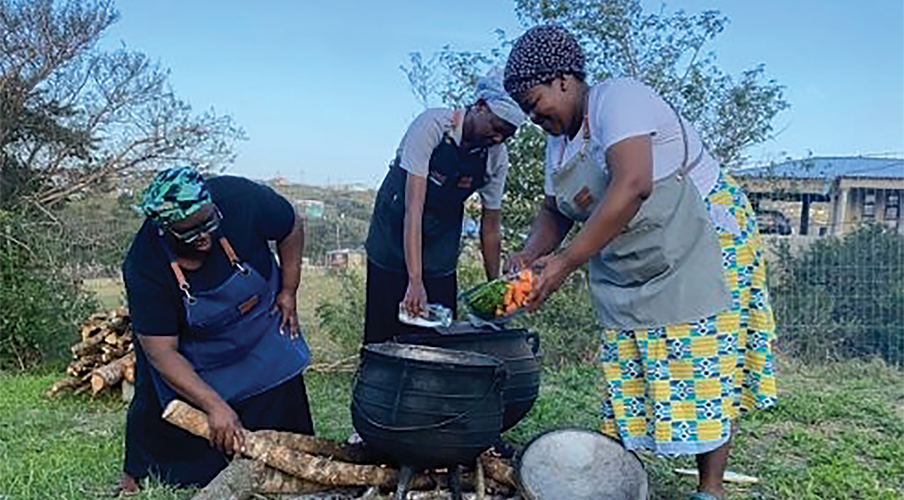
Working alongside an all-women cooking team in the village of Nxarhuni, on the outskirts of East London, Stuurman produces fresh batches of bone broth every week. The products are delivered to an expanding customer base across East London, where consumers are increasingly embracing natural, heritage-inspired wellness products.
Bone broth, consumed for centuries across many cultures, has experienced a global resurgence as consumers seek healthier, less processed foods. Rich in natural collagen, amino acids and essential minerals, it is widely valued for supporting joint health, digestion, skin health and immunity.
Rather than relying on modern industrial processes, Rural Impaqt follows traditional African cooking methods.
The broth is slow-cooked over open fires for extended periods, extracting maximum nutritional value while preserving the authentic preparation methods passed down through generations.
“We are bringing what our grandmothers knew back to the table, in a format that meets modern food safety standards and consumer desires to live well and eat well,” said Stuurman.
We are bringing what our grandmothers knew back to the table in a format
that meets modern food safety standards and today’s demand for
healthy living…
“In a market dominated by synthetic supplements, we offer a whole-food alternative that is affordable, natural, healing and deeply rooted in African food tradition.”
Beyond its nutritional appeal, the enterprise embraces principles of the circular economy by converting agricultural waste into a premium health product.

Instead of allowing animal bones to be discarded, they become the foundation of a value chain that generates employment, creates income and strengthens local supply networks.
“It is a waste-to-nutrition pipeline that channels urban consumer demand into rural jobs and wages, creating value where none previously existed,” Stuurman explained.
She says the business was inspired by the African philosophy of vukuzenzele — “wake up and do it yourself.”
“I saw untapped potential in the wisdom and resources that already exist within our rural communities rather than focusing on what we lacked.”
Stuurman’s entrepreneurial journey follows a dramatic career shift.
After spending 15 years in Gauteng working in the public sector in financial management as well as monitoring and evaluation, she returned to her hometown of East London to care for family members. The move prompted her to pursue a long-held dream of building a business capable of creating opportunities in rural communities.
Although she earned an MBA more than a decade ago, she believes entrepreneurship requires a different mindset from corporate employment.
Business education
“My mindset then was that of an employee, not a business owner,” she said.
“The MBA gave me valuable strategic thinking skills, but the Small Business Academy is helping me think bigger, learn how to scale the business, and focus on working on the business rather than simply working in it.”
Stuurman is among participants in the second East London cohort of the Stellenbosch Business School’s Small Business Academy (SBA), a programme delivered in partnership with Standard Bank and the Border-Kei Chamber of Business.
The academy equips entrepreneurs from underserved communities with formal business education, mentorship and practical skills designed to improve the long-term sustainability of small enterprises.
Professor Armand Bam, Head of the Small Business Academy, said the programme was established to address one of South Africa’s greatest economic challenges — the high failure rate of small businesses.
“The programme equips entrepreneurs with the knowledge and practical capability they need to build sustainable businesses that create jobs and strengthen their communities,” Bam said.
He added that Standard Bank’s partnership strengthens the academy’s ability to support entrepreneurs in disadvantaged communities.
Unlike many business support initiatives, the academy maintains ongoing relationships with graduates rather than ending support once training has concluded.
“Many start-ups fail within their first two years because entrepreneurs have technical expertise but lack business management skills,” Bam said.
“The Small Business Academy bridges that gap through education, mentorship and continued business development support.”
The programme’s impact has been significant.
Since its launch 14 years ago, more than 460 entrepreneurs have graduated with an accredited NQF Level 6 qualification from Stellenbosch University.
According to the academy, more than 80% of graduates remain in business and continue growing their profitability, while over 90% have created new full-time jobs.
For Rural Impaqt Bone Broth, the ambitions extend well beyond the current home-based operation.
Today, Stuurman and her three part-time employees produce small batches from a home kitchen, marketing primarily through social media, WhatsApp orders, local markets and collection points in Beacon Bay and Vincent.
Healthier alternative
But the long-term vision is to establish a dedicated rural production facility capable of creating between five and eight permanent jobs during its first year of operation, particularly for unemployed women and young people.
“Our vision is not simply to build a food brand,” she said.
“We want to build a rural manufacturing ecosystem — one that demonstrates that high-value health food production can happen outside urban centres while creating dignified employment, strengthening local supply chains and transforming rural economies.”
Beyond drinking it as a nourishing beverage, bone broth can also be used as a healthier alternative to commercial stock cubes or water when preparing rice, pasta, vegetables, soups, stews, legumes, sauces and gravies.
For Stuurman, however, the true value of the product extends beyond nutrition.
It represents an opportunity to reconnect with African food heritage while proving that traditional knowledge, when combined with entrepreneurship and innovation, can become a powerful catalyst for inclusive economic growth.