 WeeklySA_Admin
STORM: Home Affairs has withdrawn its asylum directive after protests descended into arson, looting and intimidation. But renewed unrest in Durban has prompted a request for military support, while asylum seekers face fresh uncertainty…
By Own Correspondents
Home Affairs’ withdrawal of a directive reopening access to asylum applications has failed to immediately quell this week’s unrest over the Department of Home Affairs directive for asylum seekers, with further violence reported in Durban and KwaZulu-Natal Premier Thami Ntuli requesting military assistance.
A Saturday morning SABC report described alleged attacks on foreign nationals following a confrontation at the intersection of Anton Lembede and Dr Yusuf Dadoo streets.
Police rescued one individual on Friday night, while officers struggled to contain protesters moving through the city centre.
Ntuli said he had asked Acting Police Minister Firoz Cachalia for army deployment to help restore order. His announcement was a request for assistance; it did not confirm that deployment had been authorised. He also warned that continuing destruction could undermine investment and jobs.
The developments followed Friday’s decision by the Home Affairs director-general to withdraw the 28 September instruction concerning the intake of asylum applications.
The department said refugee reception offices had been overwhelmed within days, officials placed at risk and serious public-safety threats created. It described the directive as an operational attempt to implement the Constitutional Court’s 7 July judgment in the Scalabrini Centre matter.
The right to raise concerns and to protest does not give anyone the right to commit crime…
Home Affairs said the instruction had been issued without the knowledge of Minister Leon Schreiber or other political office-bearers. It rejected claims of political motivation and promised a fresh process to establish a workable way of complying with the judgment.
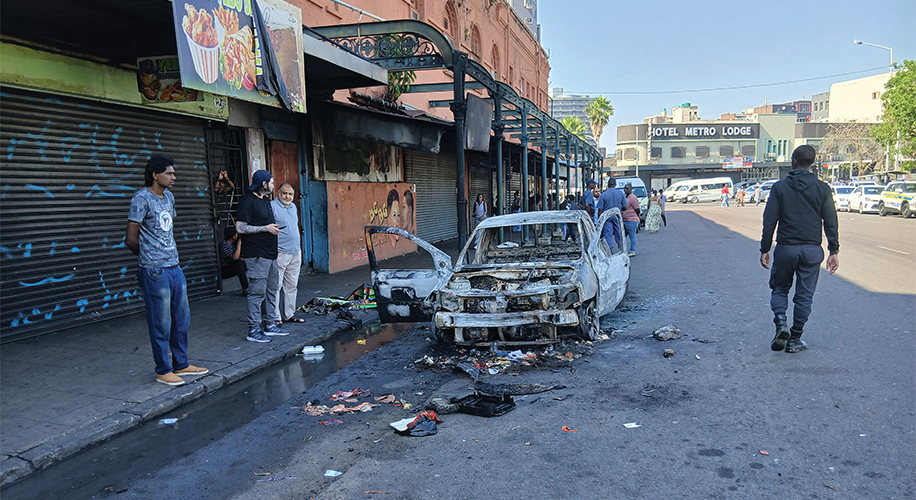
That reversal came after Thursday’s protests escalated into widespread destruction. Police reported 14 vehicles torched in Durban and another 10 in Soweto, alongside the looting of shops belonging to foreign nationals.
Acting National Police Commissioner Lieutenant-General Puleng Dimpane warned that perpetrators would be investigated and prosecuted where sufficient evidence existed.
“The right to raise concerns and to protest does not give anyone the right to commit crime,” she said. Public-order policing had been reinforced as authorities sought to contain the unrest.
In Durban, demonstrations centred on the refugee reception office on Che Guevara Road before violence spread into surrounding commercial areas. Shops were vandalised, businesses looted and vehicles burned.
In Soweto, Reuters witnessed people carrying groceries from a shop they identified as Somali-owned after its operator had been chased away. The looters dispersed when police arrived.
By Friday, the damage was visible in shuttered shops and burned-out vehicles. Durban businessman Samuel Michael told GroundUp that two of his Gillespie Street shops had been vandalised, with doors and windows smashed.
Michael, originally from Nigeria, said he had lived in South Africa for 24 years and that his wife and son were South African.
South African liquor-store owner Vinay Maharaj also reported damage. He said his business employed South Africans and believed the attackers had targeted it to steal alcohol. His account illustrated how the destruction extended beyond the foreign-owned businesses protesters claimed to oppose.
Court ruling storm
Government has blamed deliberate misinformation for inflaming hostility around the court judgment.
The Inter-Ministerial Committee on Migration explained that the ruling removed procedural barriers which could exclude people from seeking asylum before their claims were assessed. These included irregular entry, lacking an asylum transit visa or missing a reporting deadline.
It did not automatically award refugee status, permanent residence or an unrestricted right to remain. Applications still had to undergo assessment, and fraudulent or unfounded claims could be rejected through lawful processes.
The committee also dismissed claims that refugees would gain voting rights. Withdrawing the departmental directive does not overturn the court judgment, which remains binding on the state.
Despite Friday’s withdrawal, some Durban protesters told the SABC that evening that they were unaware of the decision. The report described continuing unrest and an increased police presence, underscoring the difficulty of communicating policy changes amid rapidly spreading rumours.
In Pretoria, GroundUp reported intimidation outside the Marabastad refugee reception office on Friday by protesters associated with March and March, Operation Dudula and the United Progressive People’s Alliance Party.
Immigrants were chased, spat at and pelted with water bottles.
Protesters later moved to Luttig Street, forcing immigrant shopkeepers to close and threatening owners and their children.
GroundUp reporter Seth Thorne reported that his phone was seized and that he was repeatedly slapped while covering the confrontation. Some residents, including South Africans, attempted to defend the shopkeepers.
The supplied reporting also recorded a vehicle being set alight during Friday’s protest outside the Constitutional Court in Johannesburg.
Meanwhile, Cachalia said the government was considering approaching the Constitutional Court for additional implementation time. Legal advice was being sought on whether the order could be adjusted to accommodate administrative difficulties. This remained a possible application, rather than an announced change to the judgment.
‘Govt bowing to pressure’
For asylum seekers, the immediate consequence is renewed uncertainty. Zimbabwe Migrants Support Network chairman Chris Mapingure advocated online applications to reduce exposure to confrontation.
Dale McKinley of Kopanang Africa Against Xenophobia, accused the government of bowing to pressure and warned that suspending implementation left applicants in limbo. The Scalabrini Centre told GroundUp it would not speak to the media because of safety concerns.
As the week ended, authorities faced overlapping demands: restoring public order, protecting threatened communities and providing a practical route to asylum assessment consistent with the court’s ruling. – GroundUp/Fullview/WSAM