 WeeklySA_Admin
DEVELOPMENT: FIFA’s funding promises expose the competing interests behind Africa’s support for Gianni Infantino — and raise a harder question about what the continent should demand in return…
By Afolabi Adekaiyaoja
I have spent this week reflecting on African football. Qualifiers for the next Africa Cup of Nations (AFCON) have begun, the identity of the reigning champions awaits a ruling from the Court of Arbitration for Sport, and Nigeria begins its campaign without a federation board after its president and executive committee resigned in August.
That last development looks like a rare case of Nigerian football administrators paying a price for failure, though not quite the accountability it first appears. None of these developments can be separated from the politics and money shaping next year’s FIFA presidential election.
Weeks after the 2026 World Cup, FIFA unveiled a plan to sell a stake in the tournament’s commercial rights to private investors. A new entity, FIFA Forward Enterprise (FFE), would take over broadcast, sponsorship, ticketing and licensing operations. FIFA would retain control while selling minority stakes, raising up to $4.2 billion against a $20 billion valuation.
There is a difference between development that is authored and owned on the continent and development handed down as patronage…
The lead investor was reportedly Thrive, founded by Joshua Kushner, whose brother Jared is US President Donald Trump’s son-in-law. To secure approval, FIFA promised to raise each member association’s development allocation for 2027–2030 from about $8 million to $20 million, with an optional further $20 million upfront.
The backlash, led largely by UEFA, was swift. Infantino withdrew the plan and has since tried to avert a challenge to his presidency that previously seemed impossible.
Africa’s confederation stood firmly with him. Several federation presidents offered public support. Samuel Eto’o, the Cameroonian legend who now runs his country’s federation, argued that the plan could have helped smaller associations.
FIFA’s crisis meeting took place in Rabat rather than Zurich. CAF’s executive committee later met there and unanimously reaffirmed its support for Infantino. Much commentary portrayed Africa as subservient, unable to defend “true footballing values” once money was offered.
Development of Global South
But Africa’s relationship with FIFA did not begin in deference. In 1966, African federations, led by Ghana’s Ohene Djan and Ethiopia’s Yidnekatchew Tessema, boycotted World Cup qualifying because Africa shared one qualifying place with Asia and Oceania, while Europe held 10 of the tournament’s 16 spots.
The boycott worked. From 1970, Africa had a guaranteed place. In 1974, the African bloc helped Brazil’s João Havelange defeat Stanley Rous for the FIFA presidency. Rous had tried to keep apartheid South Africa, already excluded by CAF, inside world football.
Havelange’s victory established the bargain that has shaped FIFA–Africa relations since. He promised expanded tournaments and development for the Global South. He delivered, but also entrenched a culture of patronage.
Sepp Blatter inherited that structure in 1998 and used it to win African votes even though CAF officially backed UEFA’s Lennart Johansson. When CAF president Issa Hayatou contested the FIFA presidency in 2002, he was heavily defeated, deserted by members who preferred their existing patron.
Under Infantino, FIFA has become more involved in Africa’s administration. Madagascar’s Ahmad Ahmad unseated Hayatou as CAF president in 2017, reportedly with Infantino’s support. A year later, Ahmad declared Africa’s backing for Infantino’s re-election.
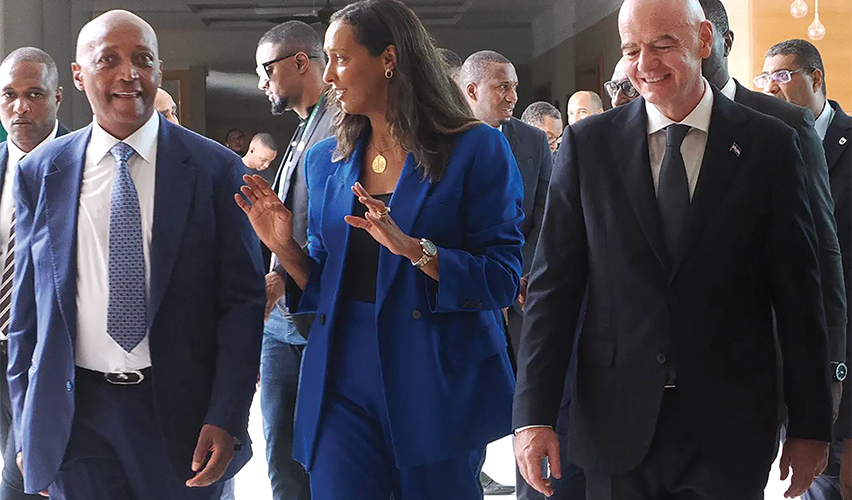
Motsepe: Infantino’s proxy?
FIFA subsequently sent secretary-general Fatma Samoura to oversee CAF’s affairs for six months in 2019. After Ahmad’s ethics ban, Infantino again cast a long shadow over the 2021 succession, when rivals withdrew and endorsed South African mining billionaire Patrice Motsepe. His tenure has brought successes, but critics still portray him as Infantino’s proxy.
The continent’s football politics have changed too. Earlier political leaders saw football as an arena for development and anti-imperialist engagement. Today, career football politicians largely control the game, trading votes for funding and loyalty.
That trade is pragmatic. African federations need FIFA’s money, and more than doubling their grants is a powerful inducement. Distributed effectively, funding could also challenge established hierarchies and make African football more competitive. The deeper issue is who captures football’s value. Africa develops and exports talent, while much of the financial return accrues to European clubs and leagues.
The 2026 World Cup tests the development argument. Nigeria and Cameroon, with eight AFCON titles between them, failed to qualify.
Nigeria’s campaign featured three coaches, disputes over unpaid wages and bonuses, and a security agency investigation into a ₦17 billion government fund intended to settle outstanding payments.
That investigation helps explain why the board’s resignation is not straightforward accountability. Ibrahim Gusau and his colleagues stepped down after reports of pressure to leave. The National Sports Commission then suspended the election to replace them. FIFA treats government interference as grounds for suspension, leaving supporters caught between administrators they struggle to remove and a state acting through pressure.
In Cameroon, Eto’o has openly fought the sports ministry, including over the national coach. Both countries’ size and economic weight should make them less dependent on FIFA, making their loyalty harder to explain.
Morocco: Infantino’s trusted ally
Compare them with Comoros, a two-time AFCON qualifier, and Cape Verde, whose debut World Cup campaign reached the round of 32 after an unbeaten group stage against opponents including Spain and Uruguay.
Comoros’s federation president has described financial struggles. FIFA, meanwhile, presented Cape Verde as evidence that a decade of forward funding could help a smaller nation reach the World Cup.
Infantino’s strongest ally remains Morocco, whose federation president, Fouzi Lekjaa, was among the first to pledge support. Rabat will host the next FIFA presidential election, while Morocco has lobbied to stage the 2030 World Cup final.
Morocco has progressed from missing four successive World Cups to a semifinal in 2022 and a quarterfinal this year. Its continental title, however, remains contested.
Senegal won January’s AFCON final in Rabat, but CAF’s appeal board subsequently ruled that Senegal had forfeited after its players left the field protesting a late penalty. It awarded Morocco a 3–0 victory. Senegal appealed to the Court of Arbitration for Sport. The dispute reinforces perceptions that FIFA’s most influential African ally holds the continental crown through an off-field decision.
These examples suggest a neat contrast between FIFA-backed development in Cape Verde and effective management in Morocco. The distinction is less clear.
Cape Verde benefited from funding for pitches and coach training, but also from recruiting its diaspora in Portugal and the Netherlands. Morocco’s Mohammed VI Football Complex and diaspora recruitment have helped produce competitive teams across genders and age groups, including last year’s men’s Under-20 World Cup winners.
Neither project was authored by FIFA. It cannot claim sole credit for either.
African football shows that competence and patronage can coexist. Morocco’s planning bought leverage, which it invested in loyalty. Nigeria and Cameroon, amid administrative turmoil, needed the proposed grants too much to challenge their benefactor.
The strong and struggling reached the same position without publicly demanding structural concessions. Emerging nations face another test: turning diaspora-built national teams into lasting domestic development pipelines.
This complicates any description of the proposed grant as merely a bribe. One continent’s support conceals different interests and motivations.
Folly of Africa’s loyalty
Nor is UEFA football’s moral arbiter. It resisted the Super League in 2021, then accommodated powerful clubs by expanding the Champions League to 36 teams. Europe’s leading clubs are represented by a body headed by Paris Saint-Germain and Qatar Sports Investments chairman Nasser Al-Khelaifi.
Gulf money sat on both sides of the argument. Africa has no more reason to trust European piety than FIFA’s generosity.
The FFE proposal sought to sell rights to football’s future commercial income. African federations were right to consider its financial benefits seriously. That does not make them sellouts. Their failure was offering political loyalty without demanding lasting changes in return.
Infantino’s re-election would reinforce a system built partly on courting Africa’s 54 votes. Such leverage is legitimate: UEFA uses its markets, Asia its investment and audiences, and South America its marketable stars.
The question is whether Africa uses its influence to secure anything durable. Infantino has proposed an independent governance review and assured associations that their treatment will not depend on their position on any proposal. The need for that assurance is revealing.
Africa: Lasting value imperative
Africa’s leaders could spend their leverage on loyalty or, as in 1966, pursue structural change. They could demand independently audited development funding, stronger safeguards against projects serving political interests, and greater returns for academies that produce professional players.
They could also insist on meaningful influence over an international calendar still shaped around Europe’s priorities.
These demands would give substance to the continent’s voting strength. A larger grant can build facilities, pay coaches and support competitions. But its lasting value depends on transparent decisions, competent administration and institutions that survive changes of leadership. Without those foundations, each funding cycle risks renewing the same dependence.
None of this would arrive as a patron’s gift. It would have to be negotiated and demanded.
Football’s capacity to improve lives in difficult economic conditions is undeniable. But there is a difference between development authored and owned on the continent and development handed down as patronage.
African supporters should demand administrators who understand that distinction — and use their votes to secure gains that no one in Zurich can simply bestow or withdraw. – Africa is a Country