
 WeeklySA_Admin
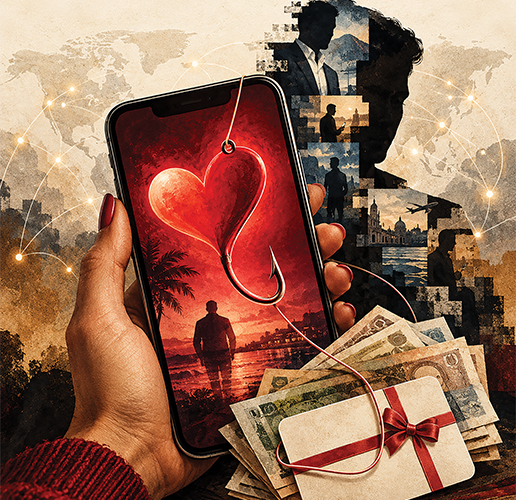
RACKET: Journalist Carlos Barragán’s search for the scammer who targeted his mother led him into a world where poverty, loneliness and a global payment network sustain an industry built on deception…
By Own Correspondent
In February, OCCRP tracked down a 31-year-old man to his mansion in Nigeria’s capital, Abuja. He had allegedly posed as Dubai’s Crown Prince to con a Romanian businesswoman out of more than $2.5 million in a romance scam, according to the victim and two accomplices.
Internet fraud has become a source of income for some young Nigerians facing poverty and limited opportunities. Yet most romance scams originating in Nigeria are neither particularly complex nor lucrative, says journalist Carlos Barragán.
His recently published book, The Yahoo Boys, explores what drives the country’s teenage fraudsters and the repercussions in Nigeria and abroad. Their nickname comes from the Yahoo email addresses associated with “Nigerian prince” scams in the internet’s early days.
How did you come to write your book?
Ten years ago, my mom was trying to find a partner online after I suggested she try a dating app. She met this wonderful American soldier called Brian and fell in love.
After years of seeing her struggle with loneliness, I travelled to Nigeria to find Brian. I couldn’t find him, but I remained fascinated by the Nigerian romance scam industry…
After a month, I discovered Brian was not an American soldier based in Syria, but a Nigerian scammer trying to lure my mom into giving him money.
After years of seeing her struggle with loneliness, I travelled to Nigeria to find Brian. I couldn’t find him, but I remained fascinated by the Nigerian romance scam industry.
Instead of writing a personal memoir about my mom’s scammer, I decided to investigate further and answer some of my questions.
How did Nigeria’s internet scam industry take root?
In the 1970s, Nigeria was so rich that there was a statistic about it being the world’s leading importer of champagne. A general said something along the lines of: “Nigeria’s problem is not the money but how to spend it.”
Then came the oil crisis. By the end of the decade, Nigeria’s debt had ballooned. Millions were out of work, and many emigrated to the United States and Britain.
Nigerian historians say the scam industry started in the 1980s. Scammers sent letters, followed by those well-known emails to Americans and Europeans saying: “I’m a Nigerian prince, but I need your help to access this money.”
They were not targeting loneliness as they do now. During the 1990s, the letters promised that, if you collaborated, you could access an enormous amount of money.
I think it mirrors our own societies. In the 1990s, capitalism was riding high. After the millennium came social media and smartphones, and scammers moved towards targeting loneliness.
We shouldn’t forget Nigeria’s economic situation, especially after the pandemic and inflation. It became so difficult that many young people in Lagos started scamming.
Some Nigerians see Yahoo boys as bringing money into an economy damaged by corruption. One Lagos resident tells you: “Scammers steal from foreigners and spend their money here; politicians steal from us and send the money abroad.” How much money reaches the economy?
The book focuses on four Yahoo boys who, in the bigger scheme of things, are not making much money, except for one named Chibuike.
It is difficult to establish how much money comes in. But in places such as Ikotun, the Lagos neighbourhood where they live, where many people survive day by day, the effects of Yahoo money are staggering.
You see stores, clubs, hotels and businesses that probably wouldn’t otherwise exist. I mention Nigerians saying the economy could crumble without Yahoo money, although I think that is probably exaggerated.
For me, the most interesting thing was the perception, rather than actual numbers, for which reliable data was unavailable.
Finding Nigerians who told me, “After oil, scams are the biggest contributor to the Nigerian economy,” mattered. That perception told me I was looking at a huge story.
You contrast large, industrial-style scam operations in Southeast Asia with the teenagers working alone or in small groups whom you encountered in Nigeria. Why does the idea that Nigerian scammers all belong to large criminal syndicates persist?
When the head of an American scam victim support group challenged me about this, I had been reporting for less than a year. He called me a terrible reporter and threatened to hang up.
I doubted my reporting. I wondered whether the scammers were lying to me. That was after one or two trips to Nigeria.
Why was he so unwilling to hear what I had found? I still don’t have the answer.
Perhaps we want to believe something bigger is behind these scams. If a sophisticated criminal enterprise were behind my mom’s scam, for example, I might find reality easier to accept.
But if it is a 15-year-old whose English is not very good, who perhaps couldn’t afford lunch that day, it becomes a twisted mirror. It reflects questions about what is happening in my own family, city and society.
The head of that support group didn’t want to discuss the responsibilities we have as a society.
Your book describes police extortion, peer pressure and a lack of job prospects. Beyond the social and economic reforms needed in Nigeria, could action against the infrastructure scammers use prevent fraud at scale?
I think Big Tech companies could do much more. Some scammers used to populate dating apps. None of those I interviewed were using them because there were so many controls that they couldn’t use them.
Those controls can involve checking your ID, whether it matches your face, or your location.
Of course, that raises bigger questions about privacy. But I was amazed that many scammers I spoke to weren’t even using a VPN. That suggests Big Tech can know what is happening, and I wonder why companies don’t do more.
It is difficult. Would that mean stopping people in Nigeria from talking to people in the United States?
Technology companies could give older people in America and Europe more information about scams. That would help.
There are also ways to pursue scam infrastructure that require tackling money laundering.
A Nigerian scammer cannot simply tell a victim: “Transfer the money to this Nigerian bank account.”
First, the victim would realise the person is in Nigeria. Second, the account would reveal a different name from the one the scammer is using.
So they ask the victim to buy a gift card.
What role do gift cards play in keeping the scams going?
Throughout the book, I wondered why this gift card economy still works.
It is not very good for consumers. Sometimes people forget about their cards, leaving money unspent. Some cards don’t even work.
But when you look at the numbers, they are tremendously profitable for companies. That is why so many companies have their own gift cards.
So it is probably a matter of protecting consumers.
Then there are cryptocurrencies, which require international regulation. That would demand a level of international coordination that, nowadays, seems so far-fetched that it is difficult to imagine.
You describe vendors in China helping scammers convert victims’ gift cards into cash. What did those connections reveal?
While reporting, I thought it was quite telling of our times that Biggy could be smoking his joint, scamming $50 from a victim, and sometimes FaceTiming a Chinese man in a corporate office, probably in Hong Kong or Shenzhen.
Just the idea of those two having a conversation because someone had been scammed in Mississippi — and that person had gone to Walmart to buy a gift card — is mind-blowing.
The connection was something I kept thinking about throughout the reporting: a teenager in Nigeria, someone sitting in a corporate office in China, and a victim in the United States, all linked through a gift card bought at a local shop.
What stayed with you about the way people understand these scams?
For me, the perception really mattered. In Nigeria, I met people who saw scam money sustaining businesses in neighbourhoods where people were struggling to survive.
Elsewhere, I encountered resistance to the idea that the person behind a devastating romance scam might be a teenager working with very little.
I kept returning to my mother’s experience and the loneliness I had watched her struggle with. That was what first took me to Nigeria, even though I never found Brian. The questions I went there to ask became much bigger than the search for one man. — Organised Crime and Corruption Reporting Project (OCCRP)