 WeeklySA_Admin
GAPS: With 569 women murdered in three months and more than 9 000 rapes reported, government concedes that stronger institutions have yet to deliver consistently timely justice for survivors…
By WSAM Reporter
South Africa recorded the murders of 569 women in just three months — more than six every day — yet government acknowledges that investigative weaknesses, mounting sexual offences backlogs and secondary victimisation continue to undermine justice for survivors.
The April–June 2026 police figures, cited by the National Shelter Movement of South Africa, also recorded 9 201 reported rapes across the country: an average of about 101 a day. The rape total covers all victims, while the murder figure relates specifically to women.
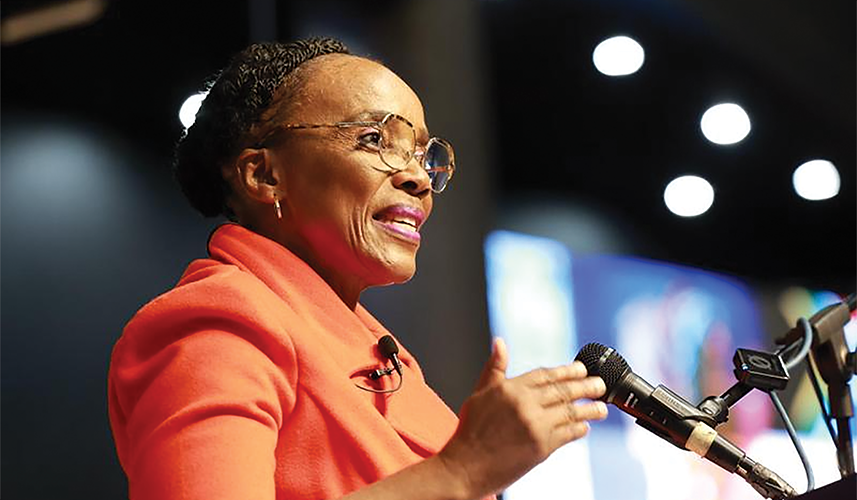
Against this backdrop, Minister in the Presidency for Women, Youth and Persons with Disabilities, Sindisiwe Chikunga, conceded today that improvements in courts, training and support facilities had not yet translated into consistently timely, survivor-centred outcomes.
Her acknowledgement highlights the distance between government’s reported institutional progress and the experiences of survivors navigating the criminal justice system.
Although system capacity has improved, timely, survivor-centred case outcomes remain the real test…
Speaking during a strategic engagement with the Commission for Gender Equality (CGE) on November 13, Chikunga identified persistent problems with access to justice, case management, investigative capacity, conviction rates and coordination.
“These challenges are real, and government remains committed to addressing them decisively,” she said.
The engagement examined implementation of the Justice, Safety and Protection pillar of the National Strategic Plan on Gender-Based Violence and Femicide (GBVF). It followed a CGE study assessing weaknesses across reporting, victim support, investigation, prosecution and sentencing.
Chikunga welcomed the commission’s oversight, including a joint inquiry with the South African Human Rights Commission and the CRL Rights Commission, involving engagements in Mpumalanga, the Eastern Cape and KwaZulu-Natal.
The recent figures also expose the danger within homes.
According to the National Shelter Movement, 4,121 of 6,596 rape cases sampled by police occurred at a residence — more than 60% of the sample. The organisation cautioned that under-reporting means recorded cases cannot capture the full extent of sexual violence.
It warned in September that shelters were struggling with delayed state subsidies, inadequate infrastructure and shortages of specialist support, sometimes leaving women and children unable to secure emergency accommodation.
Separate findings from Statistics South Africa’s 2025/26 Governance, Public Safety and Justice Survey reinforce the threat posed by people known to victims.
Among female assault victims aged 16 and older, 70.3% had been assaulted by someone they knew. Spouses or intimate partners accounted for 31.4%, friends or acquaintances for 19.8%, and relatives or other household members for 17.3%.
The survey also found that 45.1% of women felt very unsafe walking alone in their neighbourhoods after dark, up from 44.9% in the previous reporting period. These are broader measures of assault and perceived safety, rather than a count of GBVF cases.
Demand for assistance has also been substantial. The Department of Social Development recorded 6,782 calls to its GBV Command Centre between September 1 and 16, averaging 424 a day — 21% above the daily average for the corresponding period in August.
The department cautioned that further analysis was needed to establish whether the increase represented a sustained trend. Calls measure demand for the service and should not be treated as a count of separate victims or offences.
Court upgrades
Chikunga said the justice pillar had nevertheless recorded the strongest five-year performance among the strategic plan’s six pillars. Of its 54 indicators, 31 had been achieved, 14 remained in progress and nine had not been achieved.
Improvements included upgrading 40 district courts to support domestic violence survivors and establishing 14 sexual offences courts during the financial year ending March 2026. Another 338 functional testimony facilities were available for remote or protected testimony.
However, specialised prosecutor training remained well below its stated target: 221 prosecutors had completed GBVF training against a target of 800 — approximately 28%.
Between January and June, a further 1,185 law enforcement officers participated in GBV-related learning programmes aimed at improving investigations, prosecutions and victim support.
Despite these interventions, Chikunga acknowledged a worsening sexual offences case backlog and uneven evidence about how cases progress, the quality of services and survivors’ experiences.
“Although system capacity has improved, timely, survivor-centred case outcomes remain the real test,” she said.
Her account did not provide a numerical breakdown of the backlog or a current conviction rate, leaving important measures of justice delivery unquantified.
The department has established more than 40 district and municipal Rapid Response Teams and deployed European Union-funded technical monitors and data collectors to provincial Offices of the Premiers.
A national services dashboard has also been developed to guide planning and resource allocation.
Chikunga said the next phase would prioritise survivor-centred justice, stronger coordination, better data and departmental accountability.
For survivors, the measure of those commitments will be the protection they receive, the support available when they report abuse and the progress of their cases towards justice. – Additional reporting by SAnews.gov.za.
MIRROR Briefs
PACT TO OUST ‘RIGHT-WINGERS’
The Council of the Left, comprising the South African Communist Party , uMkhonto weSizwe Party, African Congress for Transformation Africa Mayibuye Movement and the Economic Freedom Fighters , held a media briefing at the weekend seeking to provide an update on the Council of the Left’s programme, resolutions and political direction after the 2026 Local Government Elections.
The political bloc managed to garner close to 20 percent of the vote in the recent polls.
Delivering the joint statement, MK Party member, Dali Mpofu, said the Conference of the Left wanted progressive forces to unite behind a common political programme and challenge what they described as right-wing influence in government.
“We call on those within the current national coalition and in the former liberation movement in particular to demand the removal of right-wing reactionary forces from the so-called GNU,” he said.
“A government that claims to serve the people cannot be shaped by those who are aggressively championing the transfer of people’s assets into private hands.”
Mpofu said the Conference of the Left was extending an invitation to progressive forces, including the ANC, to support its position. “The Conference of the Left therefore invites all progressive forces, including the ANC, to join this call.”- Lehlohonolo Lehana.
TOP COP’S MURDER shock
The Acting Minister of Police, Firoz Cachalia, has strongly condemned the killing of a Station Commander who was shot while responding to a business robbery in Greytown, KwaZulu-Natal this week.
Cachalia described the killing as a senseless and cowardly attack on a police officer who was carrying out her constitutional responsibility to protect communities and uphold the law.
“The Station Commander demonstrated exceptional courage and commitment to duty by personally leading her members in responding to the robbery, during which a business owner was shot and injured and employees were assaulted,” the Minister said.
A Sergeant was also shot and injured during the exchange of gunfire and was receiving medical attention.
The murder of the senior police officer happened at a time when the country is plagued by the increasing number of violent crimes with police doing their utmost to crack down on criminal syndicates.
The Acting Minister commended the police members who responded to the robbery and pursued the suspects, as well as the collaboration between SAPS and private security during the operation.
He extended his deepest condolences to the family, friends and colleagues of the murdered Station Commander and also wished the injured police officer a speedy recovery. – SAnews.
PREMIER THREAT: MAN HELD
Western Cape police have arrested a 46-year-old man in connection with threatening messages directed at Western Cape Premier Alan Winde.
The arrest followed an investigation into intimidating text messages received by the complainant on October 17, 2026. The messages allegedly contained threats directed at the Premier, as well as a direct threat to shoot the complainant.
“Detectives from the Provincial Murder and Robbery Unit, working closely with Crime Intelligence, pursued several investigative leads to identify and trace the suspect. Following the gathering and analysis of relevant information, an arrest warrant was obtained,” the South African Police Service said in a statement.
The suspect was arrested at approximately 3:30 on Friday morning in Kensington, Cape Town. A cellular telephone believed to have been used to commit the offence was seized.
“The suspect is facing charges relating to intimidation and contraventions of the Cybercrimes Act, 19 of 2020.
“Western Cape police take threats and intimidation seriously, particularly where they are intended to undermine the safety of individuals or public representatives. Such conduct will be investigated and dealt with through the appropriate legal processes,” the police said. – SAnews.
CITRUS EXPORTS DISRUPTED
South Africa’s citrus shipments fell 1.5 percent this year, as the US-Israeli war with Iran disrupted access to some key markets and bad weather affected production in parts of the country, a farmers’ group said this week.
Citrus growers exported 201 million cartons in the 2026 season, compared to 204 million cartons shipped in 2025, the Citrus Growers’ Association of Southern Africa (CGA) said in a statement.
South Africa is the world’s No.2 citrus exporter by value after Spain and citrus is the country’s biggest agricultural export, earning 44.9 billion rand in 2025.
Exporters struggled to access the Middle East market, which typically accounts for 20% of South Africa’s citrus exports, amid a container shortage. Exporters could often reach key markets such as Iraq and Saudi Arabia only through longer shipping routes, the CGA said. Flooding across the Western and Eastern Cape destroyed some orchards in key producing regions.
Citrus exporters are bracing for the impact of South Africa’s exclusion from the United States’ African Growth and Opportunity Act, ending duty-free access to a market accounting for about 5% of citrus exports. – Fullview.