 WeeklySA_Admin
AGONY: A falling murder rate may look like progress on a ministerial chart, but every number represents a life violently taken and family left carrying grief that statistics cannot measure…
By Themba Khumalo
In a living room filled with mourners under the mid-morning sun, an atmosphere of heavy sorrow takes hold.
Relatives, friends and neighbours sit silently, filling every available seat. Soft murmurings of condolence cut through the quiet, punctuated by the sharp weeping of an aunt in the corner. Glowing candles flicker on the floor, casting subtle shadows against a framed matric farewell photograph: a young woman smiling in a satin dress, her entire future ahead of her.
On a mattress, a mother sits bent double, clutching her daughter’s school jersey to her chest as women from the church sit beside her in quiet comfort.
Outside in the yard, a father sits with his brothers and friends, staring into the street with clenched fists, his eyes hollowed by shock and despair.
The girl who filled this home with laughter will not be coming home. Her life was ended in a vacant lot, her body discarded in the grass, leaving an entire community shattered by a shared, unbearable grief.
At that very same hour, a few kilometres away in a brightly lit auditorium, men in tailored suits sit behind microphones, carefully positioned for maximum solemnity, to unpack tables of numbers. Charts are displayed, curves are pointed out, and a minor drop in the national murder total is carefully extracted, polished and presented to the public as evidence of progress.
We are asked to find comfort in a downward percentage. We are invited to applaud police management because slightly fewer citizens were slaughtered in their homes, in taverns and on unlit township streets between April and June than during the corresponding three months of the previous year.
This is the cold, arithmetic calculus of public safety governance. In the sterile dialect of ministerial briefings, human lives are converted into key performance indicators. The violent killing of a mother, a father, a child or a neighbour is neatly absorbed into a statistical aggregate, reduced to a decimal place and weighed on an operational balance sheet. If the curve dips, the quarter is logged as a success.
It is a perverse comfort.
Perhaps those who stand behind the microphones should exercise a little more caution when they announce these figures. A fall in the murder rate should never become an occasion for self-congratulation, because every number in that total represents a human being whose life was taken and a family condemned to live with the consequences.
Even when the number goes down, the dead do not become less dead, and their families do not grieve any less because a few hundred names have disappeared from the statistics.
These are not abstract numbers moving across a ministerial presentation; they are sons and daughters, mothers and fathers, brothers and sisters, friends and neighbours whose lives mattered to somebody.
If the numbers fall, acknowledge the fall, by all means, but do so with the humility to remember what remains behind the number: a human life that cannot be recovered.
A percentage drop does not build a coffin. It does not pay for a funeral, nor does it comfort a house full of mourners trying to make sense of a blood-stained police docket. One murder is not a manageable metric; it is an absolute catastrophe for the human beings left behind.
The raw, terrifying reality of violent crime in South Africa cannot be managed through press releases or absorbed into administrative spreadsheets.
If anyone in leadership requires a reminder of what lies beneath their quarterly charts, they need only look to the grounds of Ekurhuleni.
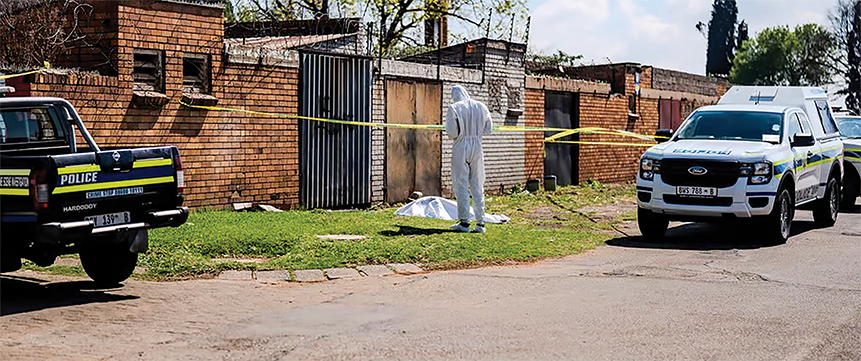
The recent discovery of the bodies of women dumped in the East Rand exposes the grim distance between police statistics and the actual conditions of human existence on the ground. These were not abstract data points to be factored into a precinct crime ratio.
They were human beings — women who lived, worked, had families and were subjected to the ultimate violence before being discarded like rubbish in public spaces.
When bodies are pulled from vacant lots and overgrown fields in broad daylight, the assertion that tactical operations are turning the tide rings hollow. For communities living in the shadow of these dumpsites, the pain is not theoretical. It is an immediate, suffocating fear.
Parents watch the clock and pace the yard as their children walk home from taxi ranks, with fathers and brothers heading out into the dark to meet them at the corner. Families trade warnings on neighbourhood WhatsApp groups. The grief is compounded by a profound, burning frustration: the sense that those tasked with protecting the public are fundamentally disconnected from the terror of everyday life.
The structural flaw in our public security architecture is that it measures activity rather than safety. Police leadership tracks vehicle searches, firearm confiscations, high-density patrols and quarterly percentage shifts.
But safety is not a calculation; it is a lived condition. A community is not safe because a bar chart shows a minor contraction in contact crime. A community is safe when a woman can walk to a local shop after dusk without calculating the risk of her own destruction.
By treating murder as a variable to be managed down rather than an intolerable crisis to be eradicated, leadership reveals the limits of its own approach. When success is defined as five thousand four hundred victims instead of five thousand seven hundred, the baseline of what this nation accepts as normal has already been shattered.
To the mother sitting on that mattress on the floor, holding her daughter’s school jersey, a 5.9% reduction in national murder figures offers zero comfort. To the father sitting in the yard among his brothers, staring into the street with a broken heart, the minister’s polished charts do not restore a life, nor do they diminish the crushing weight of his loss.
A statistical drop of a few hundred cases across nine provinces is an empty victory when the empty chair in your own living room is permanent.
The time for measured relief and administrative self-congratulation is long past. The Ministry of Police and the SAPS high command do not need better communication strategies or more sophisticated presentation slides. They need to look directly at the human wreckage left in the wake of this violence.
Until public policy is driven by an authentic recognition of human grief, rather than the cynical preservation of institutional KPIs, the quarterly crime statistics will remain what they have always been: a tragic accounting of a nation at war with itself.