 WeeklySA_Admin
TENSIONS: Deprived of oil shipments following the US attack on Venezuela, Cuba has made moves to survive the economic blockade…
By Pablo Meriguet
The January 3 attack on Venezuela by the US military profoundly transformed the dynamics in the region, especially in the Caribbean.
Following agreements reached between the Venezuelan government led by Delcy Rodríguez and the Trump administration, Cuba was forced to quickly seek solutions to its economic crisis.
We deeply understand that true friendship is revealed in times of greatest
need… [China] has always been Cuba’s most steadfast partner… every grain of rice delivered today embodies the unwavering commitment of the Chinese people…
For more than 60 years of economic and trade blockade by Washington, Cuba has managed to survive thanks to the support of allied governments, which have provided support for the revolutionary process. During its existence, the USSR supported the island with machinery and goods in exchange for the sale of sugar and other products. After the fall of the USSR, Cuba has navigated a prolonged economic crisis thanks to the support of governments such as China and Vietnam, among others.
However, during the 21st century, Hugo Chávez and Venezuela became a lifeline for the Caribbean island. Despite threats from the United States and the tightening of sanctions against Havana, Venezuela decided to sell oil and other products in exchange for the various services that Cuban professionals could offer in the South American country.
However, the Trump administration seems determined to stifle the Cuban economy at all costs. According to reports, several of the Venezuelan oil tankers seized by US forces in the Caribbean Sea were bound for Cuba, sending a strong and clear message to the government of Cuban President Miguel Díaz-Canel.
“Cuba lived, for many years, on large amounts of oil and money from Venezuela. In return, Cuba provided “Security Services” for the last two Venezuelan dictators, BUT NOT ANYMORE! Most of those Cubans are DEAD from last week’s U.S.A. attack, and Venezuela doesn’t need protection anymore from the thugs and extortionists who held them hostage for so many years. Venezuela now has the United States of America, the most powerful military in the World (by far!), to protect them, and protect them we will. THERE WILL BE NO MORE OIL OR MONEY GOING TO CUBA – ZERO! I strongly suggest they make a deal, BEFORE IT IS TOO LATE.”
Despite threats, a massive march of nearly 500 000 people paraded through the streets of Havana to honour the 32 Cuban combatants who were killed in Venezuela. During the march, the country’s top leaders promised that they would not surrender in the face of renewed imperialist aggression.
Now that Washington has forced the Venezuelan government to stop selling oil to Cuba, Havana has had to turn to other allies who have promised their help. Among them is China, which has pledged food and financial aid to the revolutionary government in Havana.
China’s aid
Beijing’s aid includes the delivery of 60 000 tons of rice to Cuba, the first part of which arrived on the Caribbean island on January 20. Cuban Deputy Prime Minister Oscar Pérez-Oliva said: “We deeply appreciate and are grateful for this aid at a difficult time, when levels of aggression are rising, and the United States’ economic, commercial, and financial blockade against the Cuban people is intensifying in an unprecedented manner.”
For his part, Chinese Ambassador to Cuba Hua Xin said the aid “embodies the deep bonds of special friendship between the two nations.” He added: “We deeply understand that true friendship is revealed in times of greatest need… [China] has always been Cuba’s most steadfast partner… every grain of rice delivered today embodies the unwavering commitment of the Chinese people.”
In November last year, China sent six shipments of food by air. In 2025, Beijing sent essential supplies to the island, including solar lamps, roofing materials, and mattresses. In addition to aid, Chinese President Xi Jinping approved financial assistance amounting to USD 80 million.
Russian diplomats visit Cuba
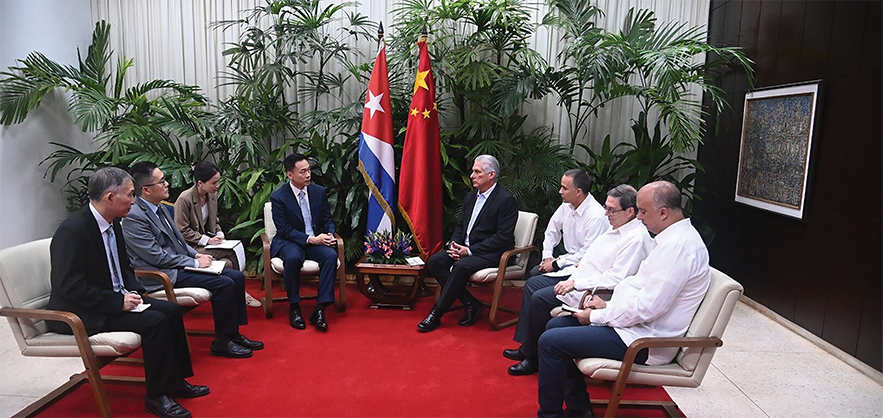
Russia has also maintained friendly ties with Cuba despite the collapse of the USSR. On January 21, Russian Interior Minister Vladimir Alexandrovich Kolokoltsev, accompanied by a delegation of Russian officials and military personnel, held talks with Díaz-Canel in Havana. The Russian Interior Minister said that the meeting was held to exchange opinions and views on the complex global situation following the US attack on Venezuela.
This visit comes after Putin’s recent statement affirming that Russia “will continue to provide assistance to our Cuban friends, standing in solidarity with their determination to defend their sovereignty and independence by all means.”
Abel Prieto, Cuban writer and the president of Casa de las Américas, and Dr. José R. Cabañas, the director of the Center for International Policy Research and former Cuban ambassador to the United States, spoke to Peoples Dispatch to share their perspectives on the threats lodged by Trump and how the attack on Venezuela has transformed the region.
“What the Trump administration did in Venezuela was an act of fascist barbarism, completely illegal, against all norms of civilized coexistence between nations,” he said. “It represents the beginning of a sinister era where, as Ivan Karamazov said, ‘everything is permitted’ for the most powerful. It has been a blow to the Venezuelan people, to the Cuban people, and to all Latin American peoples.”
“However,” Prieto says, the attack has also turned the tide among the progressive movement, “I believe it has strengthened anti-imperialism and anti-fascism in all decent people, whether they are on the left or not. The Yankee Empire is in irreversible decline, and this makes it more violent and rabid.”
As can be seen, Havana has made its moves to find a way to overcome the new obstacles that the Trump administration has placed in its path. Once again, the resilience and resistance of the Cuban people will be put to the test in the face of US power, which, since the beginning of the Cuban revolution, has done everything possible to destroy it. – People’s Despatch and additional reporting by Pablo Meriguet and Zoe Alexandra
We deeply understand that true friendship is revealed in times of greatest
need… [China] has always been Cuba’s most steadfast partner… every grain of rice delivered today embodies the unwavering commitment of the Chinese people…
Comment
Before Another Child Dies
South Africa is mourning again. The scholar transport crash in Vanderbijlpark this week, which claimed the lives of schoolchildren on their way to class, has torn open a wound that never truly heals. The names change. The towns change. The tears are the same. And the outrage — however genuine — too often fades into the next news cycle. We must confront an uncomfortable truth: these are not “accidents” in the ordinary sense. They are predictable outcomes of a system we have allowed to remain dangerously weak.
When children are repeatedly killed in overcrowded vehicles, driven by exhausted or reckless drivers, on roads with poor enforcement and limited infrastructure, the tragedy is not random. It is structural. It is policy failure made flesh.
Scholar transport in South Africa sits at the intersection of apartheid geography and modern inequality. Families in townships and rural areas travel long distances because they want what every parent wants: a decent school, a safer environment, a better future. But the price of that hope is increasingly unbearable. A commute has become a gamble. We have enough laws. We have enough strategies. We have enough committees. What we do not have is consistent implementation and real consequences.
We cannot continue with a situation where unroadworthy vehicles operate openly, where overloading is normalised, where seatbelts are absent or ignored, and where roadworthy certificates can be bought rather than earned. We cannot accept a culture in which children are squeezed into unsafe vehicles because the system rewards cheapness and punishes compliance.
The crisis goes beyond the road. It includes governance. Funding meant for scholar transport has been mismanaged or abused in too many cases. Tender processes have been contested and corrupted. Operators complain about late payments and unclear rules. In some areas, intimidation and turf battles turn children into collateral. And when transport fails, learners are stranded — exposed to crime, harassment and exploitation. This is a national emergency disguised as routine.
Government must act with urgency — and with coordination. The concerned departments cannot keep operating in silos while children die in the gaps between them. School transport needs dedicated oversight, predictable funding flows, strict vehicle and driver compliance, and visible enforcement that targets repeat offenders. It needs proper pick-up and drop-off zones, safer roads near schools, and traffic calming measures that are enforced, not merely recommended. Most importantly, it needs accountability. Every crash must trigger not only condolences, but audits, prosecutions where necessary, and the removal of unsafe operators from the road. Parents must be empowered with clear reporting channels. Schools must insist on minimum safety standards. Provinces must publish transparent data on contracts, compliance and incidents.
A child leaving home for school should return alive. That is the minimum standard of a caring state. Until the school transport system is treated with the seriousness it demands, South Africa will keep burying its future — one minibus at a time.